

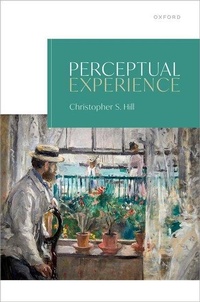
Perceptual Experience
Published on 1. September 2022
Book
Hardback
290 pages
978-0-19-286776-6 (ISBN)
Description
This is an open access title available under the terms of a CC BY-NC-ND 4.0 International licence. It is free to read at Oxford Scholarship Online and offered as a free PDF download from OUP and selected open access locations.
Christopher S. Hill argues that perceptual experience constitutively involves representations of worldly items, and that the relevant form of representation can be explained in broadly biological terms. He then maintains that the representational contents of perceptual experiences are perceptual appearances, interpreted as relational, viewpoint-dependent properties of external objects. There is also a complementary explanation of how the objects that possess these properties are represented. Hill maintains that perceptual phenomenology can be explained reductively in terms of the representational contents of experiences, and uses this doctrine to undercut the traditional arguments for dualism. This treatment of perceptual phenomenology is expanded to encompass cognitive phenomenology, the phenomenology of moods and emotions, and the phenomenology of pain. Hill also offers accounts of the various forms of consciousness that perceptual experiences can possess. One aim is to argue that phenomenology is metaphysically independent of these forms of consciousness, and another is to de-mystify the form known as phenomenal consciousness. The book concludes by discussing the relations of various kinds that perceptual experiences bear to higher-level cognitive states, including relations of format, content, and justification or support.
Christopher S. Hill argues that perceptual experience constitutively involves representations of worldly items, and that the relevant form of representation can be explained in broadly biological terms. He then maintains that the representational contents of perceptual experiences are perceptual appearances, interpreted as relational, viewpoint-dependent properties of external objects. There is also a complementary explanation of how the objects that possess these properties are represented. Hill maintains that perceptual phenomenology can be explained reductively in terms of the representational contents of experiences, and uses this doctrine to undercut the traditional arguments for dualism. This treatment of perceptual phenomenology is expanded to encompass cognitive phenomenology, the phenomenology of moods and emotions, and the phenomenology of pain. Hill also offers accounts of the various forms of consciousness that perceptual experiences can possess. One aim is to argue that phenomenology is metaphysically independent of these forms of consciousness, and another is to de-mystify the form known as phenomenal consciousness. The book concludes by discussing the relations of various kinds that perceptual experiences bear to higher-level cognitive states, including relations of format, content, and justification or support.
More details
Language
English
Place of publication
Oxford
United Kingdom
Product notice
sewn/stitched
Cloth over boards
Dimensions
Height: 229 mm
Width: 165 mm
Thickness: 36 mm
Weight
590 gr
ISBN-13
978-0-19-286776-6 (9780192867766)
Copyright in bibliographic data and cover images is held by Nielsen Book Services Limited or by the publishers or by their respective licensors: all rights reserved.
Schweitzer Classification
Other editions
Additional editions

Christopher S. Hill
Perceptual Experience
E-Book
08/2022
1st Edition
OUP eBook
€71.49
Available for download

Christopher S. Hill
Perceptual Experience
E-Book
08/2022
1st Edition
OUP eBook
€54.49
Available for download
Person
Christopher S. Hill is Faunce Professor of Philosophy at Brown University. He previously held teaching positions at Case Western Reserve University and the University of Arkansas. He has had visiting appointments at the University of Pittsburgh, the University of Michigan, and MIT. He is the author of several books, including Meaning, Mind, and Knowledge (OUP, 2014) and a number of articles.
Content
- 1: Representationalism
- 2: Appearance and Reality I
- 3: Appearance and Reality II
- 4: Perceptual Awareness of Particulars
- 5: Perceptual Phenomenology
- 6: A Quasi-Perceptualist Account of Pain
- 7: Perceptual Consciousness
- 8: Percepts and Concepts
- 9: The Epistemic Role of Perception