

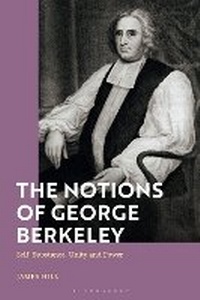
The Notions of George Berkeley
Self, Substance, Unity and Power
Published on 25. January 2024
Book
Paperback/Softback
184 pages
978-1-350-29972-6 (ISBN)
Description
George Berkeley's doctrine of notions is often disparaged or dismissed. In a systematic interpretation and positive reconstruction of the doctrine, James Hill presents Berkeley's understanding of the inner sphere and self-awareness, and reassesses the widely held view of Berkeley as an empiricist.
Examining the development of Berkeley's philosophy from the early notebooks to the late Siris, Hill sets out how knowledge by notion involves a radical rejection of the perceptual model of self-cognition and of the attempt to frame our knowledge of the inner by analogy with the outer. He points to Berkeley's divergence from the assumption among rationalists and empiricists that we know our selves and our mental acts by idea, or by an immediate presentation before the mind.
Weaving together Berkeley's conception of the intellect, conceptual thought, mathematics, ethics and theology in the light of the doctrine of notions, Hill invites us to treat Berkeley's philosophy of mind as distinct from the empiricist tradition. This cutting edge reflection on the doctrine of notions is essential reading for students and scholars specialising in Berkeley as well as early modern accounts of the self, perception and God.
Examining the development of Berkeley's philosophy from the early notebooks to the late Siris, Hill sets out how knowledge by notion involves a radical rejection of the perceptual model of self-cognition and of the attempt to frame our knowledge of the inner by analogy with the outer. He points to Berkeley's divergence from the assumption among rationalists and empiricists that we know our selves and our mental acts by idea, or by an immediate presentation before the mind.
Weaving together Berkeley's conception of the intellect, conceptual thought, mathematics, ethics and theology in the light of the doctrine of notions, Hill invites us to treat Berkeley's philosophy of mind as distinct from the empiricist tradition. This cutting edge reflection on the doctrine of notions is essential reading for students and scholars specialising in Berkeley as well as early modern accounts of the self, perception and God.
Reviews / Votes
The Notions of George Berkeley is a major event in Berkeley studies. For no commentator before Hill has gotten as close to Berkeley on this crucial subject, or shown how encompassing it is in Berkeley's philosophy. * David Berman, Emeritus Fellow and Professor of Philosophy, Trinity College Dublin, Ireland * A textually moored, historically contextualized and philosophically sophisticated reconstruction of Berkeley's puzzling doctrine of notions, our knowledge of ourselves, our acts, relations, number, virtue and God. Hill persuasively explains why Berkeley is part-empiricist and part-rationalist, and why his positive ontological views, not only his well-known immaterialism, deserve a closer look. * Samuel C. Rickless, Professor of Philosophy, University of California San Diego, USA *More details
Language
English
Place of publication
London
United Kingdom
Publishing group
Bloomsbury Publishing PLC
Target group
Professional and scholarly
Dimensions
Height: 234 mm
Width: 156 mm
ISBN-13
978-1-350-29972-6 (9781350299726)
Copyright in bibliographic data and cover images is held by Nielsen Book Services Limited or by the publishers or by their respective licensors: all rights reserved.
Schweitzer Classification
Other editions
Additional editions
E-Book
06/2022
1st Edition
Bloomsbury Academic
€32.99
Available for download
E-Book
06/2022
1st Edition
Bloomsbury Academic
€32.99
Available for download
Person
James Hill is Associate Professor of Philosophy at Charles University, Prague.
Content
Acknowledgements
Abbreviations
1. Introduction
2. Berkeley's Predecessors on Self-Knowledge
3. A Notion of an Active Self
4. Notions and Innatism
5. Sense Perception: A Passive or an Active Power?
6. Berkeley's Conceptual Dynamism
7. A Notion of Goodness
8. Number and the Notion of God
Notes
Bibliography
Index
Abbreviations
1. Introduction
2. Berkeley's Predecessors on Self-Knowledge
3. A Notion of an Active Self
4. Notions and Innatism
5. Sense Perception: A Passive or an Active Power?
6. Berkeley's Conceptual Dynamism
7. A Notion of Goodness
8. Number and the Notion of God
Notes
Bibliography
Index