

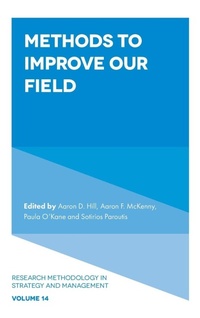
Methods to Improve Our Field
Published on 18. January 2023
Book
Hardback
192 pages
978-1-80455-365-7 (ISBN)
Description
Research Methodology in Strategy and Management advances understanding of the methods used to study organizations - including managers, strategies, and how firms succeed.
Offering innovative ideas that explore how strategy and management methodology can be developed, the chapter authors in Volume 14, Methods to Improve Our Field, consider approaches that range from the re-imagining of secondary data in the digital age and Interpretive Phenomenological Analysis (IPA) to Machine Learning and Artificial Intelligence.
Methods to Improve Our Field is a necessity for both academics and researchers interested in the progression and cutting-edge studies of management, strategy, international business, entrepreneurship, and organization theory.
Offering innovative ideas that explore how strategy and management methodology can be developed, the chapter authors in Volume 14, Methods to Improve Our Field, consider approaches that range from the re-imagining of secondary data in the digital age and Interpretive Phenomenological Analysis (IPA) to Machine Learning and Artificial Intelligence.
Methods to Improve Our Field is a necessity for both academics and researchers interested in the progression and cutting-edge studies of management, strategy, international business, entrepreneurship, and organization theory.
More details
Series
Language
English
Place of publication
Bingley
United Kingdom
Target group
Professional and scholarly
Dimensions
Height: 235 mm
Width: 157 mm
Thickness: 15 mm
Weight
437 gr
ISBN-13
978-1-80455-365-7 (9781804553657)
Copyright in bibliographic data and cover images is held by Nielsen Book Services Limited or by the publishers or by their respective licensors: all rights reserved.
Schweitzer Classification
Other editions
Additional editions
Aaron D. Hill | Aaron F. McKenny | Paula O'Kane
Methods to Improve Our Field
E-Book
01/2023
1st Edition
Emerald Publishing Limited
€105.99
Available for download
Persons
Aaron D. Hill is an Associate Professor in the Management Department of the Warrington College of Business at the University of Florida, USA.
Aaron F. McKenny is an Assistant Professor at the Kelley School of Business, Indiana University Bloomington, USA.
Paula O'Kane is a Senior Lecturer in the Department of Management at the Otago Business School, University of Otago, New Zealand.
Sotirios Paroutis is Professor of Strategic Management at Warwick Business School, the University of Warwick, UK.
Aaron F. McKenny is an Assistant Professor at the Kelley School of Business, Indiana University Bloomington, USA.
Paula O'Kane is a Senior Lecturer in the Department of Management at the Otago Business School, University of Otago, New Zealand.
Sotirios Paroutis is Professor of Strategic Management at Warwick Business School, the University of Warwick, UK.
Content
Chapter 1. Introduction to Methods to Improve Our Field; Aaron D. Hill, Aaron F. McKenny, Paula O'Kane, and Sotirios Paroutis
Chapter 2. Reimagining Secondary Data in a Digital Age; Katrina Pritchard
Chapter 3. Insights from the Application of Interpretative Phenomenological Analysis in Management Research; Yulia Taylor and Fiona Edgar
Chapter 4. Synthesizing Best Practices for Conducting Dictionary-Based Computerized Text Analysis Research; Shane W. Reid, Aaron F. McKenny, and Jeremy C. Short
Chapter 5. Using Mixed Effect Growth Models To Examine Time as a Predictor of Interest and Between-Firm Differences Over Time; Donald J. Schepker and Paul D. Bliese
Chapter 6. Garbage In, Garbage Out: A Theory-Driven Approach To Improve Data Handling In Supervised Machine Learning; Steven J Hyde, Eric Bachura, and Joseph Harrison
Chapter 7. Artificial Intelligence and Operationalization of Psychological Constructs: The Case of Emotions and Emotional Authenticity of Entrepreneurs during Pitch Presentations; Andreas Schwab, Yanjinlkham Shuumarjav, Jake B. Telkamp, and Jose R. Beltran
Chapter 8. PechaKucha-based Participatory Video for Organizational Research; Timothy Madden, Laura T. Madden, and Anne D. Smith
Chapter 2. Reimagining Secondary Data in a Digital Age; Katrina Pritchard
Chapter 3. Insights from the Application of Interpretative Phenomenological Analysis in Management Research; Yulia Taylor and Fiona Edgar
Chapter 4. Synthesizing Best Practices for Conducting Dictionary-Based Computerized Text Analysis Research; Shane W. Reid, Aaron F. McKenny, and Jeremy C. Short
Chapter 5. Using Mixed Effect Growth Models To Examine Time as a Predictor of Interest and Between-Firm Differences Over Time; Donald J. Schepker and Paul D. Bliese
Chapter 6. Garbage In, Garbage Out: A Theory-Driven Approach To Improve Data Handling In Supervised Machine Learning; Steven J Hyde, Eric Bachura, and Joseph Harrison
Chapter 7. Artificial Intelligence and Operationalization of Psychological Constructs: The Case of Emotions and Emotional Authenticity of Entrepreneurs during Pitch Presentations; Andreas Schwab, Yanjinlkham Shuumarjav, Jake B. Telkamp, and Jose R. Beltran
Chapter 8. PechaKucha-based Participatory Video for Organizational Research; Timothy Madden, Laura T. Madden, and Anne D. Smith