

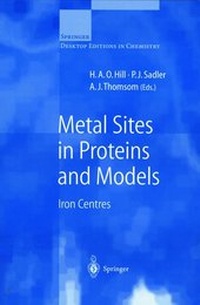
Metal Sites in Proteins and Models
Iron Centres
1st Edition
Published on 6. August 1997
Book
Hardback
VII, 207 pages
978-3-540-62870-5 (ISBN)
Description
Biological chemistry is a major frontier of inorganic chemistry. Three special volumes devoted to
Metal Sites in
Proteins
and
Models
address the questions: how unusual ("entatic") are metal sites in metalloproteins and metalloenzymes compared to those in small coordination complexes? And if they are special, how do polypeptide chains and co-factors control this? The chapters deal with iron, with metal centres acting as Lewis acids, metals in phosphate enzymes, with vanadium, and with the wide variety of transition metal ions which act as redox centres. They illustrate in particular how the combined armoury of genetics and structure determination at the molecular level are providing unprecedented new tools for molecular engineering.
More details
Series
Language
English
Place of publication
Heidelberg
Germany
Publishing group
Springer Berlin
Target group
Professional and scholarly
Research
Illustrations
19
27 farbige Abbildungen, 52 s/w Abbildungen, 19 s/w Tabellen
25 colour & 52 b&w illustrations, 17 tables
Dimensions
Height: 23.5 cm
Width: 15.5 cm
Weight
490 gr
ISBN-13
978-3-540-62870-5 (9783540628705)
DOI
10.1007/3-540-62870-3
Schweitzer Classification
Other editions
Additional editions
E-Book
07/2006
Springer
€53.49
Available for download
Book
04/1999
Springer
€53.49
Shipment within 7-9 days
Content
Polyiron oxides, oxyhydroxides and hydroxides as models for biomineralisation processes.- Heme: The most versatile redox centre in biology?.- Rationalisation of metal binding to transferrin: Prediction of metal-protein stability constants.- Metal centres of bacterioferritins or non-haem-iron-containing cytochromes b 557.- Ribonucleotide reductases - a group of enzymes with different metallosites and a similar reaction mechanism.- Protein engineering of cytochrome P450cam.