

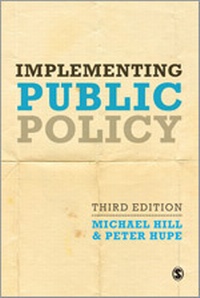
Implementing Public Policy
An Introduction to the Study of Operational Governance
3rd Edition
Published on 12. May 2014
Book
Paperback/Softback
248 pages
978-1-4462-6684-7 (ISBN)
Description
Building on the success of the previous two editions, this book provides students with an exemplary overview of the theory and practice of public policy implementation and how it relates to contemporary public management. In doing so, this new edition makes use of more illustrative examples, delves further into researching implementation and explores issues about the relationship between policy formulation and implementation in greater depth.
Written for an international audience, this is essential reading for upper-level undergraduate and graduate students studying or conducting research in public policy, social policy, public management, public administration and governance.
Written for an international audience, this is essential reading for upper-level undergraduate and graduate students studying or conducting research in public policy, social policy, public management, public administration and governance.
Reviews / Votes
This updated edition consolidates its position as the leading text on implementation, and is fast approaching the status of a 'modern classic'. With its comprehensive coverage of the field by two leading scholars, it will be valuable to both students and specialists. -- Professor Martin Powell The Third Edition of Implementing Public Policy enhances what has become the gold standard for navigating the literature about policy design, implementation, and governance. This edition serves as a clarion call for rethinking how policies serve as instruments for governing. -- Peter J. May In this new edition, Michael Hill and Peter Hupe provide an essential handbook to students, teachers, and practitioners of the art of implementation. The authors' thoughtful and theoretically-informed perspective brings clarity and insight to the study and practice of implementation. -- Professor Evelyn BrodkinMore details
Edition
3rd Revised edition
Language
English
Place of publication
London
United Kingdom
Target group
College/higher education
Edition type
Revised edition
Dimensions
Height: 234 mm
Width: 156 mm
Weight
386 gr
ISBN-13
978-1-4462-6684-7 (9781446266847)
Copyright in bibliographic data and cover images is held by Nielsen Book Services Limited or by the publishers or by their respective licensors: all rights reserved.
Schweitzer Classification
Other editions
New editions
Michael Hill | Peter Hupe
Implementing Public Policy
An Introduction to the Study of Operational Governance
Book
12/2021
4th Edition
SAGE Publications Ltd
€46.29
Shipment within 15-20 days
Previous edition
Michael Hill | Peter Hupe
Implementing Public Policy
An Introduction to the Study of Operational Governance
Book
12/2008
2nd Edition
SAGE Publications Inc
€54.65
Article exhausted; check for reprint
Persons
Michael Hill is Emeritus Professor of Social Policy at the University of Newcastle, UK. Before entering academic life at the University of Reading he was a street-level bureaucrat in a local social assistance office. He later worked on research at the Universities of Oxford and Bristol on the implementation of social policy. Since retiring from Newcastle he has held part-time visiting professorships in London University at Goldsmiths College and Queen Mary College and also in the London School of Economics and the University of Brighton. His long-standing text The Public Policy Process reached its eighth edition in 2021 in a joint version with Frederic Varone of the University of Geneva. In 2020 he published Exploring the World of Social Policy with Zoe Irving of the University of York.
Peter Hupe is Visiting Professor at the Public Governance Institute, KU Leuven, Belgium. He is also Honorary Senior Research Fellow at the School of Social Policy, University of Birmingham, UK. While teaching Public Administration at Erasmus University Rotterdam, the Netherlands, he had academic affiliations in Leiden, Leuven, London, Oxford and Potsdam. The major part of his research regards the theoretical-empirical study of policy processes, particularly implementation and street-level bureaucracy. He discovered the relevance of the latter during an earlier career as a policymaker in the Dutch national civil service. Publishing regularly in journals like Public Administration, Public Policy and Administration and Public Management Review, in 2019 he composed the Research Handbook of Street-Level Bureaucracy: The Ground Floor of Government in Context. With Tony Evans he edited Discretion and the Quest for Controlled Freedom (2020).
Peter Hupe is Visiting Professor at the Public Governance Institute, KU Leuven, Belgium. He is also Honorary Senior Research Fellow at the School of Social Policy, University of Birmingham, UK. While teaching Public Administration at Erasmus University Rotterdam, the Netherlands, he had academic affiliations in Leiden, Leuven, London, Oxford and Potsdam. The major part of his research regards the theoretical-empirical study of policy processes, particularly implementation and street-level bureaucracy. He discovered the relevance of the latter during an earlier career as a policymaker in the Dutch national civil service. Publishing regularly in journals like Public Administration, Public Policy and Administration and Public Management Review, in 2019 he composed the Research Handbook of Street-Level Bureaucracy: The Ground Floor of Government in Context. With Tony Evans he edited Discretion and the Quest for Controlled Freedom (2020).
Content
Introduction
Introduction
Structure of the book
Some matters of definition
Notes
Positioning Implementation Studies
Introduction
Concerns about implementation: Historical origins
The rule of law
The idea of democracy and its implications
Public Administration and Public Management
Institutional theory
Postmodernist theory
Conclusion
Notes
Implementation Theory: The Top-Down/Bottom-Up Debate
The discovery of the 'missing link'
The classical top-down authors
The bottom-up challenge
Conclusion
Implementation Theory
The search for a synthesis
Where does implementation begin
Layers in policy processes
Networks: Broadening the horizontal dimension
Managing performance: Redefining the vertical dimension
Differentiating policy types
Including responses of affected actors
Conclusion
Implementation and Governance
Introduction
The age of interventionism
The age of the market and corporate government
The age of neo-interventionism
Assessment
Conclusion
Notes
Implementation Theory and the Study of Governance
Introduction
The stages model of the policy process
Alternative analytical frameworks
The Multiple Governance Framework
Studying implementation as governance research
Conclusion
Notes
Researching Implementation
Introduction
Defining studies of implementation
Explaining what needs explanation
Isolating implementation
Dealing with layers
Specifying inter-organizational relationships
Differentiating agency responses
Identifying stakes
Recognizing macro-parameters
Quantitative versus qualitative studies
Conclusion
Implementation in Context
Introduction
Implementation in practice
The quest for appropriate action
Policy settings
Institutional environments
Operational governance in context
Conclusion
Notes
The Future of Implementation Studies
Introduction
The objective of studying implementation
The study of governance in operation
Promising developments
Conclusion
Introduction
Structure of the book
Some matters of definition
Notes
Positioning Implementation Studies
Introduction
Concerns about implementation: Historical origins
The rule of law
The idea of democracy and its implications
Public Administration and Public Management
Institutional theory
Postmodernist theory
Conclusion
Notes
Implementation Theory: The Top-Down/Bottom-Up Debate
The discovery of the 'missing link'
The classical top-down authors
The bottom-up challenge
Conclusion
Implementation Theory
The search for a synthesis
Where does implementation begin
Layers in policy processes
Networks: Broadening the horizontal dimension
Managing performance: Redefining the vertical dimension
Differentiating policy types
Including responses of affected actors
Conclusion
Implementation and Governance
Introduction
The age of interventionism
The age of the market and corporate government
The age of neo-interventionism
Assessment
Conclusion
Notes
Implementation Theory and the Study of Governance
Introduction
The stages model of the policy process
Alternative analytical frameworks
The Multiple Governance Framework
Studying implementation as governance research
Conclusion
Notes
Researching Implementation
Introduction
Defining studies of implementation
Explaining what needs explanation
Isolating implementation
Dealing with layers
Specifying inter-organizational relationships
Differentiating agency responses
Identifying stakes
Recognizing macro-parameters
Quantitative versus qualitative studies
Conclusion
Implementation in Context
Introduction
Implementation in practice
The quest for appropriate action
Policy settings
Institutional environments
Operational governance in context
Conclusion
Notes
The Future of Implementation Studies
Introduction
The objective of studying implementation
The study of governance in operation
Promising developments
Conclusion