

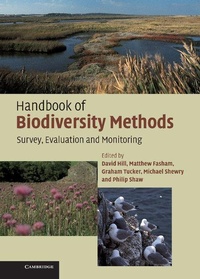
Handbook of Biodiversity Methods
Survey, Evaluation and Monitoring
Published on 4. August 2005
Book
Hardback
588 pages
978-0-521-82368-5 (ISBN)
Description
Biodiversity is recognised to be of global importance, yet species and habitats continue to be under increasing pressure from human-induced influences. Environmental concerns are high on the political agenda, driving increased legislation to protect the natural environment. The starting point for much of this legislation is the requirement for a comprehensive biodiversity audit. For those needing to undertake such audits, this Handbook, first published in 2005, provides standard procedures which will enable practitioners to better monitor the condition of the biodiversity resource, resulting in improved data upon which to base future policy decisions and actions. Organised in three parts, the Handbook first addresses planning, covering method selection, experimental design, sampling strategy, and data analysis and evaluation. The second part describes survey, evaluation and monitoring methods for a broad range of habitats. Part three considers species and provides information on general methods before addressing specific methods of survey and monitoring for the major taxonomic groups.
Reviews / Votes
'Many consultants and project students should find it very helpful.' Ibis 'The Handbook draws together much material that has usually been scattered in the literature. ... Numerous approaches to biodiversity evaluation are described and discussed in its pages and a practical focus is maintained throughout.' Biologist '... impressive ... Extremely helpful ...' Basic and Applied Ecology 'When I opened it and started to flick through it I found that I was drawn into reading section after section. ... well written and covers each separate subject concisely ... It is difficult to find fault with this publication ... in time this handbook will become the standard text for biodiversity monitoring and will grace the shelves of consultants, wildlife professionals and conservation workers alike.' BRISC Recorder News '... a valuable reference for anyone involved in the many biodiversity audits ... well set out and easy to read ... useful diagrams ... The authors and editors of this handbook are all experienced field ecologists and highly respected authorities ...' In PracticeMore details
Language
English
Place of publication
Cambridge
United Kingdom
Target group
Professional and scholarly
Illustrations
58 Tables, unspecified; 28 Line drawings, unspecified
Dimensions
Height: 260 mm
Width: 183 mm
Thickness: 36 mm
Weight
1286 gr
ISBN-13
978-0-521-82368-5 (9780521823685)
Copyright in bibliographic data and cover images is held by Nielsen Book Services Limited or by the publishers or by their respective licensors: all rights reserved.
Schweitzer Classification
Other editions
Additional editions
David Hill | Matthew Fasham | Graham Tucker
Handbook of Biodiversity Methods
Survey, Evaluation and Monitoring
E-Book
09/2005
Cambridge University Press
€154.99
Available for download
David Hill | Matthew Fasham | Graham Tucker
Handbook of Biodiversity Methods
Survey, Evaluation and Monitoring
Book
Cambridge University Press
€97.47
The article will not be published
Previous edition
David Hill | Matthew Fasham | Graham Tucker
Handbook of Biodiversity Methods
Survey, Evaluation and Monitoring
Book
Cambridge University Press
€97.47
The article will not be published
Persons
David Hill is Director of Ecology, RPS Group plc, UK. Matthew Fasham is Principal Consultant, RPS Group plc, UK. Graham Tucker is a freelance ecological consultant with Ecological Solutions, UK. Michael Shewry is Environmental Statistician, Scottish Natural Heritage, UK. Philp Shaw is Environmental Audit Officer, Scottish Natural Heritage, UK.
Content
Preface; Acknowledgements; Part I. Planning M. Fasham, G. Tucker, A. Bennett, T. Rich, M. Shewry, P. Shaw and M. Wade: 1. Introduction to Part 1; 2. Planning a programme; 3. Evaluation methods; Part II. Habitats G. Tucker, M. Fasham, T. Rich, M. Rebane, G. Peterken, F. McMeechan and R. Birnie: 4. Introduction to Part 2; 5. Habitat requirements and issues; 6. Methods for surveying habitats; 7. Surveying and monitoring management or environmental impacts; 8. Habitat conservation evaluation criteria; Part III. Species: 9. Introduction to Part 3; 10. General principles and methods for species M. Fasham and S. Mustoe; 11. Fungi R. Watling, M. Fasham and D. Dobson; 12. Lichens S. Davey, M. Fasham and D. Dobson; 13. Bryophytes G. Rothero, D. Dobson and M. Fasham; 14. Aquatic macrophytes and algae N. Stewart and M. Wade; 15. Vascular plants T. Rich, V. Hack and F. McMeechan; 16. Dragonflies and damselflies C. Plant, R. Sands and M. Fasham; 17. Butterflies C. Plant, R. Sands and M. Fasham; 18. Macromoths C. Plant, R. Sands and M. Fasham; 19. Other terrestrial invertebrates P. Dennis, C. Plant, R. Sands and M. Fasham; 20. Aquatic invertebrates P. Kerrison, T. Norman and M. Fasham; 21. Fish N. Giles, R. Sands and M. Fasham; 22. Amphibians D. Latham, E. Jones and M. Fasham; 23. Reptiles D. Latham, E. Jones and M. Fasham; 24. Birds S. Mustoe, D. Hill, D. Frost and G. Tucker; 25. Bats R. Stebbings, H. Mansfield and M. Fasham; 26. Other mammals A. Bennett, P. Ratcliffe, E. Jones, H. Mansfield and R. Sands; Acknowledgements; Glossary, Appendices; Recommended sources of further information; References; Index.