

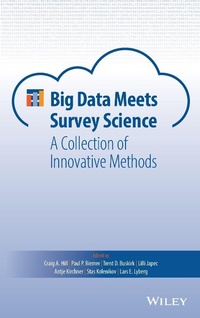
Big Data Meets Survey Science: A Collection of Innovative Methods
A Collection of Innovative Methods
Published on 9. September 2020
Book
Hardback
800 pages
978-1-118-97632-6 (ISBN)
Description
Offers a clear view of the utility and place for survey data within the broader Big Data ecosystem
This book presents a collection of snapshots from two sides of the Big Data perspective. It assembles an array of tangible tools, methods, and approaches that illustrate how Big Data sources and methods are being used in the survey and social sciences to improve official statistics and estimates for human populations. It also provides examples of how survey data are being used to evaluate and improve the quality of insights derived from Big Data.
Big Data Meets Survey Science: A Collection of Innovative Methods shows how survey data and Big Data are used together for the benefit of one or more sources of data, with numerous chapters providing consistent illustrations and examples of survey data enriching the evaluation of Big Data sources. Examples of how machine learning, data mining, and other data science techniques are inserted into virtually every stage of the survey lifecycle are presented. Topics covered include: Total Error Frameworks for Found Data; Performance and Sensitivities of Home Detection on Mobile Phone Data; Assessing Community Wellbeing Using Google Street View and Satellite Imagery; Using Surveys to Build and Assess RBS Religious Flag; and more.
* Presents groundbreaking survey methods being utilized today in the field of Big Data
* Explores how machine learning methods can be applied to the design, collection, and analysis of social science data
* Filled with examples and illustrations that show how survey data benefits Big Data evaluation
* Covers methods and applications used in combining Big Data with survey statistics
* Examines regulations as well as ethical and privacy issues
Big Data Meets Survey Science: A Collection of Innovative Methods is an excellent book for both the survey and social science communities as they learn to capitalize on this new revolution. It will also appeal to the broader data and computer science communities looking for new areas of application for emerging methods and data sources.
More details
Other editions
Additional editions
Craig A. Hill | Paul P. Biemer | Trent D. Buskirk
Big Data Meets Survey Science
A Collection of Innovative Methods
E-Book
09/2020
1st Edition
Wiley
€111.99
Available for download
Craig A. Hill | Paul P. Biemer | Trent D. Buskirk
Big Data Meets Survey Science
A Collection of Innovative Methods
E-Book
08/2020
1st Edition
Wiley
€107.99
Available for download
Persons
Craig A. Hill, PhD is Senior Vice President at RTI International and has always had a research focus on application of new technology to quantitative social science research. He was the Chair of the Scientific Committee for the inaugural Big Data Meets Survey Science (BigSurv18) conference. He is also the lead editor of Social Media, Sociality, and Survey Research (Wiley, 2013).
Paul P. Biemer, PhD is Distinguished Fellow, Statistics at RTI International. He is an author, co-author and co-editor of other books including Introduction to Survey Quality, Latent Class Analysis of Survey Error, Measurement Errors in Surveys, Survey Measurement and Process Quality, Telephone Survey Methodology and Total Error in Practice, all published by John Wiley & Sons.
Trent D. Buskirk, Ph.D. is the Novak Family Distinguished Professor of Data Science and the Chair of the Applied Statistics and Operations Research Department in the College of Business at Bowling Green State University. Trent was the 2018 Conference chair of the American Association of Public Opinion Research and is a fellow of the American Statistical Association. His research interests include using technology to improve data collection and the application of data science methods to improve social science data collection, design and analysis.
Lilli Japec, Ph.D., former Director of Research and Development Department and Quality Director at Statistics Sweden. She co-chaired AAPOR's Task Force on Big Data and co-edited Advances in Telephone Survey Methodology published by John Wiley & Sons. Her main research interests include interview surveys, data quality and multiple data sources. Currently she serves as Senior Scientific Adviser at Statistics Sweden.
Antje Kirchner, Ph.D., is a Research Survey Methodologist at RTI International. Her work and research addresses challenges in survey methodology, for example, how to improve data quality using adaptive/responsive designs, or how to assess the quality of survey data leveraging new data sources. She is the Chair of the Scientific Committee of the "Big Data Meets Survey Science (BigSurv20)" conference.
Stanislav (Stas) Kolenikov, PhD, is Principal Scientist at Abt Associates. His work focuses on survey statistics, including issues in sampling, weighting, variance estimation, multiple imputation, and small area estimation; and on statistical computing, including software development and tools for reproducible workflows.
Lars E. Lyberg, Ph.D., is former Head of the Research and Development Department at Statistics Sweden and retired Professor at the Department of Statistics, Stockholm University. He is the founder of the Journal of Official Statistics (JOS) and served as its Chief Editor for 25 years. He is an author, co-author and co-editor of eight books all except one published by John Wiley & Sons. He currently serves as senior advisor at Demoskop, Inc.
Content
Introduction (Hill, Biemer, Buskirk, Japec, Kirchner, Kolenikov, Lyberg)
Section 1: The New Survey Landscape
1. Why Machines Matter for Survey and Social Science Researchers: Exploring Applications of Machine Learning Methods for Design, Data Collection, and Analysis
Trent D. Buskirk and Antje Kirchner
2. The Future Is Now: How Surveys Can Harness Social Media To Address 21st Century Challenges
Amelia Burke-Garcia, Brad Edwards, and Ting Yan
3. Linking Survey Data with Commercial or Administrative Data for Data Quality Assessment
A. Rupa Datta, Gabriel Ugarte, and Dean Resnick
Section 2: Total Error and Data Quality
4. Total Error Frameworks for Hybrid Estimation and Their Applications
Paul P. Biemer and Ashley Amaya
5. Measuring the Strength of Attitudes in Social Media Dataa
Ashley Amaya, Ruben a, Frauke Kreuter, and Florian Keusch
6. Attention to Campaign Events: Do Twitter and Self-Report Metrics Tell the Same Story?
Josh Pasek, Lisa O. Singh, Yifang Wei, Stuart N. Soroka, Jonathan M. Ladd, Michael W. Traugott, Ceren Budak, Leticia Bode, and Frank Newport
7. Improving Quality of Administrative Data: A Case Study with FBI's National Incident-Based Reporting System Data
Dan Liao, Marcus Berzofsky, Lance Couzens, Ian Thomas, and Alexia Cooper
8. Performance and Sensitivities of Home Detection on Mobile Phone Data
Maarten Vanhoof, Clement Lee, and Zbigniew Smoreda
Section 3: Big Data in Official Statistics
9. Big Data Initiatives in Official Statistics
Lilli Japec and Lars Lyberg
10. Big Data in Official Statistics: A Perspective from Statistics Netherlands
Barteld Braaksma, Kees Zeelenberg, and Sofie De Broe
11. Mining the New Oil for Official Statistics
Siu-Ming Tam, J. K. Kim, Lyndon Ang, and Han Pham
12. Investigating Alternative Data Sources to Reduce Respondent Burden in United States Census Bureau Retail Economic Data Products
Rebecca J. Hutchinson
Section 4: Combining Big Data with Survey Statistics: Methods and Applications
13. Effects of Incentives in Smartphone Data Collection
Georg-Christoph Haas, Frauke Kreuter, Florian Keusch, Mark Trappmann, and Sebastian Bähr
14. Using Machine Learning Models to Predict Attrition in a Survey Panel
Mingnan Liu
15. Assessing Community Well-being using Google Street-View and Satellite Imagery
Dr. Pablo Diego-Rosell, Stafford Nicols, Dr. Rajesh Srinivasan, and Dr. Ben Dilday
16. Nonparametric Bootstrap and Small Area Estimation to Mitigate Bias in Crowdsourced Data: Simulation Study and Application to Perceived Safety
David Buil-Gil, Reka Solymosi, and Angelo Moretti
17. Using Big Data to Improve Sample Efficiency
Jamie Ridenhour, Joe McMichael, Karol Krotki, and Howard Speizer
Section 5: Combining Big Data with Survey Statistics: Tools
18. Feedback Loop: Using Surveys to Build and Assess Registration-Based Sample Religious Flags for Survey Research
David Dutwin
19. Artificial Intelligence and Machine Learning Derived Efficiencies for Large-Scale Survey Estimation Efforts
Steven B. Cohen, PhD and Jamie Shorey, PhD
20. Worldwide Population Estimates for Small Geographic Areas: Can We Do a Better Job?
Safaa Amer, Dana Thomson, Rob Chew, and Amy Rose
Section 6: The Fourth Paradigm, Regulations, Ethics, Privacy
21. Reproducibility in the Era of Big Data: Lessons for Developing Robust Data Management and Data Analysis Procedures
D.B. McCoach, J. Necci Dineen, Sandra M. Chafouleas, and Amy Briesch
22. Combining Active and Passive Mobile Data Collection: A Survey of Concerns
Florian Keusch, Bella Struminskaya, Frauke Kreuter, and Martin Weichbold
23. Attitudes Toward Data Linkage: Privacy, Ethics, and the Potential for Harm
Aleia Clark Fobia, Jennifer Hunter Childs, and Casey Eggleston
24. Moving Social Science into the Fourth Paradigm: The Data Life Cycle
Craig A. Hill