

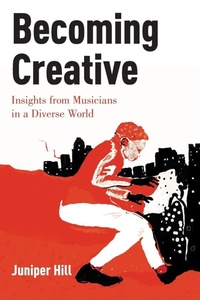
Becoming Creative
Insights from Musicians in a Diverse World
Published on 22. November 2018
Book
Paperback/Softback
280 pages
978-0-19-936518-0 (ISBN)
Description
How are our ability and motivation to be creative shaped by the world around us? Why does creativity seem to flourish in some environments, while others seem to stifle it? Many societies value creativity as an abstract concept and many, perhaps even most, individuals feel an internal drive to be creative; however, tremendous social pressures restrict individuals' development of creative skill sets, engagement in creative activities, and willingness to take creative risks.
Becoming Creative explores how social and cultural factors enable or inhibit creativity in music. Author Juniper Hill integrates perspectives from ethnomusicology, education, sociology, psychology, and performance studies, while prioritizing the voices of practicing musicians and music educators. Insights are drawn from ethnographic research and in-depth interviews with classical, jazz, and traditional musicians in South Africa, Finland, and the US. By comparing and analysing these musicians' personal experiences, Becoming Creative deepens our understanding of the development and practice of musical creativity, the external factors that influence it, and strategies for enhancing it. Hill reveals the common components of how musical creativity is experienced across these cultures and explains why creativity might not always be socially desirable. She identifies ideal creativity-enabling criteria -- specific skills sets, psychological traits and states, and access to opportunities and authority -- and illustrates how these enablers of creativity are fostered or thwarted by a variety of beliefs, attitudes, learning methods, social relationships, institutions, and social inequalities. In addition to theoretical contributions, many sections have direct applications for practice, especially the examination of formal and informal strategies for overcoming inhibitors of creativity. Becoming Creative is for scholars, artists, educators, and anyone wishing to better understand and support creative development in today's world.
Becoming Creative explores how social and cultural factors enable or inhibit creativity in music. Author Juniper Hill integrates perspectives from ethnomusicology, education, sociology, psychology, and performance studies, while prioritizing the voices of practicing musicians and music educators. Insights are drawn from ethnographic research and in-depth interviews with classical, jazz, and traditional musicians in South Africa, Finland, and the US. By comparing and analysing these musicians' personal experiences, Becoming Creative deepens our understanding of the development and practice of musical creativity, the external factors that influence it, and strategies for enhancing it. Hill reveals the common components of how musical creativity is experienced across these cultures and explains why creativity might not always be socially desirable. She identifies ideal creativity-enabling criteria -- specific skills sets, psychological traits and states, and access to opportunities and authority -- and illustrates how these enablers of creativity are fostered or thwarted by a variety of beliefs, attitudes, learning methods, social relationships, institutions, and social inequalities. In addition to theoretical contributions, many sections have direct applications for practice, especially the examination of formal and informal strategies for overcoming inhibitors of creativity. Becoming Creative is for scholars, artists, educators, and anyone wishing to better understand and support creative development in today's world.
Reviews / Votes
For those who work in the field of creation, it's likely to find in Hill's work a clear articulation of complex phenomena personally encountered. Ultimately, giving voice to that shared experience delivers balm to creation's spiritual wounds and encouragement to continue. * Katherine Oktober Matthews, Riding the Dragon * Readers will find inspiration in the interviews and thick descriptions, and they may be encouraged to take musical risks that will take them over the top in search of their own creative impulses. * Patricia Shehan Campbell, Donald E. Peterson Professor of Music, University of Washington * This monumental study of musical creativity in 3 contrasting cultures is set to become a landmark in the field. I know of no other study which so rigorously extracts important lessons from such a large and diverse set of interviews with practicing musicians. By uncovering and explaining the multiple blocks to creativity, and examining successful strategies for overcoming them, this book will hopefully serve not only the scholar but the musical community at large. * John Sloboda, Research Professor, Guildhall School of Music & Drama *More details
Language
English
Place of publication
New York
United States
Target group
College/higher education
Illustrations
5 line, 14 halftone
Dimensions
Height: 234 mm
Width: 156 mm
Thickness: 17 mm
Weight
484 gr
ISBN-13
978-0-19-936518-0 (9780199365180)
Copyright in bibliographic data and cover images is held by Nielsen Book Services Limited or by the publishers or by their respective licensors: all rights reserved.
Schweitzer Classification
Other editions
Additional editions
Book
11/2018
Oxford University Press Inc
€185.40
Shipment within 15-20 days
E-Book
10/2018
OUP eBook
€18.49
Available for download
E-Book
10/2018
OUP eBook
€18.49
Available for download
Person
Juniper Hill has conducted extensive fieldwork on creativity, improvisation, pedagogy, and intercultural dynamics in South Africa, Finland, the US, and Ecuador. She has been awarded a Marie Curie fellowship, a Humboldt fellowship, and two Fulbright fellowships, and has held positions at the University of California, University of Cambridge, and University College Cork. She is currently Professor and Chair of Ethnomusicology at the University of Wuerzburg.
Content
Table of Contents Acknowledgments
List of Figures Chapter One: Interpreting Creative Experience Across Diverse Musical Communities 1.1. Introduction 1.2. What does it mean to be creative? An experiential model of musical creativity Generativity Agency Interaction Nonconformity Recycling Flow Value as a problematic component of creativity 1.3. Creativity as socially undesirable behavior: some theoretical insights Social pressures to conform
Internalizing motivations not to be creative 1.4. Common enablers and inhibitors of creativity: an overview of chapters 1.5. Learning from the experiences of musicians: methodology 1.6. Contrasting musical communities: the case studies The allure of Helsinki, Cape Town, and Los Angeles as research sites Urban distinctions Cross-cultural comparisons of classical, jazz, and folk music communities Chapter Two: Developing Creativity Enabling Skills 2.1. Introduction to creativity enabling skills 2.2. Technique The myth of technical mastery as prerequisite for creativity Overemphasis on technique Correct technique as conformativity or toolbox 2.3. Aural skills Building aural skills through oral transmission Lack of aural skills as inhibiting Concerns about oral transmission and imitation 2.4. Vocabulary and memory facility Building vocabulary for idiomatic creative activities Human memory as facilitator of creativity Oral versus written culture Reviving oral culture and unfixing notation A critique of pattern manipulation as (un)creative 2.5. Syntax and the ability to apply music theory 2.6. Decision-making skills Lack of decision-making skills as inhibiting Approaches for fostering decision-making skills 2.7. Self-assessment skills 2.8. Summary of developing creativity enabling skills Chapter Three: Developing Psychological Enablers and Inhibitors of Creativity 3.1. Introduction to psychological enablers and inhibitors of creativity 3.2. Beliefs about talent and potential Western attitudes toward talent and their impacts South African attitudes toward musical and creative potential and their impacts 3.3. Role models Identification with role models and sense of potential Role models as conveyors of norms and permission 3.4. Assessment and feedback Positive feedback Constructive critical assessment
Destructive feedback Anticipating feedback Self-judgment 3.5. Values and attitudes Mistakes and Perfectionism Originality versus recycling 3.6. Summary of psychological enablers and inhibitors Chapter Four: Accessing the Opportunity, Permission, and Authority to be Creative 4.1. Opportunities and barriers in creative development: social inequalities Prejudice and internalized perceptions of limited potential Economic inequalities in music learning 4.2. Opportunities and barriers in creative work: economic pressures Private gigs, corporate sponsorship, and neoliberal policies in Cape Town Working for the music, television, and film industries in Los Angeles State support for the arts in Helsinki Policies, markets, motivation, and education 4.3. Authority, permissions, and prohibitions: who's allowed to create what music? Codifying rules for newcomers and restricting outsiders Stylstic boundaries and the politics of race, class, and cultural imperialism Internalizing musical attitudes and practices as moral values 4.4. Summary of societal enablers and inhibitors of creativity Chapter Five: Overcoming Inhibitors of Creativity 5.1. Mechanisms for overcoming inhibitors of creativity The safe transgression of comfort zones 5.2. Formal methods for enhancing creative agency: courses and programs Safety and emotional support Facilitating composition and improvisation within an idiom Free improvisation, experimentalism, and the breaking of convention Multiple modes of expression: singing, multi-instrumentalism, dance, and theatre Exposure, facilitator expectations, and validation 5.3. Informal strategies for overcoming creative hurdles: individual journeys Tuomas Jackie Kyle Anja Juniper 5.5. Conclusions on increasing creative agency Musicians Interviewed References
List of Figures Chapter One: Interpreting Creative Experience Across Diverse Musical Communities 1.1. Introduction 1.2. What does it mean to be creative? An experiential model of musical creativity Generativity Agency Interaction Nonconformity Recycling Flow Value as a problematic component of creativity 1.3. Creativity as socially undesirable behavior: some theoretical insights Social pressures to conform
Internalizing motivations not to be creative 1.4. Common enablers and inhibitors of creativity: an overview of chapters 1.5. Learning from the experiences of musicians: methodology 1.6. Contrasting musical communities: the case studies The allure of Helsinki, Cape Town, and Los Angeles as research sites Urban distinctions Cross-cultural comparisons of classical, jazz, and folk music communities Chapter Two: Developing Creativity Enabling Skills 2.1. Introduction to creativity enabling skills 2.2. Technique The myth of technical mastery as prerequisite for creativity Overemphasis on technique Correct technique as conformativity or toolbox 2.3. Aural skills Building aural skills through oral transmission Lack of aural skills as inhibiting Concerns about oral transmission and imitation 2.4. Vocabulary and memory facility Building vocabulary for idiomatic creative activities Human memory as facilitator of creativity Oral versus written culture Reviving oral culture and unfixing notation A critique of pattern manipulation as (un)creative 2.5. Syntax and the ability to apply music theory 2.6. Decision-making skills Lack of decision-making skills as inhibiting Approaches for fostering decision-making skills 2.7. Self-assessment skills 2.8. Summary of developing creativity enabling skills Chapter Three: Developing Psychological Enablers and Inhibitors of Creativity 3.1. Introduction to psychological enablers and inhibitors of creativity 3.2. Beliefs about talent and potential Western attitudes toward talent and their impacts South African attitudes toward musical and creative potential and their impacts 3.3. Role models Identification with role models and sense of potential Role models as conveyors of norms and permission 3.4. Assessment and feedback Positive feedback Constructive critical assessment
Destructive feedback Anticipating feedback Self-judgment 3.5. Values and attitudes Mistakes and Perfectionism Originality versus recycling 3.6. Summary of psychological enablers and inhibitors Chapter Four: Accessing the Opportunity, Permission, and Authority to be Creative 4.1. Opportunities and barriers in creative development: social inequalities Prejudice and internalized perceptions of limited potential Economic inequalities in music learning 4.2. Opportunities and barriers in creative work: economic pressures Private gigs, corporate sponsorship, and neoliberal policies in Cape Town Working for the music, television, and film industries in Los Angeles State support for the arts in Helsinki Policies, markets, motivation, and education 4.3. Authority, permissions, and prohibitions: who's allowed to create what music? Codifying rules for newcomers and restricting outsiders Stylstic boundaries and the politics of race, class, and cultural imperialism Internalizing musical attitudes and practices as moral values 4.4. Summary of societal enablers and inhibitors of creativity Chapter Five: Overcoming Inhibitors of Creativity 5.1. Mechanisms for overcoming inhibitors of creativity The safe transgression of comfort zones 5.2. Formal methods for enhancing creative agency: courses and programs Safety and emotional support Facilitating composition and improvisation within an idiom Free improvisation, experimentalism, and the breaking of convention Multiple modes of expression: singing, multi-instrumentalism, dance, and theatre Exposure, facilitator expectations, and validation 5.3. Informal strategies for overcoming creative hurdles: individual journeys Tuomas Jackie Kyle Anja Juniper 5.5. Conclusions on increasing creative agency Musicians Interviewed References