

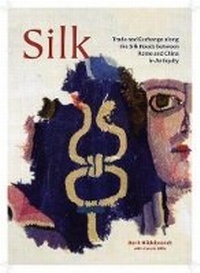
Silk
Trade and Exchange along the Silk Roads between Rome and China in Antiquity
Published on 12. January 2017
Book
Hardback
152 pages
978-1-78570-279-2 (ISBN)
Description
Already in Greek and Roman antiquity a vibrant series of exchange relationships existed between the Mediterranean regions and China, including the Indian subcontinent, along well-defined routes we call the Silk Roads. Among the many goods that found their way from East to West and vice versa were glass, wine spices, metals and precious stones as well as textile raw materials and fabrics of wool and silk, a precious fibre that was highly appreciated in many of the cultures along the roads that were named after it by modern scholars.
These collected papers bring together current historical, philological and archaeological research from different areas and disciplines in order highlight the use, circulation and meaning of silk as a commodity, gift, tribute , booty, and status symbol in varying cultural and chronological contexts between East and West, including technological aspects of silk production. Rome and China in antiquity provide the geographical and chronological frame for this volume (c. from the third century BCE to the fifth century CE), but also earlier and later epochs and cultures in between these empires are considered in order to build and intercultural and diachronic understanding of long-distance relations that involved silk.
These collected papers bring together current historical, philological and archaeological research from different areas and disciplines in order highlight the use, circulation and meaning of silk as a commodity, gift, tribute , booty, and status symbol in varying cultural and chronological contexts between East and West, including technological aspects of silk production. Rome and China in antiquity provide the geographical and chronological frame for this volume (c. from the third century BCE to the fifth century CE), but also earlier and later epochs and cultures in between these empires are considered in order to build and intercultural and diachronic understanding of long-distance relations that involved silk.
Reviews / Votes
Hildebrandt's eleven-page introduction observes that silk, more than other traded commodities, allows us to understand both the economic and political dimensions of trade in ancient cultures, and permits insights into the development and transfer of textile technologies between East and West. * New Testament Abstracts * This volume will appeal to the specialist focused on ancient textiles, but there is more on offer here. The lines of communication and extent of knowledge about and between the cultures at the eastern and western limits of the Silk Road and in the many regions that acted as intermediaries are topics that will have wider significance to scholars and students. * Ancient Near Eastern Studies * There is much here to engage the expert but we might hope that others may also learn more about a subject which was far more conspicuous in antiquity than most that occupy archaeologists, and therefore perhaps a more valuable guide to our understanding of people, places and motives. * Ancient West & East *More details
Series
Language
English
Place of publication
Oxford
United Kingdom
Target group
College/higher education
Professional and scholarly
Illustrations
bw and colour
Dimensions
Height: 240 mm
Width: 170 mm
ISBN-13
978-1-78570-279-2 (9781785702792)
Copyright in bibliographic data and cover images is held by Nielsen Book Services Limited or by the publishers or by their respective licensors: all rights reserved.
Schweitzer Classification
Other editions
Additional editions
E-Book
02/2017
Oxbow Books
€29.49
Available for download

E-Book
02/2017
OXBOW BOOKS
€29.49
Available for download
Person
Berit Hildebrandt is a researcher at the Nordic Centre of Heritage Learning and Creativity in OEstersund, Sweden. She has previously worked at the Danish National Research Foundation's Centre for Textile Research at Copenhagen University, Denmark, where she specialised, among other topics, in the study of Greek and Roman texts related to silk and the silk trade in antiquity.
Content
Preface
Introduction: Silk on the Silk Roads. Exchange between East and West in Antiquity.
Berit Hildebrandt
Looking towards the West - how the Chinese viewed the Romans
Liu Xinru
2. Textiles and Trade in South Asia during the Proto-Historic and Early Historic Period
J. Mark Kenoyer
3. Word migration on the Silk Road: the etymology of English silk and its congeners
Adam Hyllested
4. Silk production and trade in the Roman Empire
Berit Hildebrandt
5. Perspectives on the wide world of luxury in later Antiquity: silk and other exotic textiles found in Syria and Egypt
Thelma K. Thomas
6. Decoration, astrology and empire: inscribed silk from Niya in the Taklamakan Desert
Lillian Lan-ying Tseng
7. Domestic, wild or unravelled? A study on tabby, taquete and jin with spun silk from Yingpan, Xinjiand, thierd-fourth centuries
Zhao Feng
8. Chinese silks that circulated among people north and west: implications for technological exchanges in early times?
Angela Sheng
Dr. Irene Lee Good (April 24 1958 - February 3 2013). An appreciation
Robert E. Murowchick, Angela Sheng and Kaoru Ueda
Introduction: Silk on the Silk Roads. Exchange between East and West in Antiquity.
Berit Hildebrandt
Looking towards the West - how the Chinese viewed the Romans
Liu Xinru
2. Textiles and Trade in South Asia during the Proto-Historic and Early Historic Period
J. Mark Kenoyer
3. Word migration on the Silk Road: the etymology of English silk and its congeners
Adam Hyllested
4. Silk production and trade in the Roman Empire
Berit Hildebrandt
5. Perspectives on the wide world of luxury in later Antiquity: silk and other exotic textiles found in Syria and Egypt
Thelma K. Thomas
6. Decoration, astrology and empire: inscribed silk from Niya in the Taklamakan Desert
Lillian Lan-ying Tseng
7. Domestic, wild or unravelled? A study on tabby, taquete and jin with spun silk from Yingpan, Xinjiand, thierd-fourth centuries
Zhao Feng
8. Chinese silks that circulated among people north and west: implications for technological exchanges in early times?
Angela Sheng
Dr. Irene Lee Good (April 24 1958 - February 3 2013). An appreciation
Robert E. Murowchick, Angela Sheng and Kaoru Ueda