

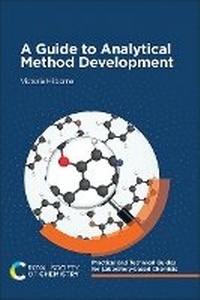
A Guide to Analytical Method Development
1st Edition
Will be published approx. on 18. March 2026
Book
Paperback/Softback
72 pages
978-1-83916-810-9 (ISBN)
Description
Have you been given a sample of unknown matter and don't know where to start with working out what that sample might be?
Knowing where to start when presented with a new chemical measurement problem can be daunting, but this book guides you through the reasonable steps to take to ascertain what a sample might be. From planning and developing appropriate analytical measurement methods to method validation, it fills a gap in the literature where there are few, to no, general guides on what to consider when developing chemical measurement methods. Starting with managing the various complexities of sample matrices, discussion on how to select techniques for the identification and quantification of analytes and, finally, details on assessment of the data to streamline the method development process are provided. Approaches range from sourcing and using established methods to adaptation and innovation in method development. Consideration is also given to what is appropriate to solve the analytical measurement problem whilst minimizing cost and optimizing use of time.
Written for the novice, this book is also appropriate for established analytical chemists looking for new ideas. It will remove the worry of starting a new project or identifying that elusive sample.
Knowing where to start when presented with a new chemical measurement problem can be daunting, but this book guides you through the reasonable steps to take to ascertain what a sample might be. From planning and developing appropriate analytical measurement methods to method validation, it fills a gap in the literature where there are few, to no, general guides on what to consider when developing chemical measurement methods. Starting with managing the various complexities of sample matrices, discussion on how to select techniques for the identification and quantification of analytes and, finally, details on assessment of the data to streamline the method development process are provided. Approaches range from sourcing and using established methods to adaptation and innovation in method development. Consideration is also given to what is appropriate to solve the analytical measurement problem whilst minimizing cost and optimizing use of time.
Written for the novice, this book is also appropriate for established analytical chemists looking for new ideas. It will remove the worry of starting a new project or identifying that elusive sample.
More details
Series
Language
English
Place of publication
Cambridge
United Kingdom
Target group
Professional and scholarly
Product notice
Unsewn / adhesive bound
Dimensions
Height: 156 mm
Width: 235 mm
Thickness: 10 mm
Weight
150 gr
ISBN-13
978-1-83916-810-9 (9781839168109)
DOI
10.1039/9781837673575
Copyright in bibliographic data and cover images is held by Nielsen Book Services Limited or by the publishers or by their respective licensors: all rights reserved.
Schweitzer Classification
Other editions
Additional editions
Victoria Hilborne
A Guide to Analytical Method Development
E-Book
03/2026
1st Edition
Royal Society of Chemistry
€47.99
Available for download
Person
Dr Victoria Hilborne is a Lecturer (Teaching) for University College London (UCL) Department of Chemistry, developing new teaching in analytical and physical chemistry with an interest in application to environmental chemistry. Since joining UCLChemistry in 2016, Vicky has substantially developed and modernised new physical and analytical chemistry data processing and laboratory courses, plus introduced new approaches to assessment and feedback in level 7 Topics in Modern Chemistry.
Content
Introduction
Sustainability in Analytical Science
Principles for Method Development
Considerations and Strategies
Validity and Reliability of Analytical Measurement Methods: Data Analytics
Sustainability in Analytical Science
Principles for Method Development
Considerations and Strategies
Validity and Reliability of Analytical Measurement Methods: Data Analytics