

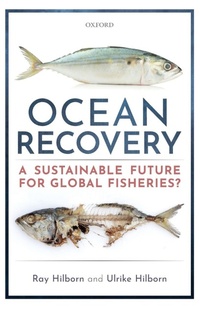
Ocean Recovery
A sustainable future for global fisheries?
Published on 27. June 2019
Book
Hardback
210 pages
978-0-19-883976-7 (ISBN)
Description
Over the last two decades, the scientific and popular media have been bombarded by gloom and doom stories of the future of fisheries, the status of fish stocks, and the impact of fishing on marine ecosystems. Dozens of certification and labeling schemes have emerged to advise consumers on what seafood is sustainable. In recent years, an opposing narrative has emerged emphasizing the success of fisheries management in many places, the increasing abundance of fish stocks in those places, and the prescription for sustainable fisheries. However, there has been no comprehensive survey of what really constitutes sustainability in fisheries, fish stock status, success and failures of management, and consideration of the impacts of fishing on marine ecosystems. This book will explore very different perspectives on sustainability, and bring together the data from a large number of studies to show where fish stocks are increasing, where they are declining, the consequences of alternative fisheries management regimes, and what is known about a range of fisheries issues such as the impacts of trawling on marine ecosystems.
Ocean Recovery is aimed principally at a general audience that is already interested in fisheries but seeks both a deeper understanding of what is known about specific issues and an impartial presentation of all the data rather than selected examples used to justify a particular perspective or agenda. It will also appeal to the scientific community eager to know more about marine fisheries and fishing data, and serve as the basis for graduate seminars on the sustainability of natural resources.
Ocean Recovery is aimed principally at a general audience that is already interested in fisheries but seeks both a deeper understanding of what is known about specific issues and an impartial presentation of all the data rather than selected examples used to justify a particular perspective or agenda. It will also appeal to the scientific community eager to know more about marine fisheries and fishing data, and serve as the basis for graduate seminars on the sustainability of natural resources.
Reviews / Votes
Elucidating global fisheries management, debunking some of the oft-mentioned myths, and providing readers with science-based facts, Ocean Recovery provides an excellent resource for understanding modern fishery practices. * Society for Conservation Biology * The style of writing is open and informative, the illustrations are clear and the general message is that for fisheries that are well managed the outlook for fish populations is good ... Ocean Recovery is a clear, well written and engaging account of how fisheries are assessed and managed. I like it particularly because it takes a positive view of how we humans are trying our best to tackle environmental issues, rather than adopting a negative view that always dwells on the worst possible outcome. * Paul J. B. Hart, Fish and Fisheries * We would recommend this book both as a knowledge-expanding international foray for scientists and managers and as an important component of an educated reader's introduction to fisheries. * Zoe J. Kitchel, R.M.W.J. Bandara, Jaelyn T. Bos, Rene D. Clark, Daniel L. Forrest, and Malin L. Pinsky, Rutgers University, American Fisheries Society * This thoroughly researched book covers a lot of territory in relation to fisheries management, including the perspectives of scientists, managers, fishermen, and conservationists. * Byron Anderson, Electronic Green Journal * Biologists often focus exclusively on species protection, for Hilborn sustainable development is about reaching a compromise between that and our need to eat...Ocean Recovery is a thought-provoking read that made me re-think some of my own preconceptions. Any book that does that is worth your time. The Inquisitive BiologistMore details
Language
English
Place of publication
Oxford
United Kingdom
Target group
College/higher education
Dimensions
Height: 240 mm
Width: 161 mm
Thickness: 16 mm
Weight
485 gr
ISBN-13
978-0-19-883976-7 (9780198839767)
Copyright in bibliographic data and cover images is held by Nielsen Book Services Limited or by the publishers or by their respective licensors: all rights reserved.
Schweitzer Classification
Other editions
Additional editions
E-Book
06/2019
1st Edition
OUP eBook
€39.49
Available for download
Persons
Ray Hilborn is a Professor in the School of Aquatic and Fishery Sciences, University of Washington specializing in natural resource management and conservation. He teaches graduate and undergraduate courses in food sustainability, conservation, and quantitative population dynamics. He has co-authored several books including Overfishing: what everyone needs to know, Quantitative fisheries stock assessment, and The ecological detective: confronting models with data and has published over 300 peer reviewed articles. He has served on the Editorial Boards of numerous journals including 7 years on the Board of Reviewing Editors of Science Magazine. He has received the Volvo Environmental Prize, the American Fisheries Societies Award of Excellence, The Ecological Society of America's Sustainability Science Award, and the International Fisheries Science Prize. He is a Fellow of the American Fisheries Society, the Royal Society of Canada, and the American Academy of Arts and Sciences.
Ulrike Hilborn is a writer and has worked with her husband, Ray, for over 40 years.
Ulrike Hilborn is a writer and has worked with her husband, Ray, for over 40 years.
Content
1: The Bristol Bay salmon fishery 2: Fisheries sustainability 3: How fisheries are managed 4: Who gets to fish? 5: The global status of fisheries: a long tale of scientists, opinions, papers written and refuted, all in the pursuit of the same truth 6: The environmental impacts of fishing 7: Recreational fishing 8: Freshwater fisheries 9: Mixed species fishing and bycatch 10: Bottom trawling 11: The forage fish rollercoaster 12: Following the rules and illegal fishing 13: Seafood certification and NGOs 14: Ecosystem based management and marine protected areas 15: Enhancement and aquaculture 16: Climate change 17: The future of fisheries