

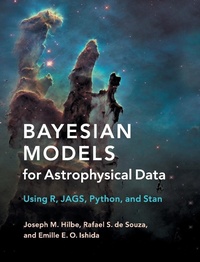
Bayesian Models for Astrophysical Data
Using R, JAGS, Python, and Stan
Published on 27. April 2017
Book
Hardback
408 pages
978-1-107-13308-2 (ISBN)
Description
This comprehensive guide to Bayesian methods in astronomy enables hands-on work by supplying complete R, JAGS, Python, and Stan code, to use directly or to adapt. It begins by examining the normal model from both frequentist and Bayesian perspectives and then progresses to a full range of Bayesian generalized linear and mixed or hierarchical models, as well as additional types of models such as ABC and INLA. The book provides code that is largely unavailable elsewhere and includes details on interpreting and evaluating Bayesian models. Initial discussions offer models in synthetic form so that readers can easily adapt them to their own data; later the models are applied to real astronomical data. The consistent focus is on hands-on modeling, analysis of data, and interpretations that address scientific questions. A must-have for astronomers, its concrete approach will also be attractive to researchers in the sciences more generally.
Reviews / Votes
'This volume is a very welcome addition to the small but growing library of resources for advanced analysis of astronomical data. Astronomers are often confronted with complex constrained regression problems, situations that benefit from computationally intensive Bayesian approaches. The authors provide a unique and sophisticated guide with tutorials in methodology and software implementation. The worked examples are impressive. Many astronomers use Python and will benefit from the less familiar capabilities of R, Stan, and JAGS for Bayesian analysis. I suspect the work will also be useful to scientists in other fields who venture into the world of Bayesian computational statistics.' Eric D. Feigelson, Pennsylvania State University, author of Modern Statistical Methods for Astronomy 'Encyclopaedic in scope, a treasure trove of ready code for the hands-on practitioner.' Ben Wandelt, Paris Institute of Astrophysics, Institut Lagrange de Paris, Universite Paris-Sorbonne 'This informative book is a valuable resource for astronomers, astrophysicists, and cosmologists at all levels of their career. From students starting out in the field to researchers at the frontiers of data analysis, everyone will find insightful techniques accompanied by helpful examples of code. With this book, Hilbe, de Souza, and Ishida are firmly taking astrostatistics into the twenty-first century.' Roberto Trotta, Imperial College London, author of The Edge of the Sky '... the focus of the book is not on providing a full understanding of how the distributions arise, but to give guidelines on how to write code for applications, including building multi-level models, and here it succeeds well, and is an excellent resource in conjunction with powerful packages such as STAN and JAGS.' Alan Heavens, The ObservatoryMore details
Language
English
Place of publication
Cambridge
United Kingdom
Target group
Professional and scholarly
Illustrations
11 Tables, black and white; 45 Halftones, black and white; 23 Line drawings, color; 21 Line drawings, black and white
Dimensions
Height: 260 mm
Width: 208 mm
Thickness: 27 mm
Weight
1135 gr
ISBN-13
978-1-107-13308-2 (9781107133082)
Copyright in bibliographic data and cover images is held by Nielsen Book Services Limited or by the publishers or by their respective licensors: all rights reserved.
Schweitzer Classification
Other editions
Additional editions
Joseph M. Hilbe | Rafael S. de Souza | Emille E. O. Ishida
Bayesian Models for Astrophysical Data
Using R, JAGS, Python, and Stan
E-Book
04/2017
Cambridge University Press
€73.99
Available for download
Persons
Joseph M. Hilbe is Solar System Ambassador with NASA's Jet Propulsion Laboratory, California Institute of Technology, Adjunct Professor of Statistics at Arizona State University, and Professor Emeritus at the University of Hawaii. He is currently President of the International Astrostatistics Association (IAA) and was awarded the IAA's 2016 Outstanding Contributions to Astrostatistics medal, the association's top award. Hilbe is an elected Fellow of both the American Statistical Association and the IAA and is a full member of the American Astronomical Society. He has authored nineteen books on statistical modeling, including leading texts on modeling count and binomial data. His book, Modeling Count Data (Cambridge, 2014) received the 2015 PROSE honorable mention for books in mathematics. Rafael S. de Souza is a researcher at Eoetvos Lorand University, Budapest. He is currently Vice-President for development of the International Astrostatistics Association (IAA) and was awarded the IAA's 2016 Outstanding Publication in Astrostatistics award. He has authored dozens of scientific papers, serving as the leading author for over twenty of them. Emille E. O. Ishida is a researcher at the Universite Clermont-Auvergne (Universite Blaise Pascal), France. She is cochair of the Cosmostatistics Initiative and coordinator of its Python-related projects. She is a specialist in machine learning applications to astronomy with special interests in type Ia supernovae spectral characterization, classification, and cosmology. She has been the lead author of numerous articles in prominent astrophysics journals and currently serves as chair of the IAA public relations committee.
Content
Preface; 1. Astrostatistics; 2. Prerequisites; 3. Frequentist vs Bayesian methods; 4. Normal linear models; 5. GLM part I - continuous and binomial models; 6. GLM part II - count models; 7. GLM part III - zero-inflated and hurdle models; 8. Hierarchical GLMMs; 9. Model selection; 10. Astronomical applications; 11. The future of astrostatistics; Appendix A. Bayesian modeling using INLA; Bibliography; Index.