

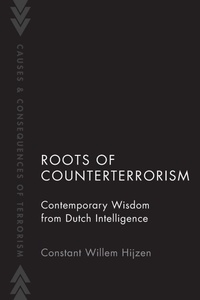
Roots of Counterterrorism
Contemporary Wisdom from Dutch Intelligence
Published on 4. December 2024
Book
Paperback/Softback
408 pages
978-0-19-778604-8 (ISBN)
Description
The dominant narrative in intelligence studies portrays the evolution of intelligence from Cold War times to the present as one of increasing complexity. But Western intelligence and security services have countered terrorism before: terrorism became an important threat from the end of the 1960s onwards. Counterterrorism efforts before 9/11, however, differed from those employed post-9/11, not only in the way threats were perceived, but also in the repertoires of action that emerged to counter them.
Using newly declassified primary sources, Roots of Counterterrorism puts into focus how the rise of terrorism in the 1970s challenged the existing perceived core functions of intelligence, specifically in the Netherlands. Constant Willem Hijzen analyses how the Dutch domestic security service Binnenlandse Veiligheidsdienst (BVD) scrutinized traces of terrorism from 1968, when Spanish anarchists bombed embassies in The Hague, until the South Moluccan attack of 1978, after which the threat of terrorism and political violence diminished. Unlike counterterrorism in the post-9/11 era, prevention was not the primary goal. Instead, the Dutch security service launched intelligence investigations into the suspected perpetrators of attacks, provided hands-on assistance during terrorist incidents, and advised the police and the Justice department.
Roots of Counterterrorism sheds new light on Dutch intelligence history, but also on the dynamics of international intelligence cooperation, operational complexities, and more fundamental questions in intelligence and security studies about the essence and evolution of intelligence and intelligence organizations.
Using newly declassified primary sources, Roots of Counterterrorism puts into focus how the rise of terrorism in the 1970s challenged the existing perceived core functions of intelligence, specifically in the Netherlands. Constant Willem Hijzen analyses how the Dutch domestic security service Binnenlandse Veiligheidsdienst (BVD) scrutinized traces of terrorism from 1968, when Spanish anarchists bombed embassies in The Hague, until the South Moluccan attack of 1978, after which the threat of terrorism and political violence diminished. Unlike counterterrorism in the post-9/11 era, prevention was not the primary goal. Instead, the Dutch security service launched intelligence investigations into the suspected perpetrators of attacks, provided hands-on assistance during terrorist incidents, and advised the police and the Justice department.
Roots of Counterterrorism sheds new light on Dutch intelligence history, but also on the dynamics of international intelligence cooperation, operational complexities, and more fundamental questions in intelligence and security studies about the essence and evolution of intelligence and intelligence organizations.
Reviews / Votes
Hijzen has contributed a though provoking account and a valuable addition to the literature. * Studies in Intelligence *More details
Series
Language
English
Place of publication
New York
United States
Target group
College/higher education
Dimensions
Height: 234 mm
Width: 156 mm
Thickness: 25 mm
Weight
692 gr
ISBN-13
978-0-19-778604-8 (9780197786048)
Copyright in bibliographic data and cover images is held by Nielsen Book Services Limited or by the publishers or by their respective licensors: all rights reserved.
Schweitzer Classification
Other editions
Additional editions
Book
12/2024
Oxford University Press Inc
€137.80
Shipment within 15-20 days
E-Book
10/2024
OUP eBook
€32.99
Available for download
E-Book
10/2024
OUP eBook
€32.99
Available for download
Person
Constant Willem Hijzen is an affiliated researcher in Intelligence Studies at the Institute of Security and Global Affairs Leiden University (the Netherlands). From 2016 to 2021, he was Assistant Professor and Head of the research group of Intelligence and Security of the Institute of Security and Global Affairs at Leiden University, whilst also teaching at the Institute for History at the same university. In his dissertation, he focused on the interaction between the Dutch security service and their political, bureaucratic, and societal context. In 2017, he received a research grant from the National Coordinator for Counterterrorism and Security for a research project on intelligence and counterterrorism.
Content
Introduction
Chapter 1: Historiography
Chapter 2: Counterterrorism intelligence: a new conceptual approach
Vignette I: Traces of Spanish anarchists
Chapter 3: The language of violence, 1968-1970
Vignette II: Traces of the bombing of the Russian Trade Delegation (April 1971)
Chapter 4: No ordinary crimes, 1971-1972
Vignette III: Traces of the Rode Jeugd, Rode Hulp, and Rood Verzetsfront
Chapter 5: Munich and two years of talking about terrorism, 1972-1973
Vignette IV: Traces of the Rote Armee Fraktion
Chapter 6: A fragmentary terrorist net which is spread over Europe, 1974-1975
Vignette V: Traces from BVD agents among South Moluccans
Chapter 7: The terrorist future in the present. South Moluccan attacks, 1975-1978
Chapter 8: Towards the paradigm of prevention, 1978-present
Traces of terrorism: a concluding analysis
Appendix: Sources and Methods
Endnotes
Chapter 1: Historiography
Chapter 2: Counterterrorism intelligence: a new conceptual approach
Vignette I: Traces of Spanish anarchists
Chapter 3: The language of violence, 1968-1970
Vignette II: Traces of the bombing of the Russian Trade Delegation (April 1971)
Chapter 4: No ordinary crimes, 1971-1972
Vignette III: Traces of the Rode Jeugd, Rode Hulp, and Rood Verzetsfront
Chapter 5: Munich and two years of talking about terrorism, 1972-1973
Vignette IV: Traces of the Rote Armee Fraktion
Chapter 6: A fragmentary terrorist net which is spread over Europe, 1974-1975
Vignette V: Traces from BVD agents among South Moluccans
Chapter 7: The terrorist future in the present. South Moluccan attacks, 1975-1978
Chapter 8: Towards the paradigm of prevention, 1978-present
Traces of terrorism: a concluding analysis
Appendix: Sources and Methods
Endnotes