

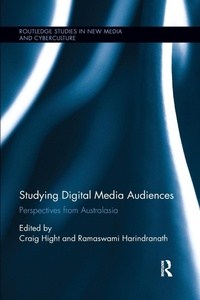
Studying Digital Media Audiences
Perspectives from Australasia
1st Edition
Published on 10. December 2019
Book
Paperback/Softback
228 pages
978-0-367-87819-1 (ISBN)
Description
Although many digital platforms continue to appropriate and reconfigure familiar forms of media experience, this is an environment which no longer consistently constructs an identifiable 'mass' audience in the terms understood by twentieth century audience researchers. The notion of 'audiencing' takes on different characteristics within a digital environment where platforms encourage users to upload, share and respond to content, while the platforms themselves monetise the digital traces of this activity. This environment demands new ways of thinking about audience and user engagement with media technologies, and raises significant questions on methods of conceiving and researching audience-users. This volume addresses ongoing debates in the field of audience research by exploring relevant conceptual and methodological issues concerning the systematic study of digital audiences. Drawing from work conducted by researchers based in Australia and New Zealand, the book uses theoretical frameworks and case study material which are of direct relevance to audience researchers globally.
More details
Series
Language
English
Place of publication
London
United Kingdom
Publishing group
Taylor & Francis Ltd
Target group
College/higher education
Postgraduate and Undergraduate
Dimensions
Height: 229 mm
Width: 152 mm
Thickness: 12 mm
Weight
337 gr
ISBN-13
978-0-367-87819-1 (9780367878191)
Copyright in bibliographic data and cover images is held by Nielsen Book Services Limited or by the publishers or by their respective licensors: all rights reserved.
Schweitzer Classification
Other editions
Additional editions
Book
02/2017
1st Edition
Routledge
€233.10
Shipment within 10-20 days
E-Book
01/2017
Routledge
€60.49
Available for download
E-Book
01/2017
Routledge
€60.49
Available for download
Persons
Craig Hight is an Associate Professor in Communication at the University of Newcastle, Australia. His research interests have focused on audience research, digital media and documentary theory. He is currently researching the relationships between digital media technologies and documentary practice, especially the variety of factors shaping online documentary cultures.
Ramaswami Harindranath is Professor of Media at the University of New South Wales, Australia. He has published widely on audience research; global media, economy and culture; diasporic media and cultural politics; multicultural arts and cultural citizenship; South Asian politics and culture; and postcoloniality. He is currently completing a manuscript entitled Southern Discomfort, which re-assesses the concept and politics of cultural imperialism.
Ramaswami Harindranath is Professor of Media at the University of New South Wales, Australia. He has published widely on audience research; global media, economy and culture; diasporic media and cultural politics; multicultural arts and cultural citizenship; South Asian politics and culture; and postcoloniality. He is currently completing a manuscript entitled Southern Discomfort, which re-assesses the concept and politics of cultural imperialism.
Content
Introduction: Studying digital media audiences
1. User-Led transnationalism, Big Data and the World Wide Web
[Adrian Athique]
2. Audiences and Australian media policy: The relevance of George Gerbner
[Andy Ruddock]
3. Locating mobile media audiences: In plain view with Pokemon GO
[Gerard Goggin]
4. Social media, radicalization and extremist violence: challenges for research
[Ramaswami Harindranath]
5. Audiencing through social media
[Darryl Woodford, Katie Prowd, and Axel Bruns]
6. The challenges of using YouTube as a data resource
[Craig Hight]
7. You Tried!: Failure in a universityy social network site
[Erika Pearson and A.C.M. Moskal]
8. Beyond 'the profile': Multiple qualitative methods for researching Facebook drinking cultures
[Ian Goodwin, Christine Griffin, Antonia Lyons and Tim McCreanor]
9. Ambient liveness: Searchable audiences and second screens
[Michele Zappavigna]
10. Teaching with Twitter: A case study in the practice of audiencing
[Sue Turnbull and Christopher Moore]
11. Migrants and mediatization: Three generations of Dutch migrants to Aotearoa / New Zealand.
[Joost de Bruin]
1. User-Led transnationalism, Big Data and the World Wide Web
[Adrian Athique]
2. Audiences and Australian media policy: The relevance of George Gerbner
[Andy Ruddock]
3. Locating mobile media audiences: In plain view with Pokemon GO
[Gerard Goggin]
4. Social media, radicalization and extremist violence: challenges for research
[Ramaswami Harindranath]
5. Audiencing through social media
[Darryl Woodford, Katie Prowd, and Axel Bruns]
6. The challenges of using YouTube as a data resource
[Craig Hight]
7. You Tried!: Failure in a universityy social network site
[Erika Pearson and A.C.M. Moskal]
8. Beyond 'the profile': Multiple qualitative methods for researching Facebook drinking cultures
[Ian Goodwin, Christine Griffin, Antonia Lyons and Tim McCreanor]
9. Ambient liveness: Searchable audiences and second screens
[Michele Zappavigna]
10. Teaching with Twitter: A case study in the practice of audiencing
[Sue Turnbull and Christopher Moore]
11. Migrants and mediatization: Three generations of Dutch migrants to Aotearoa / New Zealand.
[Joost de Bruin]