

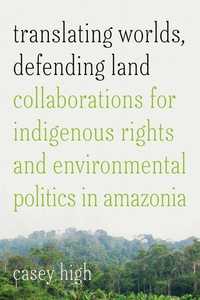
Translating Worlds, Defending Land
Collaborations for Indigenous Rights and Environmental Politics in Amazonia
Published on 18. February 2025
Book
Hardback
224 pages
978-1-5036-4048-1 (ISBN)
Description
In 2019, after decades of ecological damage from oil, Waorani people took to the streets of Amazonian Ecuador to protest drilling on their ancestral lands. Working with international activists, lawyers, and other Indigenous groups, they successfully sued the government for selling oil concessions without prior consent. Placing their struggle for territorial autonomy in the global spotlight, this unprecedented legal victory for environmental rights by an Indigenous people reflected the new forms of collaboration emerging in contemporary Amazonia. Translating Worlds, Defending Land explores how Waorani collaborations, whether with environmentalists or academic researchers, bring about new possibilities, challenges, and imaginative horizons.
Based on fieldwork over a period of twenty-five years, Casey High interrogates what these engagements mean for Indigenous communities and how they offer critical reflection on collaboration as a concept, method, and practice. The alliances, misunderstandings, and conflicts that emerge in these contexts challenge the assumption that productive collaborations reflect-or require-shared purposes, generating important implications for an engaged anthropology open to reconsidering what constitutes ethnographic knowledge and who it is for. As some young Waorani adults become not just community leaders or environmental citizens, but also skilled researchers and ethnographers, translating between Indigenous understandings of land and the Western language conservation, they create a powerful new voice in international environmental politics.
Based on fieldwork over a period of twenty-five years, Casey High interrogates what these engagements mean for Indigenous communities and how they offer critical reflection on collaboration as a concept, method, and practice. The alliances, misunderstandings, and conflicts that emerge in these contexts challenge the assumption that productive collaborations reflect-or require-shared purposes, generating important implications for an engaged anthropology open to reconsidering what constitutes ethnographic knowledge and who it is for. As some young Waorani adults become not just community leaders or environmental citizens, but also skilled researchers and ethnographers, translating between Indigenous understandings of land and the Western language conservation, they create a powerful new voice in international environmental politics.
Reviews / Votes
"Casey High offers us a brilliant ethnography in the form of fluid and intimate writing, which makes the book a page turner. What we see in these pages is the inauguration of a new line of anthropological reflection, in which collaboration between anthropologists and Indigenous people ceases to be a simple method and becomes the very object of analysis."-Aparecida Vilaca, Museu Nacional, Universidade Federal do Rio de Janeiro "In this thought-provoking meditation on the dynamics of collaboration, Casey High explores what it means for anthropology and anthropologists when our epistemic partners start doing ethnography their own way, for their own ends."
-Stuart Kirsch, University of Michigan "Narrating in Waorani lands (that are also Ecuadorian), this strong and delicate ethnography also narrates us. Relentlessly written from a 'complex we' the stories it tells make it clear that 'we' have interlocutors and are interlocutors and that therefore, 'we' tell stories about 'them' that are also about 'us'... ethnographic relations as moebius strip!"
-Marisol de la Cadena, University of California, Davis
More details
Edition
New edition
Language
English
Place of publication
Palo Alto
United States
Target group
Professional and scholarly
Edition type
New edition
Product notice
Cloth
Illustrations
15 halftones, 1 map
Dimensions
Height: 229 mm
Width: 152 mm
Thickness: 20 mm
Weight
494 gr
ISBN-13
978-1-5036-4048-1 (9781503640481)
Copyright in bibliographic data and cover images is held by Nielsen Book Services Limited or by the publishers or by their respective licensors: all rights reserved.
Schweitzer Classification
Other editions
Additional editions

Casey High
Translating Worlds, Defending Land
Collaborations for Indigenous Rights and Environmental Politics in Amazonia
E-Book
02/2025
Stanford University Press
€50.99
Available for download
Person
Casey High is Senior Lecturer in Social Anthropology at the University of Edinburgh. He is the author of Victims and Warriors: Violence, History and Memory in Amazonia (2015).
Content
List of Maps and Illustrations
Acknowledgments
A Note on Orthography
Introduction: Sharing Uncommon Ground
1. Collaborations in an Amazonian Contemporary
2. Speaking Differently
3. Translating Environmental Politics
4. COP26 and the Limits of Collaboration
5. How Anthropologists Lie
Conclusion: Unfinished Business
Between Hope and Apocalypse: An Epilogue
Notes
Bibliography
Index
Acknowledgments
A Note on Orthography
Introduction: Sharing Uncommon Ground
1. Collaborations in an Amazonian Contemporary
2. Speaking Differently
3. Translating Environmental Politics
4. COP26 and the Limits of Collaboration
5. How Anthropologists Lie
Conclusion: Unfinished Business
Between Hope and Apocalypse: An Epilogue
Notes
Bibliography
Index