

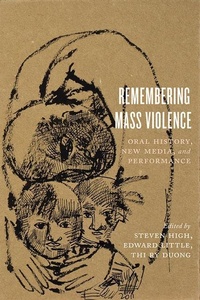
Remembering Mass Violence
Oral History, New Media and Performance
Published on 16. January 2014
Book
Hardback
376 pages
978-1-4426-4680-3 (ISBN)
Description
Remembering Mass Violence breaks new ground in oral history, new media, and performance studies by exploring what is at stake when we attempt to represent war, genocide, and other violations of human rights in a variety of creative works. A model of community-university collaboration, it includes contributions from scholars in a wide range of disciplines, survivors of mass violence, and performers and artists who have created works based on these events. This anthology is global in focus, with essays on Africa, Asia, Europe, Latin America, and North America. At its core is a productive tension between public and private memory, a dialogue between autobiography and biography, and between individual experience and societal transformation. Remembering Mass Violence will appeal to oral historians, digital practitioners and performance-based artists around the world, as well researchers and activists involved in human rights research, migration studies, and genocide studies.
More details
Language
English
Place of publication
Toronto
Canada
Target group
Professional and scholarly
College/higher education
Product notice
sewn/stitched
Cloth over boards
With dust jacket
Illustrations
19 Illustrations
Dimensions
Height: 231 mm
Width: 150 mm
Thickness: 28 mm
Weight
680 gr
ISBN-13
978-1-4426-4680-3 (9781442646803)
Copyright in bibliographic data and cover images is held by Nielsen Book Services Limited or by the publishers or by their respective licensors: all rights reserved.
Schweitzer Classification
Persons
Steven High is Canada Research Chair in Oral History, co-director of the Centre for Oral History and Digital Storytelling, and a professor in the Department of History at Concordia University. Edward Little is a professor in the Department of Theatre at Concordia University. Thi Ry Duong is the coordinator of the Cambodian Working Group with the Montreal Life Stories Project.
Content
INTRODUCTION. Edward Little (Concordia University, Theatre) and Steven High (Concordia University, History) I Turning Private History into Public Knowledge Chapter 1. Voices, Places and Spaces. Henry Greenspan (University of Michigan, Social Psychology and Social Ethics) Chapter 2. So Far from Home. Lorne Shirinian (Royal Military College of Canada, Professor Emeritus of Comparative Literature) II Performing Human Rights Chapter 3. Soldiers' Tales Untold: Trauma, Narrative and Remembering through Performance. Michael Kilburn (Endicott College, Political Science) Chapter 4. Lamentations: A Gestural Theatre in the Realm of Shadows. Sandeep Bhagwati (Concordia University, Theatre and Music) Chapter 5. Turning Together: Playback Theatre, Oral History, and Arts-Based Research in the Montreal Life Stories Project. Nisha Sajnani (New York University, Drama Therapy), Alan Wong (Concordia University, Special Individualized Program), Warren Linds (Concordia University, Applied Human Sciences), Lisa Ndejuru (Concordia University, Special Individualized Program) Chapter 6. Stories Scorched From the Desert Sun: Performing Testimony, Narrating Process. Hourig Attarian (Concordia University, Centre for Oral History and Digital Storytelling) and Rachael Van Fossen (Concordia University, Theatre) III Oral History and Digital Media Chapter 7. Oral History in the Age of Social Media Networks: Life Stories on CitizenShift and Parole Citoyenne. Reisa Levine (The Banff Centre, Arts) Chapter 8. Co-Creating Our Story: Making a Documentary Film. Noelia Gravotta (Life in the Open Prison) and Megan Webster (Life in the Open Prison) Chapter 9. Connecting the Dots: Memory, Multimedia and Community Information Integration in Northern Uganda. Jessica Anderson (George Washington University, Political Science) and Rachel Bergenfield (Yale University, International Relations) Chapter 10. Arrival Stories: Using Media to Create Connections in a Refugee Residence. Michele Luchs (Ministry of Education) and Liz Miller (Concordia University, Communications) IV Life Stories Chapter 11. "So you want to hear our ghetto stories?": Oral History at Ndinawe Youth Resource Centre. Robin Jarvis Brownlie (University of Manitoba, History) and Roewan Crowe (University of Winnipeg, Women's and Gender Studies) Chapter 12. Dishonour, Dispersion, and Dispossession: Race and Rights in 21st-Century North America-A View from the Lower Ninth Ward. D'Ann Penner (University of California at Berkeley, History) Chapter 13. The Romance of Reminiscence: Problems Posed in Life Histories with Activist Pensioners in Argentina. Lindsay DuBois (Dalhousie University, Sociology and Social Anthropology) Chapter 14. Memoires des Migrations de juifs marocains a Montreal. Yolande Cohen (Universite du Quebec a Montreal, History) V Rwanda in the Aftermath of Genocide Chapter 15. Viols des femmes Tutsi pendant le genocide: temoignage de Mme Athanasie. Athanasie Mukarwego (Village of Hope) Chapter 16. Les viols pendant le genocide des Tutsi: un crime d'envie. Emmanuel Habimana (The Children Who Lived), Carole Vacher (Montreal Life Stories), Berthe Kayitesi (University of Ottawa) and Callixte Kabayiza (Rwanda Working Group) Chapter 17. Hearing the Untold Story: Documenting LGBTI Lives in Rwanda. Valerie Love (Human Rights Collections at University of Connecticut Thomas J. Dodd Research Center) AFTERWORD. Thi Ry Duong (Montreal Life Stories)