

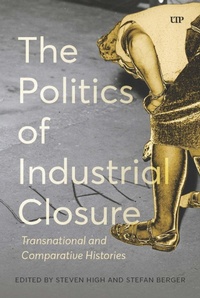
The Politics of Industrial Closure
Deindustrialization and the Politics of Our Time
Will be published approx. on 24. March 2026
Book
Paperback/Softback
420 pages
978-1-0498-0055-4 (ISBN)
Description
The Politics of Industrial Closure explores how the political consequences of neoliberal globalization have led to the decline of industrial regions across Western Europe and North America.
Co-editors and historians Steven High and Stefan Berger, and the team of contributors, depict that deindustrialization and its legacies have long-term impacts by diving into its ongoing manifestations and aftermaths. With collaboratively written chapters exploring Italy, France, Germany, the United Kingdom, the United States, and Canada, this volume examines the impacts of deindustrialization, demonstrating that it is an uneven geographical, spatial, and temporal process. This study transcends the local and regional investigations that often predominate deindustrialization studies, and the wider transnational and cross-national perspective of this work highlights the ways that geography matters in the deindustrialization process. This collection pursues diverse avenues of investigation into deindustrialization in hopes to understand the deep roots of recent, universal, and political phenomena.
The Politics of Industrial Closure considers deindustrialization as yet another form of dispossession within global capitalism and seeks to break out of a unitary understanding of the problem of deindustrialization.
Co-editors and historians Steven High and Stefan Berger, and the team of contributors, depict that deindustrialization and its legacies have long-term impacts by diving into its ongoing manifestations and aftermaths. With collaboratively written chapters exploring Italy, France, Germany, the United Kingdom, the United States, and Canada, this volume examines the impacts of deindustrialization, demonstrating that it is an uneven geographical, spatial, and temporal process. This study transcends the local and regional investigations that often predominate deindustrialization studies, and the wider transnational and cross-national perspective of this work highlights the ways that geography matters in the deindustrialization process. This collection pursues diverse avenues of investigation into deindustrialization in hopes to understand the deep roots of recent, universal, and political phenomena.
The Politics of Industrial Closure considers deindustrialization as yet another form of dispossession within global capitalism and seeks to break out of a unitary understanding of the problem of deindustrialization.
More details
Series
Language
English
Place of publication
Toronto
Canada
Target group
College/higher education
Professional and scholarly
Product notice
Paperback (trade)
Illustrations
60 illustrations
Dimensions
Height: 227 mm
Width: 148 mm
Thickness: 25 mm
Weight
626 gr
ISBN-13
978-1-0498-0055-4 (9781049800554)
Copyright in bibliographic data and cover images is held by Nielsen Book Services Limited or by the publishers or by their respective licensors: all rights reserved.
Schweitzer Classification
Persons
Steven High is professor of History at Concordia University and co-founder of the Centre for Oral History and Digital Storytelling.
Stefan Berger is a professor of social history and director of the Institute for Social Movements at Ruhr-Universitaet Bochum in Germany.
Stefan Berger is a professor of social history and director of the Institute for Social Movements at Ruhr-Universitaet Bochum in Germany.