

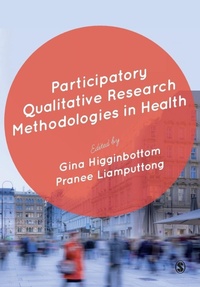
Participatory Qualitative Research Methodologies in Health
1st Edition
Published on 3. July 2015
Book
Paperback/Softback
264 pages
978-1-4462-5907-8 (ISBN)
Description
This guide to the essentials of doing participatory methods in a broad range of health contexts covers all of the stages of the research process, from research design right through to dissemination. With chapters from international contributors, each with many years' experience using participatory qualitative approaches, it provides guidance on.
- Ethical issues in Participatory Research
- Designing and conduction Participatory Research projects
- Data management and analysis
- Researching with different populations
- New technologies
Packed full of up to date and engaging case studies, Participatory Qualitative Research Methodologies in Health offers a wide range of perspectives and voices on the practicalities and theoretical issues involved in conducting participatory research today. It is the ideal resource for students and researchers embarking upon a participatory research project.
- Ethical issues in Participatory Research
- Designing and conduction Participatory Research projects
- Data management and analysis
- Researching with different populations
- New technologies
Packed full of up to date and engaging case studies, Participatory Qualitative Research Methodologies in Health offers a wide range of perspectives and voices on the practicalities and theoretical issues involved in conducting participatory research today. It is the ideal resource for students and researchers embarking upon a participatory research project.
Reviews / Votes
With this delightful collection, Higginbottom and Liamputtong advance the art and science of collaborative community based action research. The wisdom in these pages derives from a deeply ethical commitment to social justice grounded in solidly informed and creative methodological technique. -- Sally Thorne Involving people and communities in research has never been as important or as challenging. This accessible and comprehensive step-by-step guide provides vital clarity and essential help to researchers across disciplines, methods and cultures. -- Alexander Clark This book offers an excellent introduction to participatory research. It guides the reader full circle from the historical roots to the implementation of findings. It covers project planning and organization, a detailed discussion of ethical issues, and issues around methods of data collection, data management and analysis. This is complemented by chapters on special topics like working with elderly, children and youth or ethno-cultural groups and the implementation of new technologies. I recommend the book for both the use in the classroom as well as for researchers who are interested in conducting participatory community research. -- Dr. Susanne Friese Engaging individuals, families and communities in the development of programs and services is increasingly important in our culturally diverse and pluralistic global community. This text provides crucial information for individuals hoping to make a difference and increase access to health care, particularly for marginalized and vulnerable populations. -- Patricia Davidson The book has a clear and understandable style: each chapter follows a set format, setting out aims, objectives, practical tips and recommendations. Short vignettes bring the text alive, with extensive bibliographies accompanying each chapter. -- Rosemary LamportMore details
Language
English
Place of publication
London
United Kingdom
Target group
College/higher education
Professional and scholarly
Dimensions
Height: 244 mm
Width: 170 mm
Thickness: 15 mm
Weight
462 gr
ISBN-13
978-1-4462-5907-8 (9781446259078)
Copyright in bibliographic data and cover images is held by Nielsen Book Services Limited or by the publishers or by their respective licensors: all rights reserved.
Schweitzer Classification
Other editions
Additional editions
Gina Higginbottom | Pranee Liamputtong
Participatory Qualitative Research Methodologies in Health
Book
07/2015
1st Edition
SAGE Publications Ltd
€164.40
Shipment within 15-20 days
Gina Higginbottom | Pranee Liamputtong
Participatory Qualitative Research Methodologies in Health
E-Book
06/2015
1st Edition
SAGE Publications Ltd
€78.49
Available for download
Gina Higginbottom | Pranee Liamputtong
Participatory Qualitative Research Methodologies in Health
E-Book
06/2015
1st Edition
SAGE Publications Ltd
€78.49
Available for download
Persons
Gina Higginbottom holds a Tier II Canada Research Chair in Ethnicity and Health and is Professor in the Faculty of Nursing, at the University of Alberta. Gina's research portfolio focuses on ethnic minority populations and immigrant health using participatory models of research and ethnography. She has a particular focus on the broad issue of social exclusion and equity in health care, lay understandings of health and illness. A second theme in her research portfolio has focused on maternal health and well being including parenting issues, early parenthood and postnatal depression in different ethnic minority groups. Gina has been Principal Investigator on 17 nationally and internationally funded qualitative research studies, currently she holds three Canadian Institute for Health grants. Gina is Assistant Editor of Ethnicity and Health journal and co-chair of the IIQM's 2013 Thinking Qualitative Conference 2013 and an Affiliate Scholar of IIQM as well as an advisory board member of IIQM. Gina is an experienced educator with a professional teaching qualification who has facilitated many undergraduate, graduate and doctoral programs in the UK and Canada.
Pranee is a medical anthropologist whose research focuses on the health and well-being of women, children, immigrants, refugees, the elderly, ethnic minorities, and transgender individuals. Her work is particularly dedicated to maternal and neonatal health, sexual and reproductive health, gender and sexual well-being, psychological health, and chronic illnesses influenced by climate change. Her recent studies have examined gender and sexual health concerns among Asian women, refugee and immigrant women, youth, and transgender women from ethnic minority backgrounds. In Vietnam, she has investigated the effects of air pollution on maternal and neonatal health. Additionally, her research explores the health and overall well-being of ethnic minority women. As a leading social science researcher, Pranee has authored numerous books on qualitative research methodologies and various social and health-related topics. These works are widely recognized and used in both Australia and internationally. At VinUniversity, she has contributed to both medical and nursing degree programs. She has also mentored numerous undergraduate students, guiding them through research projects as part of their studies and career development. Currently, Pranee serves as Professor of Social Science in the College of Arts and Sciences and as the Leader of the Living Lab pillar at the Center for Environmental Intelligence.
Pranee is a medical anthropologist whose research focuses on the health and well-being of women, children, immigrants, refugees, the elderly, ethnic minorities, and transgender individuals. Her work is particularly dedicated to maternal and neonatal health, sexual and reproductive health, gender and sexual well-being, psychological health, and chronic illnesses influenced by climate change. Her recent studies have examined gender and sexual health concerns among Asian women, refugee and immigrant women, youth, and transgender women from ethnic minority backgrounds. In Vietnam, she has investigated the effects of air pollution on maternal and neonatal health. Additionally, her research explores the health and overall well-being of ethnic minority women. As a leading social science researcher, Pranee has authored numerous books on qualitative research methodologies and various social and health-related topics. These works are widely recognized and used in both Australia and internationally. At VinUniversity, she has contributed to both medical and nursing degree programs. She has also mentored numerous undergraduate students, guiding them through research projects as part of their studies and career development. Currently, Pranee serves as Professor of Social Science in the College of Arts and Sciences and as the Leader of the Living Lab pillar at the Center for Environmental Intelligence.
Content
Chapter 1: What is Participatory Research? Why do it? - Gina Higginbottom and Pranee Liamputtong
Chapter 2: Addressing Ethical Issues in PR: The Primacy of Relationship - Wendy Austin
Chapter 3: Designing Participatory Research Projects - Helen Vallianatos, Emina Hadziabdic and Gina Higginbottom
Chapter 4: Data Management, Analysis and Interpretation - Gina Higginbottom
Chapter 5: Drawing Conclusions from Your Research - Gina Higginbottom and Sophie Yohani
Chapter 6: Engaging Older People in Participatory Research - Pranee Liamputtong and Gina Higginbottom
Chapter 7: Involving Children and Youth in Participatory Research - Diane Conrad, Bryan Hogeveen, Joanne Minaker, Mildred Masimira and Daena Crosby
Chapter 8: Conceptualising Inclusive Research - A Participatory Research Approach with People with Intellectual Disability: Paradigm or Method? - Christine Bigby and Patsie Frawley
Chapter 9: Diverse Ethno-cultural Groups and the Use of Participatory Research - Gina Higginbottom and Pranee Liamputtong
Chapter 10: The Relationship Between Engaged Scholarship, Knowledge Translation, and Participatory Research - Sarah Bowen
Chapter 11: Community-University Partnerships: A Case Study - Sherry Ann Chapman
Chapter 12: Information and Communications Technologies and the Potentials for Participatory Research - Chris Atchison
Chapter 2: Addressing Ethical Issues in PR: The Primacy of Relationship - Wendy Austin
Chapter 3: Designing Participatory Research Projects - Helen Vallianatos, Emina Hadziabdic and Gina Higginbottom
Chapter 4: Data Management, Analysis and Interpretation - Gina Higginbottom
Chapter 5: Drawing Conclusions from Your Research - Gina Higginbottom and Sophie Yohani
Chapter 6: Engaging Older People in Participatory Research - Pranee Liamputtong and Gina Higginbottom
Chapter 7: Involving Children and Youth in Participatory Research - Diane Conrad, Bryan Hogeveen, Joanne Minaker, Mildred Masimira and Daena Crosby
Chapter 8: Conceptualising Inclusive Research - A Participatory Research Approach with People with Intellectual Disability: Paradigm or Method? - Christine Bigby and Patsie Frawley
Chapter 9: Diverse Ethno-cultural Groups and the Use of Participatory Research - Gina Higginbottom and Pranee Liamputtong
Chapter 10: The Relationship Between Engaged Scholarship, Knowledge Translation, and Participatory Research - Sarah Bowen
Chapter 11: Community-University Partnerships: A Case Study - Sherry Ann Chapman
Chapter 12: Information and Communications Technologies and the Potentials for Participatory Research - Chris Atchison