

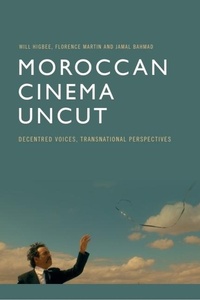
Moroccan Cinema Uncut
Decentred Voices, Transnational Perspectives
Published on 30. May 2022
Book
Paperback/Softback
288 pages
978-1-4744-7794-9 (ISBN)
Description
Moroccan film production has increased rapidly since the late 2000s, and Morocco is a thriving service production hub for international film and television. Taking a transnational approach to Moroccan cinema, this book examines diversity in its production models, its barriers to international distribution and success, its key markets and audiences, as well as the consequences of digital disruption upon it.
Reviews / Votes
Moroccan Cinema Uncut is a substantial contribution and a timely publication for those who want to fully understand the implicit and explicit dynamics of filmmaking in the country. It opens up new theoretical ways of reading Moroccan films and of thinking transnationally about them. In short, this is a well-researched/documented book, enriched more by various case studies and interviews with key figures, which will be of great interest to anyone working on or teaching film, media and gender studies in the kingdom. It offers the reader fascinating insights into the changing patterns of Moroccan cinema and society alike. -- Said Chemlal, Sidi Mohamed Ben Abdellah University * Journal of African Cinemas * This collective work reflects the maturity provided by years of experience and knowledge of Moroccan cinema by the three authors, as shown by their numerous respective specialised publications. [...] This is a necessary and honest book, which will be of interest not only in the academic world but also to the professional world of filmmaking. -- Lidia Peralta Garcia, Universidad Castilla-La Mancha * The Journal of North African Studies, 2021 * This collective work reflects the maturity provided by years of experience and knowledge of Moroccan cinema by the three authors, as shown by their numerous respective specialised publications. [...] This is a necessary and honest book, which will be of interest not only in the academic world but also to the professional world of filmmaking. -- Lidia Peralta Garcia, Universidad Castilla-La Mancha * The Journal of North African Studies, 2021 * A collaborative tour de force, Transnational Moroccan Cinema Uncut explores the conditions-including festivals, film labs, production hubs, and diasporic flows of capital and talent-that have allowed Morocco to emerge, during thesince the 1990s, as one of Africa's most significant producers of theatrically -released features. Compelling from beginning to end, Transnational Moroccan Cinema Uncut shows us the value, not only of the Moroccan cinema in question, but of an analytic framework focusing on transnationality. With their generous, inventive, precise, and always well-grounded theoretical explorations, Jamal Bahmad, Will Higbee, and Flo Martin help to transform transnational cinema studies into a truly mature, and no longer merely emerging, field of study. -- Mette Hjort, Dean of Arts, Hong Kong Baptist UniversityMore details
Language
English
Place of publication
Edinburgh
United Kingdom
Target group
Professional and scholarly
Product notice
Paperback (trade)
Unsewn / adhesive bound
Illustrations
21 black and white illustrations
Dimensions
Height: 234 mm
Width: 156 mm
Thickness: 15 mm
Weight
408 gr
ISBN-13
978-1-4744-7794-9 (9781474477949)
Copyright in bibliographic data and cover images is held by Nielsen Book Services Limited or by the publishers or by their respective licensors: all rights reserved.
Schweitzer Classification
Persons
Will Higbee is a Professor of Film Studies at the University of Exeter. He has published widely on cinemas of the Maghreb and their diasporas, as well as questions of national and transnational cinema. He is the author of Post-Beur Cinema (2013) and co-editor of De-Westernizing Film Studies (2012). Florence Martin is the Van Meter Professor of French Transnational Studies at Goucher College (US). She has published internationally on Maghrebi cinema and women's cinema. Her international publications on Maghrebi and women's cinema include Screens and Veils: Maghrebi Women's Cinema (IUP, 2011) and her co-edition of Les Cinemas du Maghreb et leurs publics (Africultures, 2013). Dr Jamal Bahmad is Lecturer in the English Department at Mohammed V University at Agdal, Morocco.
Content
Table of Contents
Acknowledgements
Introduction
Moroccan Cinema: A Story of Transnational Adaptation
Part I - Production From Above: Formal Networks
Chapter 1: Established Sites of Production At Home
1.1: Rabat and The CCM: The Institutional Centre
1.2: Ouarzazate: The Cinematic City
1.3: Tangier: The Artisanal Hub
1.4: Casablanca: The Industrial and Media Hub
Chapter 2: Transnational Crossings
2.1: The Politics of International Co-Production
2.2: The Rooted Transnationalism of Diasporic Filmmakers
2.3: Non-Western Production Networks
2.4: Co-Production Networks Between North Africa and Sub-Saharan Africa
Part II - Production From Below: Emerging Sites
Chapter 3: Alternative and Emerging Networks
3.1: Film Schools, Education and Training
3.2: Alternative Training Networks: Sahara Lab
3.3: Playing Around the System: Hicham Laari
3.4: Guerilla Filmmaking and Political Activism: Nadir Bouhmouch
Chapter 4: Diverse Voices
4.1: Amazigh Cinema: The Global Flow of Local Images
4.2: Transnational Contestations: Tala Hadid and Jawad Rhalib
4.3: Women's Cinema, Take One: Negotiating With the Establishment
4.4: Women's Cinema, Take Two: Circumventing the Establishment
Part III - Distribution Networks: Festivals Audiences and Markets
Chapter 5: Distribution and Exhibition Networks In Morocco
5.1: Festivals in the Kingdom
5.2: Piracy and the Crisis of Moroccan Distribution
5.3: Exhibition - The Trouble with Movie Theatres
5.4: Pan-Arab Transnational Exhibition: The Cinematheque de Tanger
Chapter 6: The Transnational Moroccan Festival Network
6.1: The Transnational Festival Network
6.2: Europe: A-List Festivals, Markets and Film Funds
6.3: International Festivals Beyond Europe: the Gulf and Africa
6.4: Niche Festivals in Europe and Northern America
Chapter 7: Sales, Distribution and Digital Disruption - the Unrealised Transnational Reach of Moroccan Cinema?
7.1: Sales and Distribution Outside of Morocco
7.2: Selling Moroccan Cinema to a European Audience: Much Loved
7.3 Brave New World Or The Same Old Problems? Moroccan Cinema, Online Distribution and Digital Disruption
Conclusion
Transnational Moroccan Cinema: Of Bumblebees And Butterflies
References
Bibliography
Filmography.
Acknowledgements
Introduction
Moroccan Cinema: A Story of Transnational Adaptation
Part I - Production From Above: Formal Networks
Chapter 1: Established Sites of Production At Home
1.1: Rabat and The CCM: The Institutional Centre
1.2: Ouarzazate: The Cinematic City
1.3: Tangier: The Artisanal Hub
1.4: Casablanca: The Industrial and Media Hub
Chapter 2: Transnational Crossings
2.1: The Politics of International Co-Production
2.2: The Rooted Transnationalism of Diasporic Filmmakers
2.3: Non-Western Production Networks
2.4: Co-Production Networks Between North Africa and Sub-Saharan Africa
Part II - Production From Below: Emerging Sites
Chapter 3: Alternative and Emerging Networks
3.1: Film Schools, Education and Training
3.2: Alternative Training Networks: Sahara Lab
3.3: Playing Around the System: Hicham Laari
3.4: Guerilla Filmmaking and Political Activism: Nadir Bouhmouch
Chapter 4: Diverse Voices
4.1: Amazigh Cinema: The Global Flow of Local Images
4.2: Transnational Contestations: Tala Hadid and Jawad Rhalib
4.3: Women's Cinema, Take One: Negotiating With the Establishment
4.4: Women's Cinema, Take Two: Circumventing the Establishment
Part III - Distribution Networks: Festivals Audiences and Markets
Chapter 5: Distribution and Exhibition Networks In Morocco
5.1: Festivals in the Kingdom
5.2: Piracy and the Crisis of Moroccan Distribution
5.3: Exhibition - The Trouble with Movie Theatres
5.4: Pan-Arab Transnational Exhibition: The Cinematheque de Tanger
Chapter 6: The Transnational Moroccan Festival Network
6.1: The Transnational Festival Network
6.2: Europe: A-List Festivals, Markets and Film Funds
6.3: International Festivals Beyond Europe: the Gulf and Africa
6.4: Niche Festivals in Europe and Northern America
Chapter 7: Sales, Distribution and Digital Disruption - the Unrealised Transnational Reach of Moroccan Cinema?
7.1: Sales and Distribution Outside of Morocco
7.2: Selling Moroccan Cinema to a European Audience: Much Loved
7.3 Brave New World Or The Same Old Problems? Moroccan Cinema, Online Distribution and Digital Disruption
Conclusion
Transnational Moroccan Cinema: Of Bumblebees And Butterflies
References
Bibliography
Filmography.