

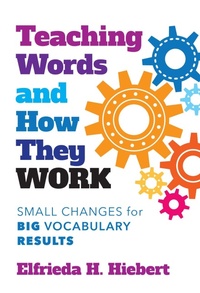
Teaching Words and How They Work
Small Changes for Big Vocabulary Results
Published on 6. December 2019
Book
Paperback/Softback
168 pages
978-0-8077-6317-9 (ISBN)
Description
Research shows that vocabulary is the best support for students' comprehension of narrative and information texts. Often, vocabulary instruction focuses on a few target words in specific texts. However, to understand the many new words in complex texts students need to know how words work. This book, written by an award-winning authority on reading instruction, shows teachers how to make small changes to teach more words and also how words work. Many of these small changes involve enrichments to existing vocabulary practices, such as word walls and conversations with students. Each chapter includes descriptions of teachers' implementation of small changes to support big gains in students' vocabulary. This book, which has sufficient depth in research and theory for graduate and undergraduate courses in vocabulary instruction, also offers practical steps that K-8 teachers can use in any reading program to help all students grow their vocabulary.
Teaching Words and How They Work shows teachers how to:
Identify the most important word families to teach.
Teach students to use opening text as background knowledge for comprehending the rest of the text.
Use word walls with more purpose and greater student engagement.
Select the right words to teach from new information texts.
Better understand limitations of leveled texts and how to adjust.
Use assets and address challenges to support English learners.
Access free mentor and teacher resources online at textproject.org.
Teaching Words and How They Work shows teachers how to:
Identify the most important word families to teach.
Teach students to use opening text as background knowledge for comprehending the rest of the text.
Use word walls with more purpose and greater student engagement.
Select the right words to teach from new information texts.
Better understand limitations of leveled texts and how to adjust.
Use assets and address challenges to support English learners.
Access free mentor and teacher resources online at textproject.org.
More details
Language
English
Place of publication
New York
United States
Target group
Professional and scholarly
Product notice
Paperback (trade)
Unsewn / adhesive bound
Dimensions
Height: 226 mm
Width: 155 mm
Thickness: 8 mm
Weight
227 gr
ISBN-13
978-0-8077-6317-9 (9780807763179)
Copyright in bibliographic data and cover images is held by Nielsen Book Services Limited or by the publishers or by their respective licensors: all rights reserved.
Schweitzer Classification
Person
Elfrieda H. Hiebert is president and CEO of TextProject, Inc., recipient of Literacy Research Association's Oscar S. Causey Award for outstanding contributions to reading research, and coauthor (with P. David Pearson) of Research-Based Practices for Teaching Common Core Literacy.
Content
Contents
Preface?ix
1.?Learning Words and How Words Work?1
Vocabulary and Texts: A Two-Way Relationship?2
Vocabulary Instruction: A Focus on Relationships Among Words, ??Not Individual Words?4
How to Implement New Vocabulary Insights: ?Small Changes = Big Results?8
The Last Word?10
2.?Making Small Changes in Vocabulary Instruction?11
Small Changes = Big Results: WHY?12
Small Changes = Big Results: WHAT?13
Small Changes = Big Results: HOW?15
The Last Word?20
3.?Why a Small Group of Word Families Is So Important ?25
The Evidence?25
Small Changes = Big Results?35
The Last Word?38
4.?A Short History of English and Why It Matters?41
The Evidence?42
Small Changes = Big Results?49
The Last Word?53
5.?Recycling and Remixing: ??Multiple Meanings and Uses of Words?54
The Evidence?56
Small Changes = Big Results?61
The Last Word?64
6.?The Vocabulary Networks of Narrative Texts?66
The Evidence?67
Small Changes = Big Results?77
The Last Word?80
7.?The Vocabulary Networks of Informational Texts?82
The Evidence?83
Small Changes = Big Results?91
The Last Word?94
8.?Vocabulary and Text Complexity Systems?98
The Evidence?99
Small Changes = Big Results?107
The Last Word?111
9.?Different Labels But the Same Concepts: English Learners?113
The Evidence?114
Small Changes = Big Results?119
The Last Word?123
Children's Literature and Instructional Texts?125
References?131
Index?139
About the Author?154
Preface?ix
1.?Learning Words and How Words Work?1
Vocabulary and Texts: A Two-Way Relationship?2
Vocabulary Instruction: A Focus on Relationships Among Words, ??Not Individual Words?4
How to Implement New Vocabulary Insights: ?Small Changes = Big Results?8
The Last Word?10
2.?Making Small Changes in Vocabulary Instruction?11
Small Changes = Big Results: WHY?12
Small Changes = Big Results: WHAT?13
Small Changes = Big Results: HOW?15
The Last Word?20
3.?Why a Small Group of Word Families Is So Important ?25
The Evidence?25
Small Changes = Big Results?35
The Last Word?38
4.?A Short History of English and Why It Matters?41
The Evidence?42
Small Changes = Big Results?49
The Last Word?53
5.?Recycling and Remixing: ??Multiple Meanings and Uses of Words?54
The Evidence?56
Small Changes = Big Results?61
The Last Word?64
6.?The Vocabulary Networks of Narrative Texts?66
The Evidence?67
Small Changes = Big Results?77
The Last Word?80
7.?The Vocabulary Networks of Informational Texts?82
The Evidence?83
Small Changes = Big Results?91
The Last Word?94
8.?Vocabulary and Text Complexity Systems?98
The Evidence?99
Small Changes = Big Results?107
The Last Word?111
9.?Different Labels But the Same Concepts: English Learners?113
The Evidence?114
Small Changes = Big Results?119
The Last Word?123
Children's Literature and Instructional Texts?125
References?131
Index?139
About the Author?154