

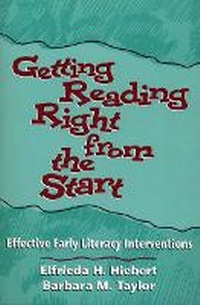
Getting Reading Right from the Start
Effective Early Literacy Interventions
Published on 1. January 1994
Book
Paperback/Softback
250 pages
978-0-205-15407-4 (ISBN)
Description
Describes seven literacy intervention programmes used by leading experts to prevent early reading failure in the primary years. These programmes focus on story book reading and writing, with attention to word-level strategies. They are developmental, not remedial, in nature.
More details
Language
English
Place of publication
United States
Publishing group
Pearson Education (US)
Target group
Professional and scholarly
Dimensions
Height: 228 mm
Width: 154 mm
Thickness: 16 mm
Weight
400 gr
ISBN-13
978-0-205-15407-4 (9780205154074)
Copyright in bibliographic data and cover images is held by Nielsen Book Services Limited or by the publishers or by their respective licensors: all rights reserved.
Schweitzer Classification
Content
I. The Context for Current Interventions.
1. Early Literacy Interventions: Aims and Issues, Barbara M. Taylor & Elfrieda H. Hiebert.
2. Compensatory and Special Education: Is There Accountability for Learning and Belief in Children's Potential?, Anne McGill-Franzen, SUNY - Albany.
II. Tutoring and Small Group Interventions.
3. At-Risk University Students Tutoring At-Risk Elementary School Children: What Factors Make it Effective?, Connie Juel, University of Virginia.
4. Implementation of Reading Recovery in the New York Area, Trika Smith-Burke & Angela M. Jaggar, New York University.
5. A Small Group Literacy Intervention With Chapter 1 Students, Elfrieda H. Hiebert.
6. Early Intervention in Reading: Supple- mental Instruction for Groups of Low-Achieving Students Provided by First-Grade Teachers, Barbara Taylor, Jean Strait & Mary Anne Medo, University of Minnesota.
III. Extending Interventions Across Schools.
7. Success for All: Policy Implications for Getting Reading Right the First Time, Robert E. Slavin, Nancy A. Madden, Nancy L. Karweit, Lawrence J. Dolan & Barbara A. Wasik, Center for Research on Effective Schooling for Disadvantaged Students, Johns Hopkins University.
8. Interactive Writing: A Transition Tool for Assisting Children in Learning to Write and Read, Gay Su Pinnell & Andrea McCarrier, The Ohio State University.
9. Promoting Early Literacy Development Among Spanish-Speaking Children: Lessons From Two Studies. Claude Goldenberg, University of California at Los Angeles.
10. Interventions and the Restructuring of American Literacy Instruction, Elfrieda H. Hiebert & Barbara M. Taylor.
1. Early Literacy Interventions: Aims and Issues, Barbara M. Taylor & Elfrieda H. Hiebert.
2. Compensatory and Special Education: Is There Accountability for Learning and Belief in Children's Potential?, Anne McGill-Franzen, SUNY - Albany.
II. Tutoring and Small Group Interventions.
3. At-Risk University Students Tutoring At-Risk Elementary School Children: What Factors Make it Effective?, Connie Juel, University of Virginia.
4. Implementation of Reading Recovery in the New York Area, Trika Smith-Burke & Angela M. Jaggar, New York University.
5. A Small Group Literacy Intervention With Chapter 1 Students, Elfrieda H. Hiebert.
6. Early Intervention in Reading: Supple- mental Instruction for Groups of Low-Achieving Students Provided by First-Grade Teachers, Barbara Taylor, Jean Strait & Mary Anne Medo, University of Minnesota.
III. Extending Interventions Across Schools.
7. Success for All: Policy Implications for Getting Reading Right the First Time, Robert E. Slavin, Nancy A. Madden, Nancy L. Karweit, Lawrence J. Dolan & Barbara A. Wasik, Center for Research on Effective Schooling for Disadvantaged Students, Johns Hopkins University.
8. Interactive Writing: A Transition Tool for Assisting Children in Learning to Write and Read, Gay Su Pinnell & Andrea McCarrier, The Ohio State University.
9. Promoting Early Literacy Development Among Spanish-Speaking Children: Lessons From Two Studies. Claude Goldenberg, University of California at Los Angeles.
10. Interventions and the Restructuring of American Literacy Instruction, Elfrieda H. Hiebert & Barbara M. Taylor.