

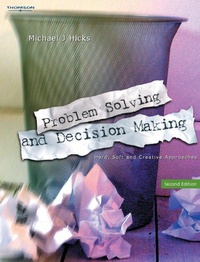
Problem Solving and Decision Making
Hard, Soft and Creative Approaches
2nd Edition
Published on 1. April 2004
Book
Paperback/Softback
320 pages
978-1-86152-617-5 (ISBN)
Description
Change and uncertainty have become an inevitable part of life, the world is more turbulent than it used to be, and is susceptible to rapid and often unpredictable change, creating the need for more creative problem solving than ever in order to survive in these conditions.
In this new edition Mick Hicks addresses the need for a new range of problem solving and decision making strategies for dealing with the problems of the modern business environment. He identifies that there is no one problem solving process or technique that is universally applicable to all the types of problem situation, and presents the processes which have had the most impact on improving our problem solving abilities, provides detailed background information about them (including illustrative case studies) to give a practical guide for their use and shows how the different approaches complement each other, thus providing a complete problem solving system to tackle almost all types of problem situation.
In this new edition Mick Hicks addresses the need for a new range of problem solving and decision making strategies for dealing with the problems of the modern business environment. He identifies that there is no one problem solving process or technique that is universally applicable to all the types of problem situation, and presents the processes which have had the most impact on improving our problem solving abilities, provides detailed background information about them (including illustrative case studies) to give a practical guide for their use and shows how the different approaches complement each other, thus providing a complete problem solving system to tackle almost all types of problem situation.
Reviews / Votes
Chapter 1: What constitutes a problem Chapter 2: How to go about tackling a problem Chapter 3: Creative abilities Chapter 4: Before problem solving Chapter 5: Data gathering Chapter 6: Problem identification Chapter 7: Ideation Chapter 8: Problem resolution Chapter 9: Solution implementation and change management Chapter 10: The Creative Problem Solving Process (Synectics) Chapter 11: Soft Systems Approach (SSM) Chapter 12: Integration of Synectics and SSM Chapter 13: The dynamics of group problem solving Chapter 14: Creativity and related topics Chapter 15: Software and problem solving Chapter 16: Information Sources References IndexMore details
Edition
2nd edition
Language
English
Place of publication
London
United Kingdom
Target group
Professional and scholarly
Product notice
Paperback (trade)
Dimensions
Height: 244 mm
Width: 190 mm
Thickness: 29 mm
Weight
856 gr
ISBN-13
978-1-86152-617-5 (9781861526175)
Copyright in bibliographic data and cover images is held by Nielsen Book Services Limited or by the publishers or by their respective licensors: all rights reserved.
Schweitzer Classification
Other editions
Previous edition
Book
01/1991
Cengage Learning EMEA
€53.49
Shipment within 10-20 days
Person
Content
1. What constitutes a problem.
2. How to go about tackling a problem.
3. Creative abilities.
4. Before problem solving.
5. Data gathering.
6. Problem identification.
7. Ideation.
8. Problem resolution.
9. Solution implementation and change management.
10. The Creative Problem Solving Process (Synectics).
11. Soft Systems Approach (SSM).
12. Integration of Synectics and SSM.
13. The dynamics of group problem solving.
14. Creativity and related topics.
15. Software and problem solving.
16. Information Sources.
References.
Index.
2. How to go about tackling a problem.
3. Creative abilities.
4. Before problem solving.
5. Data gathering.
6. Problem identification.
7. Ideation.
8. Problem resolution.
9. Solution implementation and change management.
10. The Creative Problem Solving Process (Synectics).
11. Soft Systems Approach (SSM).
12. Integration of Synectics and SSM.
13. The dynamics of group problem solving.
14. Creativity and related topics.
15. Software and problem solving.
16. Information Sources.
References.
Index.