

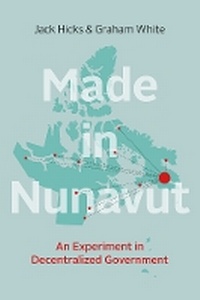
Made in Nunavut
An Experiment in Decentralized Government
Will be published approx. on 1. June 2016
Book
Paperback/Softback
392 pages
978-0-7748-3104-8 (ISBN)
Description
On April 1, 1999, after decades of dreams and negotiations and years of planning, the Inuit-dominated territory of Nunavut came into being in Canada's Eastern and Central Arctic. This was a momentous occasion, signifying not only the first change to the map of Canada in over half a century but also a remarkable achievement in terms of creating a new government from the ground up.
Made in Nunavut provides the first behind-the-scenes account of how the Government of Nunavut was designed and implemented. Written by leading authorities on governance in the Canadian Arctic, this book pays particular attention to the most distinctive and innovative organizational design feature of the new government - the decentralization of offices and functions that would normally be located in the capital to small communities spread out across the vast territory. It also critically assesses whether decentralization has delivered "better" government for the people of Nunavut.
Made in Nunavut provides the first behind-the-scenes account of how the Government of Nunavut was designed and implemented. Written by leading authorities on governance in the Canadian Arctic, this book pays particular attention to the most distinctive and innovative organizational design feature of the new government - the decentralization of offices and functions that would normally be located in the capital to small communities spread out across the vast territory. It also critically assesses whether decentralization has delivered "better" government for the people of Nunavut.
Reviews / Votes
Made in Nunavut fills an important gap. Up to now little has been written about the process through which the new territory was formed, in the period from 1993 to 1999, and on the extent to which the hopes and aspirations for that territory have been realized in the years following its establishment. This is the subject matter of Made in Nunavut, with a particular focus on the decentralization of certain functions of the Nunavut government to various communities across the territory. It is a work well suited to students of political science, public administration, and northern studies, primarily at the university level, but for some at a college level as well: it provides an enormous information base. It is written in a non-technical manner, and in this sense is also suited to the general reader. - Alastair Campbell (Arctic) Made in Nunavut is meticulous and beautifully researched. It recounts an experiment in governance in the strangest place on earth, a territory of 1.9 million square kilometres flung across three time zones ... Made in Nunavut is the definitive analysis of the nation's most ambitious trial in home rule.- Holly Doan (Blacklocks Reporter) With stories and details gathered together for the first time, Made in Nunavut ... provides a behind-the-scenes view, a critical evaluation and a solid historical account.
- Michele LeTourneau (Northern News Service)
More details
Language
English
Place of publication
Vancouver
Canada
Target group
Professional and scholarly
Product notice
Paperback (trade)
Dimensions
Height: 229 mm
Width: 152 mm
Weight
580 gr
ISBN-13
978-0-7748-3104-8 (9780774831048)
Copyright in bibliographic data and cover images is held by Nielsen Book Services Limited or by the publishers or by their respective licensors: all rights reserved.
Schweitzer Classification
Persons
Jack Hicks is a social research consultant and a university and college lecturer. He has worked in a range of senior positions in Nunavut, and has written and presented widely about public policies across the circumpolar Arctic (especially Greenland and Nunavut). His primary research interests are the social determinants of mental health and suicide behaviour among Indigenous children and youth, the negotiation and implementation of Indigenous rights agreements, the political economy of the governments and other institutions arising from such agreements, and the comparative analysis of the political economy of non-renewable resource development across the circumpolar Arctic.
Graham White is a professor emeritus in the Department of Political Science at the University of Toronto. He has written widely on Canadian politics, mostly about governmental institutions such as legislatures and cabinets at the provincial/territorial level. He has been writing about the politics of the Canadian Arctic since the late 1980s. He is the author or editor of a dozen books, including Cycling into Saigon: The Conservative Transition in Ontario (co-authored with David R. Cameron) and Cabinets and First Ministers. He is a former president of the Canadian Political Science Association and is currently English co-editor of the Canadian Journal of Political Science.
Graham White is a professor emeritus in the Department of Political Science at the University of Toronto. He has written widely on Canadian politics, mostly about governmental institutions such as legislatures and cabinets at the provincial/territorial level. He has been writing about the politics of the Canadian Arctic since the late 1980s. He is the author or editor of a dozen books, including Cycling into Saigon: The Conservative Transition in Ontario (co-authored with David R. Cameron) and Cabinets and First Ministers. He is a former president of the Canadian Political Science Association and is currently English co-editor of the Canadian Journal of Political Science.
Content
Preface
1 Introduction
2 The Literature and Experience of Decentralization in Canada
3 The Land, the Claim, and the Act
4 The Players and Their Interactions
5 The Decentralization Initiative: January 1994-December 1995
6 Solidifying the Plan: January 1996-April 1997
7 Achieving the Impossible: April 1997-April 1, 1999
8 Additional Design and Implementation Issues
9 Implementing Decentralization
10 Decentralization Evaluated
11 Conclusion
Notes
Index
1 Introduction
2 The Literature and Experience of Decentralization in Canada
3 The Land, the Claim, and the Act
4 The Players and Their Interactions
5 The Decentralization Initiative: January 1994-December 1995
6 Solidifying the Plan: January 1996-April 1997
7 Achieving the Impossible: April 1997-April 1, 1999
8 Additional Design and Implementation Issues
9 Implementing Decentralization
10 Decentralization Evaluated
11 Conclusion
Notes
Index