

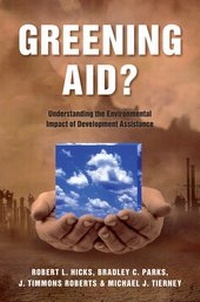
Greening Aid?
Understanding the Environmental Impact of Development Assistance
Published on 13. March 2008
Book
Hardback
368 pages
978-0-19-921394-8 (ISBN)
Description
Every year, billions of dollars of environmental aid flow from the rich governments of the North to the poor governments of the South. Why do donors provide this aid? What do they seek to achieve? How effective is the aid given? And does it always go to the places of greatest environmental need? From the first Earth Summit in Stockholm in 1972 to the G8 Gleneagles meeting in 2005, the issue of the impact of aid on the global environment has been the subject of vigorous protest and debate. How much progress has there been in improving environmental protection and clean-up in the developing world? What explains the patterns of environmental aid spending and distribution - is it designed to address real problems, achieve geopolitical or commercial gains abroad, or buy political mileage at home? And what are the consequences for the estimated 4 million people that die each year from air pollution, unsafe drinking water, and lack of sanitation? All of these questions and many more are addressed in this groundbreaking text, which is based on the authors' work compiling the most comprehensive dataset of foreign aid ever assembled.
By evaluating the likely environment impact of over 400,000 development projects by more than 50 donors to over 170 recipient nations between 1970 and 2001, Greening Aid represents a unique, state of the art picture of what is happening in foreign assistance, and its impact on the environment. Greening Aid explains major trends and shifts over the last three decades, ranks donors according to their performance, and offers case studies which compare and contrast donors and types of environmental aid.
By evaluating the likely environment impact of over 400,000 development projects by more than 50 donors to over 170 recipient nations between 1970 and 2001, Greening Aid represents a unique, state of the art picture of what is happening in foreign assistance, and its impact on the environment. Greening Aid explains major trends and shifts over the last three decades, ranks donors according to their performance, and offers case studies which compare and contrast donors and types of environmental aid.
More details
Language
English
Place of publication
Oxford
United Kingdom
Target group
Academics and graduate students with an interest in development, the environment, international relations, and politics. Policymakers and those working in NGOs, government, and aid agencies
Illustrations
numerous figures and tables
Dimensions
Height: 240 mm
Width: 163 mm
Thickness: 24 mm
Weight
695 gr
ISBN-13
978-0-19-921394-8 (9780199213948)
Copyright in bibliographic data and cover images is held by Nielsen Book Services Limited or by the publishers or by their respective licensors: all rights reserved.
Schweitzer Classification
Other editions
Additional editions
Robert L. Hicks | Bradley C. Parks | J. Timmons Roberts
Greening Aid?
Understanding the Environmental Impact of Development Assistance
Book
02/2010
Oxford University Press
€57.70
Shipment within 15-20 days
Persons
Author
Associate Professor of Economics, The College of William and Mary
Development Policy Officer, Department of Policy and International Relations at the Millennium Challenge Corporation
Director, Center for Environmental Studies, Brown University
Weingartner Associate Professor of Government, The College of William and Mary
Content
1. Introduction ; 2. Contending Theories on Environmental Aid ; 3. Which Donor Nations are Giving Aid to Protect the Environment and Why? ; 4. Outsourcing National Interest: The Puzzle of Why Nations Delegate Environmental Aid to Multilateral Agencies ; 5. To Areas of Need or Geopolitical Interest? How is Environmental Aid Allocated Among Recipient Countries? ; 6. The Local and the Global: Case Studies of Four Types of Environmental Aid ; 7. Conclusion: Two Maps of the World ; Appendix: Data Sources, Measures, Methods, and Coding