

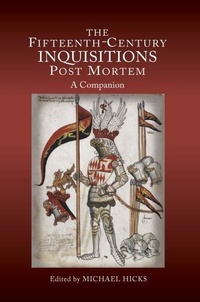
The Fifteenth-Century Inquisitions Post Mortem
A Companion
Published on 17. May 2012
Book
Hardback
272 pages
978-1-84383-712-1 (ISBN)
Description
Essays offering a guide to a vital source for our knowledge of medieval England.
The Inquisitions Post Mortem (IPMs) at the National Archives have been described as the single most important source for the study of landed society in later medieval England. Inquisitions were local enquiries into the lands heldby people of some status, in order to discover whatever income and rights were due to the crown on their death, and provide details both of the lands themselves and whoever held them. This book explores in detail for the first time the potential of IPMs as sources for economic, social and political history over the long fifteenth century, the period covered by this Companion. It looks at how they were made, how they were used, and their "accuracy",and develops our understanding of a source that is too often taken for granted; it answers questions such as what they sought to do, how they were compiled, and how reliable they are, while also exploring how they can best be usedfor economic, demographic, place-name, estate and other kinds of study.
Michael Hicks is Professor of Medieval History, University of Winchester.
Contributors: Michael Hicks, Christine Carpenter, Kate Parkin, Christopher Dyer, Matthew Holford, Margaret Yates, L.R. Poos, J. Oeppen, R.M. Smith, Sean Cunningham, Claire Noble, Matthew Holford, Oliver Padel.
The Inquisitions Post Mortem (IPMs) at the National Archives have been described as the single most important source for the study of landed society in later medieval England. Inquisitions were local enquiries into the lands heldby people of some status, in order to discover whatever income and rights were due to the crown on their death, and provide details both of the lands themselves and whoever held them. This book explores in detail for the first time the potential of IPMs as sources for economic, social and political history over the long fifteenth century, the period covered by this Companion. It looks at how they were made, how they were used, and their "accuracy",and develops our understanding of a source that is too often taken for granted; it answers questions such as what they sought to do, how they were compiled, and how reliable they are, while also exploring how they can best be usedfor economic, demographic, place-name, estate and other kinds of study.
Michael Hicks is Professor of Medieval History, University of Winchester.
Contributors: Michael Hicks, Christine Carpenter, Kate Parkin, Christopher Dyer, Matthew Holford, Margaret Yates, L.R. Poos, J. Oeppen, R.M. Smith, Sean Cunningham, Claire Noble, Matthew Holford, Oliver Padel.
Reviews / Votes
An extremely valuable and useful companion. * HISTORY, July 2013 * An indispensable introduction and guide. NORTHERN HISTORY, L, no. 2, September 2013 * . * This is a valuable collection likely to be widely used and referred to. The social and economic historian, as well as his political and administrative colleague, will find a tremendous amount to interest them here. * THE RICARDIAN * Provides a fascinating and detailed insight into this series of under-used medieval records. [It] is rigorous in its academic quality, and an interesting and thoroughly enjoyable read. It highlights the enormous potential of these records for historians and genealogists alike, and will prove an essential companion to those intending to utilise these records in their future research. * LOCAL POPULATION STUDIES * Illustrates very successfully the wide-ranging historical value of the inquisitions and the benefits of their availability in calendared form. * REVIEWS IN HISTORY *More details
Language
English
Place of publication
Woodbridge
United Kingdom
Publishing group
Boydell & Brewer Ltd
Target group
Professional and scholarly
College/higher education
Product notice
Cloth over boards
Illustrations
3 line illus.
Dimensions
Height: 241 mm
Width: 157 mm
Thickness: 23 mm
Weight
635 gr
ISBN-13
978-1-84383-712-1 (9781843837121)
Copyright in bibliographic data and cover images is held by Nielsen Book Services Limited or by the publishers or by their respective licensors: all rights reserved.
Schweitzer Classification
Other editions
Additional editions
E-Book
05/2012
1st Edition
De Gruyter
€48.99
Available for download
Persons
MICHAEL HICKS, the academic director, is Emeritus Professor of Medieval History at the University of Winchester and author of Richard III: The Self-Made King (Yale, 2019), among many other books and articles. Christopher Dyer is Emeritus Professor of History at the University of Leicester. He has written, edited, co-authored and co-edited many books, including William Dugdale, Historian, 1605-1686: His Life, his Writings and His County (Boydell, 2009). MICHAEL HICKS, the academic director, is Emeritus Professor of Medieval History at the University of Winchester and author of Richard III: The Self-Made King (Yale, 2019), among many other books and articles.
Content
Introduction - Michael Hicks
Crossing Generations: Dower, Jointure and Courtesy - Michael Hicks
The Lesser Landowners and the Inquisitions Post Mortem - Christine Carpenter
Tales of Idiots, Signifying Something: Evidence of Process in the Inquisitions Post Mortem - Kate Parkin
The Value of Fifteenth-Century Inquisitions Post Mortem for Economic and Social History - Christopher Dyer
'Notoriously Unreliable': The Valuations and Extents - Matthew Holford
The Descriptions of Land found in the Inquisitions Post Mortem and Feet of Fines. A Case Study of Berkshire - Margaret Yates
Correcting Josiah Russell's Measurements of Late Medieval Mortality using Inquisitions Post Mortem -
A Great Historical Enterprise: The Public Record Office and the Making of the Calendars of Inquisitions Post Mortem - Sean Cunningham
Writs and the Inquisitions Post Mortem: How the Crown managed the System - Claire Noble
'Thrifty Men of the Country'? The Jurors and their Role - Matthew Holford
Place-names and Calendaring Practices - Oliver J. Padel
Crossing Generations: Dower, Jointure and Courtesy - Michael Hicks
The Lesser Landowners and the Inquisitions Post Mortem - Christine Carpenter
Tales of Idiots, Signifying Something: Evidence of Process in the Inquisitions Post Mortem - Kate Parkin
The Value of Fifteenth-Century Inquisitions Post Mortem for Economic and Social History - Christopher Dyer
'Notoriously Unreliable': The Valuations and Extents - Matthew Holford
The Descriptions of Land found in the Inquisitions Post Mortem and Feet of Fines. A Case Study of Berkshire - Margaret Yates
Correcting Josiah Russell's Measurements of Late Medieval Mortality using Inquisitions Post Mortem -
A Great Historical Enterprise: The Public Record Office and the Making of the Calendars of Inquisitions Post Mortem - Sean Cunningham
Writs and the Inquisitions Post Mortem: How the Crown managed the System - Claire Noble
'Thrifty Men of the Country'? The Jurors and their Role - Matthew Holford
Place-names and Calendaring Practices - Oliver J. Padel