

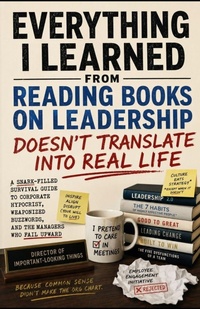
Everything I Learned From Reading Books on Leadership Doesn't Translate Into Real Life
Description
Everything I Learned From Reading Books on Leadership Doesn't Translate Into Real Life is a brutally funny, deeply cynical, first-person dismantling of modern workplace culture and the fantasy world corporate leadership books sell to employees. Through stories of incompetent managers, manipulative executives, fake "people-first" cultures, pointless meetings, weaponized HR departments, burnout disguised as resilience, and endless corporate gaslighting, the book exposes how most workplaces operate less like meritocracies and more like emotionally unstable theater productions funded by spreadsheets and panic. The narrator slowly realizes that leadership language-words like "culture," "ownership," "family," "authenticity," and "engagement"-is often just carefully polished branding wrapped around exploitation, fear, and hierarchy protection.
Across fifteen chapters filled with extreme snark and painfully recognizable workplace experiences, the book explores how organizations reward confidence over competence, punish honesty while preaching vulnerability, and demand emotional loyalty from employees they view as replaceable operational costs. It skewers performative diversity initiatives, LinkedIn influencer culture, executive hypocrisy, meaningless performance reviews, and the exhausting emotional labor workers perform just to survive corporate life. Managers fail upward, HR protects liability instead of people, and employees quietly burn themselves out trying to prove worth inside systems that were never designed to value them as humans in the first place. The humor is sharp, bitter, and deeply human because the absurdity of corporate life often becomes too ridiculous to process any other way.
At its core, the book is about reclaiming sanity. Beneath the sarcasm and rage is a growing realization that many workers are not failing because they are weak, lazy, or broken-they are reacting normally to environments built on contradiction, instability, and emotional suppression. The narrator ultimately rejects the corporate lie that every workplace problem is an individual mindset issue and instead exposes the structural dysfunction driving modern employee exhaustion. By the end, the book becomes less about leadership and more about survival: learning to stop confusing self-worth with productivity, recognizing manipulation disguised as professionalism, setting boundaries without guilt, and understanding that maybe the problem was never you at all.