

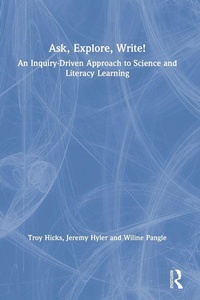
Ask, Explore, Write!
An Inquiry-Driven Approach to Science and Literacy Learning
1st Edition
Published on 21. February 2020
Book
Hardback
154 pages
978-0-367-22512-4 (ISBN)
Description
Discover how to effectively incorporate literacy instruction into your middle or high school science classroom with this practical book. You'll find creative, inquiry-based tools to show you what it means to teach science with and through writing, and strategies to help your students become young scientists who can use reading and writing to better understand their world.
Troy Hicks, Jeremy Hyler, and Wiline Pangle share helpful examples of lessons and samples of students' work, as well as innovative strategies you can use to improve students' abilities to read and write various types of scientific nonfiction, including argument essays, informational pieces, infographics, and more. As all three authors come to the work of science and literacy from different perspectives and backgrounds, the book offers unique and wide-ranging experiences that will inspire you and offer you insights into many aspects of the classroom, including when, why, and how reading and writing can work in the science lesson.
Featured topics include:
Debates and the current conversation around science writing in the classroom and society.
How to integrate science notebooks into teaching.
Improving nonfiction writing by expanding disciplinary vocabulary and crafting scientific arguments.
Incorporating visual explanations and infographics.
Encouraging collaboration through whiteboard modeling.
Professional development in science and writing.
The strategies are all aligned to the Next Generation Science Standards and Common Core State Standards for ease of implementation.
From science teachers to curriculum directors and instructional supervisors, this book is essential for anyone wanting to improve interdisciplinary literacy in their school.
Troy Hicks, Jeremy Hyler, and Wiline Pangle share helpful examples of lessons and samples of students' work, as well as innovative strategies you can use to improve students' abilities to read and write various types of scientific nonfiction, including argument essays, informational pieces, infographics, and more. As all three authors come to the work of science and literacy from different perspectives and backgrounds, the book offers unique and wide-ranging experiences that will inspire you and offer you insights into many aspects of the classroom, including when, why, and how reading and writing can work in the science lesson.
Featured topics include:
Debates and the current conversation around science writing in the classroom and society.
How to integrate science notebooks into teaching.
Improving nonfiction writing by expanding disciplinary vocabulary and crafting scientific arguments.
Incorporating visual explanations and infographics.
Encouraging collaboration through whiteboard modeling.
Professional development in science and writing.
The strategies are all aligned to the Next Generation Science Standards and Common Core State Standards for ease of implementation.
From science teachers to curriculum directors and instructional supervisors, this book is essential for anyone wanting to improve interdisciplinary literacy in their school.
More details
Language
English
Place of publication
London
United Kingdom
Publishing group
Taylor & Francis Ltd
Target group
Professional and scholarly
Professional and Professional Practice & Development
Illustrations
33 s/w Abbildungen, 27 s/w Photographien bzw. Rasterbilder, 6 s/w Zeichnungen, 8 s/w Tabellen
8 Tables, black and white; 6 Line drawings, black and white; 27 Halftones, black and white; 33 Illustrations, black and white
Dimensions
Height: 260 mm
Width: 183 mm
Thickness: 15 mm
Weight
556 gr
ISBN-13
978-0-367-22512-4 (9780367225124)
Copyright in bibliographic data and cover images is held by Nielsen Book Services Limited or by the publishers or by their respective licensors: all rights reserved.
Schweitzer Classification
Other editions
Additional editions
Troy Hicks | Jeremy Hyler | Wiline Pangle
Ask, Explore, Write!
An Inquiry-Driven Approach to Science and Literacy Learning
Book
02/2020
1st Edition
Routledge
€46.40
Shipment within 15-20 days
Troy Hicks | Jeremy Hyler | Wiline Pangle
Ask, Explore, Write!
An Inquiry-Driven Approach to Science and Literacy Learning
E-Book
02/2020
1st Edition
Routledge
€41.99
Available for download
Troy Hicks | Jeremy Hyler | Wiline Pangle
Ask, Explore, Write!
An Inquiry-Driven Approach to Science and Literacy Learning
E-Book
02/2020
1st Edition
Routledge
€41.99
Available for download
Persons
Troy Hicks is a professor of English and Education at Central Michigan University, and Director of the Chippewa River Writing Project. He has authored and co-authored nine books and over 30 journal articles and book chapters for teachers and other educators.
Jeremy Hyler is a middle school English teacher and a teacher consultant for the Chippewa River Writing Project, a satellite site of the National Writing Project. He is also a regular blogger for MiddleWeb.
Wiline Pangle is a lecturer in the Department of Biology at Central Michigan University. She also works with science teachers across Michigan to develop inquiry-based activities to promote sciences at all levels of education.
Jeremy Hyler is a middle school English teacher and a teacher consultant for the Chippewa River Writing Project, a satellite site of the National Writing Project. He is also a regular blogger for MiddleWeb.
Wiline Pangle is a lecturer in the Department of Biology at Central Michigan University. She also works with science teachers across Michigan to develop inquiry-based activities to promote sciences at all levels of education.
Content
Introduction: Our Science/Literacy Stories. Chapter 1: Writing in Science?(!). Chapter 2: Science Notebooks. Chapter 3: Visual Explanations with Infographics. Chapter 4: Encouraging Collaboration through Whiteboard Modeling. Chapter 5: Additional Strategies to Encourage Inquiry, Reading, and Writing. Chapter 6: Professional Development in Science and Writing. Conclusion: Next Steps with the Next Gen Science Standards and Literacy Learning.