

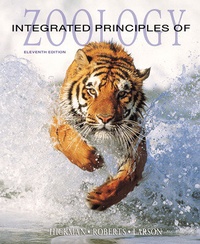
Integrated Principles of Zoology
11th Edition
Published on 16. September 2000
Book
Hardback
928 pages
978-0-07-290961-6 (ISBN)
Description
This long-awaited revision promises to maintain the best features of the "classic" zoology text, while adding eight new expert contributors and a wealth of new technology offerings!
More details
Edition
11th edition
Language
English
Place of publication
New York
United States
Publishing group
McGraw-Hill Education - Europe
Target group
College/higher education
Professional and scholarly
Illustrations
Illustrations (chiefly col.), col. maps, ports. (some col.)
Dimensions
Height: 279 mm
Width: 234 mm
Thickness: 37 mm
Weight
2177 gr
ISBN-13
978-0-07-290961-6 (9780072909616)
Copyright in bibliographic data and cover images is held by Nielsen Book Services Limited or by the publishers or by their respective licensors: all rights reserved.
Schweitzer Classification
Persons
Cleveland P. Hickman, Jr., Professor Emeritus of Biology at Washington and Lee University in Lexington, Virginia, has taught zoology and animal physiology for more than 30 years. He received his Ph.D. in comparative physiology from the University of British Columbia, Vancouver, B.C., in 1958 and taught animal physiology at the University of Alberta before moving to Washington and Lee University in 1967. He has published numerous articles and research papers in fish physiology, in addition to co-authoring these highly successful texts: Integrated Principles of Zoology, Biology of Animals, Animal Diversity, Laboratory Studies in Animal Diversity, and Laboratory Studies in Integrated Principles of Zoology.
Larry Roberts is currently teaching parasitology and marine biology at the University of Miami. He received his Ph.D. in Parasitology from Johns Hopkins University and is a coauthor of Foundations of Parasitology, 5/e. Past teaching affiliations include University of Massachusetts, Texas Tech University, and Florida International University. Dr. Roberts has authored numerous research articles and a title of related interest: Underwater World of Sport Diving.
Allan Larson is an Associate Professor at Washington University, St. Louis, MO. He received his Ph.D. in Genetics at the University of California, Berkeley. His fields of specialization include Evolutionary Biology, Molecular Population Genetics and Systematics, and Amphibian Systematics. He's taught courses in general biology, evolution, and population biology.
Larry Roberts is currently teaching parasitology and marine biology at the University of Miami. He received his Ph.D. in Parasitology from Johns Hopkins University and is a coauthor of Foundations of Parasitology, 5/e. Past teaching affiliations include University of Massachusetts, Texas Tech University, and Florida International University. Dr. Roberts has authored numerous research articles and a title of related interest: Underwater World of Sport Diving.
Allan Larson is an Associate Professor at Washington University, St. Louis, MO. He received his Ph.D. in Genetics at the University of California, Berkeley. His fields of specialization include Evolutionary Biology, Molecular Population Genetics and Systematics, and Amphibian Systematics. He's taught courses in general biology, evolution, and population biology.
Content
Part One- Introduction to the Living Animal1 Life: Biological Principles and the Science of Zoology2 Origin and Chemistry of Life3 Cells as Units of Life4 Cellular MetabolismPart Two- Continuity and Evolution of Animal Life5 Principles of Genetics: A Review6 Organic Evolution7 The Reproductive Process8 Principles of DevelopmentPart Three- The Diversity of Animal Life9 Architectural Pattern of an Animal10 Classification and Phylogeny of Animals11 Protozoan Groups12 Mesozoa and Parazoa13 Radiate Animals14 Acoelomate Animals15 Pseudocoelomate Animals16 Molluscs17 Segmented Worms18 Arthropods19 Aquatic Mandibulates20 Terrestrial Mandibulates21 Lesser Protostomes22 Lophophorate Animals23 Echinoderms24 Chaetognaths and Hemichordates25 Chordates26 Fishes27 Early Tetrapods and Modern Amphibians28 Reptilian Groups29 Birds30 MammalsPart Four- Activity of Life31 Support, Protection, and Movement32 Homeostasis33 Internal Fluids34 Digestion and Nutrition35 Nervous Coordination36 Chemical Coordination37 Immunity38 Animal BehaviorPart Five- The Animal and Its Environment39 The Biosphere and Animal Distribution40 Animal Ecology41 Animals in the Human Environment