

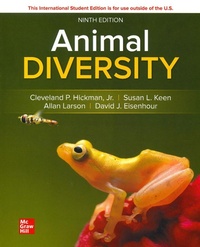
ISE Animal Diversity
9th Edition
Published on 22. October 2020
Book
Paperback/Softback
1056 pages
978-1-260-57585-9 (ISBN)
Description
This text provides a concise introduction to the field of animal biology. Readers discover general principles of evolution, ecology, animal body plans and classification and systematics. After these introductory chapters, readers delve into the biology of all groups of animals. The basic features of each group are discussed, along with evolutionary relationships among group members.
More details
Edition
9th edition
Language
English
Place of publication
OH
United States
Target group
College/higher education
US School Grade: From College Freshman to College Graduate Student
Illustrations
618 Illustrations
Dimensions
Height: 274 mm
Width: 227 mm
Thickness: 18 mm
Weight
1018 gr
ISBN-13
978-1-260-57585-9 (9781260575859)
Copyright in bibliographic data and cover images is held by Nielsen Book Services Limited or by the publishers or by their respective licensors: all rights reserved.
Schweitzer Classification
Other editions
Previous edition

Cleveland Hickman | Larry Roberts | Susan Keen
Animal Diversity
Book
02/2018
8th Edition
McGraw-Hill Education
€75.63
Article exhausted; check for reprint
Persons
Cleveland P. Hickman, Jr., Professor Emeritus of Biology at Washington and Lee University in Lexington, Virginia, has taught zoology and animal physiology for more than 30 years. He received his Ph.D. in comparative physiology from the University of British Columbia, Vancouver, B.C., in 1958 and taught animal physiology at the University of Alberta before moving to Washington and Lee University in 1967. He has published numerous articles and research papers in fish physiology, in addition to co-authoring these highly successful texts: Integrated Principles of Zoology, Biology of Animals, Animal Diversity, Laboratory Studies in Animal Diversity, and Laboratory Studies in Integrated Principles of Zoology.
Susan Keen is Lecturer at the Section of Evolution and Ecology of University of California.
Allan Larson is an Associate Professor at Washington University, St. Louis, MO. He received his Ph.D. in Genetics at the University of California, Berkeley. His fields of specialization include Evolutionary Biology, Molecular Population Genetics and Systematics, and Amphibian Systematics. He's taught courses in general biology, evolution, and population biology.
David J. Eisenhour an Associate Professor of Biology at Morehead State University.
Susan Keen is Lecturer at the Section of Evolution and Ecology of University of California.
Allan Larson is an Associate Professor at Washington University, St. Louis, MO. He received his Ph.D. in Genetics at the University of California, Berkeley. His fields of specialization include Evolutionary Biology, Molecular Population Genetics and Systematics, and Amphibian Systematics. He's taught courses in general biology, evolution, and population biology.
David J. Eisenhour an Associate Professor of Biology at Morehead State University.
Content
1. Science of Zoology and Evolution of Animal Diversity2. Animal Ecology
3. Animal Architecture
4. Taxonomy and Phylogeny of Animals
5. Unicellular Eukaryotes
6. Sponges: Phylum Porifera
7. Cnidarians and Ctenophores
8. Xenacoelomorpha, Platyhelminthes,Gastrotricha, Gnathifera, including Chaetognatha, and Mesozoa,
9. Polyzoa and Trochozoa: Cycliophora, Entoprocta, Ectoprocta, Brachiopoda, Phoronida, and Nemertea,
10. Molluscs
11. Annelids
12. Smaller Ecdysozoans
13. Arthropods
14. Echinoderms and Hemichordates
15. Vertebrate Beginnings: The Chordates
16. Fishes
17. The Early Tetrapods and Modern Amphibians
18. Amniote Origins and Nonavian Reptiles
19. Birds
20. Mammals
3. Animal Architecture
4. Taxonomy and Phylogeny of Animals
5. Unicellular Eukaryotes
6. Sponges: Phylum Porifera
7. Cnidarians and Ctenophores
8. Xenacoelomorpha, Platyhelminthes,Gastrotricha, Gnathifera, including Chaetognatha, and Mesozoa,
9. Polyzoa and Trochozoa: Cycliophora, Entoprocta, Ectoprocta, Brachiopoda, Phoronida, and Nemertea,
10. Molluscs
11. Annelids
12. Smaller Ecdysozoans
13. Arthropods
14. Echinoderms and Hemichordates
15. Vertebrate Beginnings: The Chordates
16. Fishes
17. The Early Tetrapods and Modern Amphibians
18. Amniote Origins and Nonavian Reptiles
19. Birds
20. Mammals