

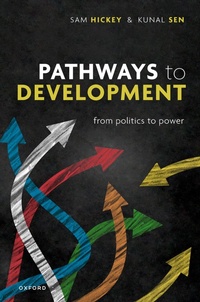
Pathways to Development
From Politics to Power
Published on 20. February 2024
Book
Hardback
192 pages
978-0-19-887256-6 (ISBN)
Description
This is an open access title available under the terms of a CC BY-BC-ND 4.0 International License. It is free to read at Oxford Scholarship Online and offered as a free PDF download from OUP and selected open access locations.
The puzzle of why some countries are wealthier and more developed than others continues to confound students and practitioners of development alike. Whereas earlier grand explanations focused on issues of 'geography' or 'institutions', the second decade of the 21st century finally saw 'politics' arrive centre-stage within international development. This catalyzed a search to answer the key question: under what conditions do governments become committed to and capable of delivering development? How can these processes be conceptualized and researched? And what (if anything) can be done to 'get the politics right' for development?
Pathways to Development draws on a major comparative research effort to present new answers to the question of how politics shapes development. It develops and applies a 'power domains' framework across multiple countries in the global South to uncover the political drivers of development across a wide range of policy areas, including economic growth, gender equity, health, and education. Hickey and Sen find that a country's pathway to development is shaped less by institutional type than by the nature of the politics and power relations that underpinned these institutions and which shape how they actually function in practice within different policy domains.
Comparative analysis reveals two alternative pathways to developmental outcomes, each of which is specific to particular configurations of power. The first involves a dominant ruling coalition with a strong developmental vision that faces an existential threat from social forces; the second involves competitive settlements within which the short-term vision of ruling elites and the politicization of the public bureaucracy are offset by the presence of strong and coherent coalitions within particular policy domains. Hickey and Sen use these insights to generate innovative, practical suggestions for policy actors seeking to promote inclusive development that are aligned to critical differences in political context.
The puzzle of why some countries are wealthier and more developed than others continues to confound students and practitioners of development alike. Whereas earlier grand explanations focused on issues of 'geography' or 'institutions', the second decade of the 21st century finally saw 'politics' arrive centre-stage within international development. This catalyzed a search to answer the key question: under what conditions do governments become committed to and capable of delivering development? How can these processes be conceptualized and researched? And what (if anything) can be done to 'get the politics right' for development?
Pathways to Development draws on a major comparative research effort to present new answers to the question of how politics shapes development. It develops and applies a 'power domains' framework across multiple countries in the global South to uncover the political drivers of development across a wide range of policy areas, including economic growth, gender equity, health, and education. Hickey and Sen find that a country's pathway to development is shaped less by institutional type than by the nature of the politics and power relations that underpinned these institutions and which shape how they actually function in practice within different policy domains.
Comparative analysis reveals two alternative pathways to developmental outcomes, each of which is specific to particular configurations of power. The first involves a dominant ruling coalition with a strong developmental vision that faces an existential threat from social forces; the second involves competitive settlements within which the short-term vision of ruling elites and the politicization of the public bureaucracy are offset by the presence of strong and coherent coalitions within particular policy domains. Hickey and Sen use these insights to generate innovative, practical suggestions for policy actors seeking to promote inclusive development that are aligned to critical differences in political context.
Reviews / Votes
Pathways to Development reveals an insightful response to a critical question: Why do some countries make choices that lead to economic and social development while others fall behind time and again? Challenging current responses emphasizing the role of institutions and democratic governance, Hickey, Sen, and their colleagues demonstrate convincingly that the nature of elite coalitions, and the ideas they embrace, condition development outcomes. In this incisive study of how several African countries have chosen to exploit their natural resources, deliver social services, and build state capacity, these scholars explain how the politics of elite bargains contribute to or diminish development potential. * Merilee S. Grindle, Edward S. Mason Professor of International Development, emerita Harvard Kennedy School * What explains differences in performance among states in the developing world? This landmark volume contains the best synthesis yet of what rigorous social science - as opposed to amateur speculation and academic dogma - has to say on this important perennial question. The answer turns out to be complicated but, in Hickey and Sen's lucid treatment, not at all obscure. Action-oriented professionals who have been demanding usable guidance on the subject should not be disappointed. Nor should scholars in mainstream economics and political science fields so long as they engage with its arguments seriously. The book not only challenges some standard assumptions that should have been consigned to the intellectual junk-yard long ago but provides a richly referenced discussion on the basis of an ample evidence-base that will be new to many. * David Booth, Senior Research Fellow, ODI * This book builds a powerful framework to illustrate how underdevelopment is a political problem. Utterly convincingly and fantastically erudite. If, like me, you believe that you can't solve the problem of development without understanding its causes, then read this book. * James A. Robinson, Harris School of Public Policy, University of Chicago * This book if read in half belief and half disbelief has all the power to shape an individual into a politically aware and critical citizen; people that the world needs desperately. * Mehak Majeed, Forum for Development Studies * This book is a good read for all the social scientists, policy makers, practitioners and the people of interest and wit alike. For a fulfilling life, it is essential that people are aware about the theories and empirics at the frontier levels. This book if read in half belief and half disbelief has all the power to shape an individual into a politically aware and critical citizen; people that the world needs desperately. * Mehak Majeed, Forum for Development Studies * Pathways to Development employs an innovative framework involving coalitions, power domains, and political settlements, to illuminate the complex process through which national and localgovernments achieve distinct development policies and outcomes. * Judith Teichman, The Journal of Development Studies *More details
Language
English
Place of publication
Oxford
United Kingdom
Target group
Professional and scholarly
Product notice
sewn/stitched
Cloth over boards
Dimensions
Height: 226 mm
Width: 152 mm
Thickness: 20 mm
Weight
454 gr
ISBN-13
978-0-19-887256-6 (9780198872566)
Copyright in bibliographic data and cover images is held by Nielsen Book Services Limited or by the publishers or by their respective licensors: all rights reserved.
Schweitzer Classification
Other editions
Additional editions
E-Book
02/2024
1st Edition
OUP eBook
€32.99
Available for download
E-Book
01/2024
1st Edition
OUP eBook
€29.99
Available for download
Persons
Sam Hickey is Professor of Politics and Development at the Global Development Institute, University of Manchester. As Research Director of the Effective States and Inclusive Development (ESID) research centre (2011-2020), he worked with many colleagues on the links between politics and development, with particular reference to state capacity, natural resource governance, social protection, education, and gender equity. He is currently Deputy CEO for the African Cities Research Consortium at the University of Manchester and President of the Development Studies Association (2020-2023).
Kunal Sen is the Director of UNU-WIDER, and Professor of Development Economics at the Global Development Institute, University of Manchester. He is a leading international expert on the political economy of growth and development. He has performed extensive research on international finance, the political economy determinants of inclusive growth, the dynamics of poverty, social exclusion, female labour force participation, and the informal sector in developing economies. His research has focused on India, East Asia, and sub-Saharan Africa. He has been the Joint Research Director of the Effective States and Inclusive Development (ESID) research centre, and a Research Fellow at IZA.
Kunal Sen is the Director of UNU-WIDER, and Professor of Development Economics at the Global Development Institute, University of Manchester. He is a leading international expert on the political economy of growth and development. He has performed extensive research on international finance, the political economy determinants of inclusive growth, the dynamics of poverty, social exclusion, female labour force participation, and the informal sector in developing economies. His research has focused on India, East Asia, and sub-Saharan Africa. He has been the Joint Research Director of the Effective States and Inclusive Development (ESID) research centre, and a Research Fellow at IZA.
Content
1: Pathways to Development: Introduction
2: Reconceptualizing the politics of development: the power domains approach
3: Political economy puzzles: how do countries grow and how can they avoid the natural resource curse?
4: Rights and recognition puzzles: when do elites commit to protecting vulnerable citizens?
5: Social provisioning puzzles: how can countries move from providing access to providing high-quality social services?
6: The politics of governance and state capacity
7: Conclusions and implications
2: Reconceptualizing the politics of development: the power domains approach
3: Political economy puzzles: how do countries grow and how can they avoid the natural resource curse?
4: Rights and recognition puzzles: when do elites commit to protecting vulnerable citizens?
5: Social provisioning puzzles: how can countries move from providing access to providing high-quality social services?
6: The politics of governance and state capacity
7: Conclusions and implications