

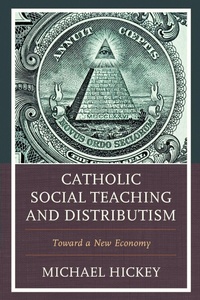
Catholic Social Teaching and Distributism
Toward A New Economy
Published on 22. November 2017
Book
Paperback/Softback
166 pages
978-0-7618-7004-3 (ISBN)
Description
Catholic Social Teaching is a relatively new and growing body of theology. Its foundation can be found in the Bible and Tradition of the Church. However, it began to be formalized beginning in 1891 with the writing of Pope Leo's revolutionary Social Letter/Encyclical, On the New Things/Rerum Novarum. It subsequently has been woven through all the many Social Encyclicals written by the modern popes, right up to the current pope, Francis.
This book is written about the many themes of Catholic Social Teaching found in these Social Letters as well as an emphasis particularly on distributive justice as found in every modern Papal Social Letter. Additionally, these Letters often discuss the current failures of modern economic systems (Capitalism, Communism, and Socialism) to meet the needs of a majority of people in the world, particularly the poor and marginalized. Although these Social Letters never propose any new economic system, the heavy emphasis on distributive justice found in all of them is used as a basis to discuss a proposed and untried economic system called "Distributism." Distributism was first introduced to the world in the early 1900's by Catholic writer and theologian, G.K. Chesterton and Hilaire Belloc.
This book is written about the many themes of Catholic Social Teaching found in these Social Letters as well as an emphasis particularly on distributive justice as found in every modern Papal Social Letter. Additionally, these Letters often discuss the current failures of modern economic systems (Capitalism, Communism, and Socialism) to meet the needs of a majority of people in the world, particularly the poor and marginalized. Although these Social Letters never propose any new economic system, the heavy emphasis on distributive justice found in all of them is used as a basis to discuss a proposed and untried economic system called "Distributism." Distributism was first introduced to the world in the early 1900's by Catholic writer and theologian, G.K. Chesterton and Hilaire Belloc.
Reviews / Votes
This book serves as a primer for CST, especially for those seeking clarification on the major themes of CST, distributive justice, and distributism. As previously mentioned, Hickey provides many thought-provoking proximal interconnections within CST themes as well as with CST and modern economics (especially in section one). On the whole, Hickey does a decent job setting the stage for "a new economy." * Catholic Social Science Review *More details
Language
English
Place of publication
Lanham, MD
United States
Publishing group
University Press of America
Dimensions
Height: 229 mm
Width: 152 mm
Thickness: 9 mm
Weight
251 gr
ISBN-13
978-0-7618-7004-3 (9780761870043)
Copyright in bibliographic data and cover images is held by Nielsen Book Services Limited or by the publishers or by their respective licensors: all rights reserved.
Schweitzer Classification
Other editions
Additional editions
E-Book
11/2017
1st Edition
Hamilton Books
€22.99
Available for download
E-Book
11/2017
1st Edition
Bloomsbury eBooks US
€22.99
Available for download
Person
Michael Hickey is a graduate of Northeastern University, Boston, MA, and a Master of Divinity Studies graduate of Weston Jesuit, now the Boston College School of Theology and Ministry. Following a career as a corporate executive for a Fortune 500 company, he became a Director of two 501 C-3 charitable non-profits; he was Executive Director of Food for the Poor Inc., Deerfield Beach, Fl., and Development Director for My Brother's Table Soup Kitchen, Lynn, MA. As he approached retirement, he began his own marketing business, retiring as a successful entrepreneur in his late fifties to teach and write. He has had four books previously published; Get Wisdom, Get Goodness, Get Real, and Get to the End. Michael Hickey is married to Theresa, a published poet and the editor of this new book. In their 50+ years of marriage they have raised four happy and "well adjusted" children into adulthood and they currently have five grandchildren.
Content
Section One: Themes of Catholic Social Teaching
Chapter One
Chapter Two
Chapter Three
Chapter Four
Chapter Five
Chapter Six
Chapter Seven
Chapter Eight
Section Two: Catholic Social Teaching and the Social Letters of the Modern Popes
Chapter Nine
Chapter Ten
Chapter Eleven: Social Letters of Pope John XXIII
Chapter Twelve: Social Letters of Vatican Council II, 1965
Chapter Thirteen: Social Letters of Pope Paul VI
Chapter Fourteen: Social Letters of John Paul II, 1981-1987
Chapter Fifteen: Social Letters of John Paul II, 1991-1995
Chapter Sixteen: Social Letter of Pope Benedict XVI, 2009
Chapter Seventeen: Social Letters of Pope Francis, 2013-2015
Section Three: Distributive Justice and Distributism
Chapter Eighteen: Roots of Distributive Justice
Chapter Nineteen: Distributive Justice in the Modern Papal Social Letters-The Foundational Letters
Chapter Twenty: Distributive Justice in the Social Letters of Pope John XXIII; and Vatican Council II
Chapter Twenty-One: Distributive Justice in t
Chapter One
Chapter Two
Chapter Three
Chapter Four
Chapter Five
Chapter Six
Chapter Seven
Chapter Eight
Section Two: Catholic Social Teaching and the Social Letters of the Modern Popes
Chapter Nine
Chapter Ten
Chapter Eleven: Social Letters of Pope John XXIII
Chapter Twelve: Social Letters of Vatican Council II, 1965
Chapter Thirteen: Social Letters of Pope Paul VI
Chapter Fourteen: Social Letters of John Paul II, 1981-1987
Chapter Fifteen: Social Letters of John Paul II, 1991-1995
Chapter Sixteen: Social Letter of Pope Benedict XVI, 2009
Chapter Seventeen: Social Letters of Pope Francis, 2013-2015
Section Three: Distributive Justice and Distributism
Chapter Eighteen: Roots of Distributive Justice
Chapter Nineteen: Distributive Justice in the Modern Papal Social Letters-The Foundational Letters
Chapter Twenty: Distributive Justice in the Social Letters of Pope John XXIII; and Vatican Council II
Chapter Twenty-One: Distributive Justice in t