


Fake-Checking
A Journalist's Guide to Deepfakes
1st Edition
Will be published approx. on 16. December 2025
Book
Hardback
160 pages
978-1-032-74131-4 (ISBN)
Description
Designed to help journalists keep pace with the rapid evolution of deepfakes as well as integrate "fake-checking" methods into their routine reporting practices, this book offers a concise and accessible guide for reporters navigating this evolving challenge.
This text aims to assist journalists in understanding the complexities of deepfakes from a number of angles including philosophical, historical, technical, and methodological. Rather than approaching deepfakes as a "journalistic apocalypse", this book contextualizes them in the larger historical practice of fact-checking and as a continuum of technological advances in image and video manipulation. Encouraging readers to view fact-checking as a multimodal process, it stresses the importance of combining philosophical and technical tools, especially ones based in epistemology and AI, with the "pavement pounding" essentials of good journalism. The book concludes with a chapter addressing how to explain deepfakes to a public progressively more concerned about the realities and consequences of AI and misinformation.
Fake-Checking serves as a practical reference for journalists and advanced media students who are increasingly required to identify and verify potential deepfakes and their future iterations.
This book is supported by online resources which can be accessed at www.routledge.com/9781032741321.
This text aims to assist journalists in understanding the complexities of deepfakes from a number of angles including philosophical, historical, technical, and methodological. Rather than approaching deepfakes as a "journalistic apocalypse", this book contextualizes them in the larger historical practice of fact-checking and as a continuum of technological advances in image and video manipulation. Encouraging readers to view fact-checking as a multimodal process, it stresses the importance of combining philosophical and technical tools, especially ones based in epistemology and AI, with the "pavement pounding" essentials of good journalism. The book concludes with a chapter addressing how to explain deepfakes to a public progressively more concerned about the realities and consequences of AI and misinformation.
Fake-Checking serves as a practical reference for journalists and advanced media students who are increasingly required to identify and verify potential deepfakes and their future iterations.
This book is supported by online resources which can be accessed at www.routledge.com/9781032741321.
More details
Language
English
Place of publication
London
United Kingdom
Publishing group
Taylor & Francis Ltd
Target group
Professional and scholarly
Postgraduate, Professional Practice & Development, and Undergraduate Advanced
Illustrations
2 s/w Tabellen, 23 s/w Abbildungen, 23 s/w Photographien bzw. Rasterbilder
2 Tables, black and white; 23 Halftones, black and white; 23 Illustrations, black and white
Dimensions
Height: 222 mm
Width: 145 mm
Thickness: 13 mm
Weight
346 gr
ISBN-13
978-1-032-74131-4 (9781032741314)
Copyright in bibliographic data and cover images is held by Nielsen Book Services Limited or by the publishers or by their respective licensors: all rights reserved.
Schweitzer Classification
Other editions
Additional editions
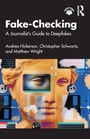
Andrea Hickerson | Christopher Schwartz | Matthew Wright
Fake-Checking
A Journalist's Guide to Deepfakes
Book
12/2025
1st Edition
Routledge
€63.90
Available immediately
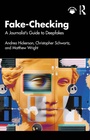
Andrea Hickerson | Christopher Schwartz | Matthew Wright
Fake-Checking
A Journalist's Guide to Deepfakes
E-Book
12/2025
Routledge
€55.49
Available for download
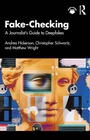
Andrea Hickerson | Christopher Schwartz | Matthew Wright
Fake-Checking
A Journalist's Guide to Deepfakes
E-Book
12/2025
Routledge
€55.49
Available for download
Persons
Andrea Hickerson is a Professor and Dean of the School of Journalism and New Media at the University of Mississippi, USA.
Christopher Schwartz is a Research Scientist in the Department of Cybersecurity at Rochester Institute of Technology, USA.
Matthew Wright is Kevin O'Sullivan Professor and Chair of Cybersecurity at Rochester Institute of Technology, USA.
Christopher Schwartz is a Research Scientist in the Department of Cybersecurity at Rochester Institute of Technology, USA.
Matthew Wright is Kevin O'Sullivan Professor and Chair of Cybersecurity at Rochester Institute of Technology, USA.
Content
Foreword
Acknowledgements
Introduction: From Fact-Checking to Fake-Checking
Chapter 1: Fact-Checking Confronts the Challenge of Deepfakes
Chapter 2: The Evolution of Fakery and Deepfakes
Chapter 3: Detection Practices and Tools
Chapter 4: Deepfake Uses, Ethics, and Emerging Challenges
Chapter 5: Helping Audiences Make Sense of Deepfakes
Conclusion: Journalism in the Matrix?
Glossary
Index
Acknowledgements
Introduction: From Fact-Checking to Fake-Checking
Chapter 1: Fact-Checking Confronts the Challenge of Deepfakes
Chapter 2: The Evolution of Fakery and Deepfakes
Chapter 3: Detection Practices and Tools
Chapter 4: Deepfake Uses, Ethics, and Emerging Challenges
Chapter 5: Helping Audiences Make Sense of Deepfakes
Conclusion: Journalism in the Matrix?
Glossary
Index