

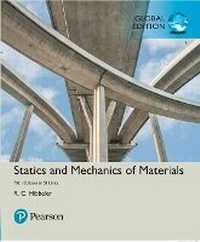
Statics and Mechanics of Materials in SI Units + Mastering Engineering with Pearson eText
5th Edition
Published on 19. June 2018
Book
Mixed media product
978-1-292-17800-4 (ISBN)
More details
Edition
5th edition
Language
English
Place of publication
Harlow
United Kingdom
Target group
Professional and scholarly
Dimensions
Height: 235 mm
Width: 205 mm
Thickness: 30 mm
Weight
1340 gr
ISBN-13
978-1-292-17800-4 (9781292178004)
Copyright in bibliographic data is held by Nielsen Book Services Limited or its licensors: all rights reserved.
Schweitzer Classification
Other editions
New editions
Russell Hibbeler
Statics and Mechanics of Materials, SI Units + Mastering Engineering with Pearson eText (Package)
Other
09/2024
6th Edition
Pearson Education Limited
€143.76
Shipment within 10-20 days
Previous edition
Book
02/2017
4th Edition
Pearson Education Limited
€117.09
Article exhausted; check for reprint
Content
1 General Principles
1.1 Mechanics
1.2 Fundamental Concepts
1.3 The International System of Units
1.4 Numerical Calculations
1.5 General Procedure for Analysis
2 Force Vectors
2.1 Scalars and Vectors
2.2 Vector Operations
2.3 Vector Addition of Forces
2.4 Addition of a System of Coplanar Forces
2.5 Cartesian Vectors
2.6 Addition of Cartesian Vectors
2.7 Position Vectors
2.8 Force Vector Directed Along a Line
2.9 Dot Product
3 Force System Resultants
3.1 Moment of a Force-Scalar Formulation
3.2 Cross Product
3.3 Moment of a Force-Vector Formulation
3.4 Principle of Moments
3.5 Moment of a Force about a Specified Axis
3.6 Moment of a Couple
3.7 Simplification of a Force and Couple System
3.8 Further Simplification of a Force and Couple System
3.9 Reduction of a Simple Distributed Loading
4 Equilibrium of a Rigid Body
4.1 Conditions for Rigid-Body Equilibrium
4.2 Free-Body Diagrams
4.3 Equations of Equilibrium
4.4 Two- and Three-Force Members
4.5 Free-Body Diagrams
4.6 Equations of Equilibrium
4.7 Characteristics of Dry Friction
4.8 Problems Involving Dry Friction
5 Structural Analysis
5.1 Simple Trusses
5.2 The Method of Joints
5.3 Zero-Force Members
5.4 The Method of Sections
5.5 Frames and Machines
6 Center of Gravity, Centroid, and Moment of Inertia
6.1 Center of Gravity and the Centroid of a Body
6.2 Composite Bodies
6.3 Moments of Inertia for Areas
6.4 Parallel-Axis Theorem for an Area
6.5 Moments of Inertia for Composite Areas
7 Stress and Strain
7.1 Introduction
7.2 Internal Resultant Loadings
7.3 Stress
7.4 Average Normal Stress in an Axially Loaded Bar
7.5 Average Shear Stress
7.6 Allowable Stress Design
7.7 Deformation
7.8 Strain
8 Mechanical Properties of Materials
8.1 The Tension and Compression Test
8.2 The Stress-Strain Diagram
8.3 Stress-Strain Behavior of Ductile and Brittle Materials
8.4 Strain Energy
8.5 Poisson's Ratio
8.6 The Shear Stress-Strain Diagram
9 Axial Load
9.1 Saint-Venant's Principle
9.2 Elastic Deformation of an Axially Loaded Member
9.3 Principle of Superposition
9.4 Statically Indeterminate Axially Loaded Members
9.5 The Force Method of Analysis for Axially Loaded Members
9.6 Thermal Stress
10 Torsion
10.1 Torsional Deformation of a Circular Shaft
10.2 The Torsion Formula
10.3 Power Transmission
10.4 Angle of Twist
10.5 Statically Indeterminate Torque-Loaded Members
11 Bending
11.1 Shear and Moment Diagrams
11.2 Graphical Method for Constructing
Shear and Moment Diagrams
11.3 Bending Deformation of a Straight Member
11.4 The Flexure Formula
11.5 Unsymmetric Bending
12 Transverse Shear
1.1 Mechanics
1.2 Fundamental Concepts
1.3 The International System of Units
1.4 Numerical Calculations
1.5 General Procedure for Analysis
2 Force Vectors
2.1 Scalars and Vectors
2.2 Vector Operations
2.3 Vector Addition of Forces
2.4 Addition of a System of Coplanar Forces
2.5 Cartesian Vectors
2.6 Addition of Cartesian Vectors
2.7 Position Vectors
2.8 Force Vector Directed Along a Line
2.9 Dot Product
3 Force System Resultants
3.1 Moment of a Force-Scalar Formulation
3.2 Cross Product
3.3 Moment of a Force-Vector Formulation
3.4 Principle of Moments
3.5 Moment of a Force about a Specified Axis
3.6 Moment of a Couple
3.7 Simplification of a Force and Couple System
3.8 Further Simplification of a Force and Couple System
3.9 Reduction of a Simple Distributed Loading
4 Equilibrium of a Rigid Body
4.1 Conditions for Rigid-Body Equilibrium
4.2 Free-Body Diagrams
4.3 Equations of Equilibrium
4.4 Two- and Three-Force Members
4.5 Free-Body Diagrams
4.6 Equations of Equilibrium
4.7 Characteristics of Dry Friction
4.8 Problems Involving Dry Friction
5 Structural Analysis
5.1 Simple Trusses
5.2 The Method of Joints
5.3 Zero-Force Members
5.4 The Method of Sections
5.5 Frames and Machines
6 Center of Gravity, Centroid, and Moment of Inertia
6.1 Center of Gravity and the Centroid of a Body
6.2 Composite Bodies
6.3 Moments of Inertia for Areas
6.4 Parallel-Axis Theorem for an Area
6.5 Moments of Inertia for Composite Areas
7 Stress and Strain
7.1 Introduction
7.2 Internal Resultant Loadings
7.3 Stress
7.4 Average Normal Stress in an Axially Loaded Bar
7.5 Average Shear Stress
7.6 Allowable Stress Design
7.7 Deformation
7.8 Strain
8 Mechanical Properties of Materials
8.1 The Tension and Compression Test
8.2 The Stress-Strain Diagram
8.3 Stress-Strain Behavior of Ductile and Brittle Materials
8.4 Strain Energy
8.5 Poisson's Ratio
8.6 The Shear Stress-Strain Diagram
9 Axial Load
9.1 Saint-Venant's Principle
9.2 Elastic Deformation of an Axially Loaded Member
9.3 Principle of Superposition
9.4 Statically Indeterminate Axially Loaded Members
9.5 The Force Method of Analysis for Axially Loaded Members
9.6 Thermal Stress
10 Torsion
10.1 Torsional Deformation of a Circular Shaft
10.2 The Torsion Formula
10.3 Power Transmission
10.4 Angle of Twist
10.5 Statically Indeterminate Torque-Loaded Members
11 Bending
11.1 Shear and Moment Diagrams
11.2 Graphical Method for Constructing
Shear and Moment Diagrams
11.3 Bending Deformation of a Straight Member
11.4 The Flexure Formula
11.5 Unsymmetric Bending
12 Transverse Shear