

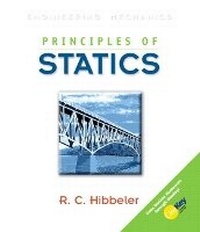
Principles of Statics
10th Edition
Published on 26. May 2005
Book
Hardback
448 pages
978-0-13-186674-4 (ISBN)
Description
For introductory statics courses found in mechanical engineering, civil engineering, aeronautical engineering, and engineering mechanics departments.
This 400 page paperback text contains all the topics and examples of the bestselling hardback text, and free access to Hibbeler's Onekey course where instructors select and post assignments. All this comes with significant savings for students!
Hibbeler's course contains over 3,000 Statics and Dynamics problems instructors can personalize and post for student assignments. OneKey lets instructors edit the values in a problem, guaranteeing a fresh problem for the students, and then use use MathCAD solutions worksheets to generate solutions for use in grading (and post for student review). Each problem also comes with optional student hints and an assignment guide.
PHGradeAssist - Hibbeler's PHGradeassist course contains over 600 Statics and Dynamics problems an instructor can use to generate algorithmic homework. PHGA grades and tracks student answers and performance, and offers sample solutions as feedback.
Students will also find a complete Activebook (cross referenced in hints) as well as a set of animations and simulations for use on-line. Professors will find complete support including Powerpoints, JPEGS, Active Learning Slides for CRS systems, Matlab/Mathcad support, and student Math Review
Of course, the Hibbeler Principles book retains all it's core features that make it the most student friendly book on the market -- the most examples, 3D photrealistic artwork, Procedure for Analysis problem solving boxes, triple accuracy checking, photgraphs that teach, and a carefully-crafted, student centered design.
This 400 page paperback text contains all the topics and examples of the bestselling hardback text, and free access to Hibbeler's Onekey course where instructors select and post assignments. All this comes with significant savings for students!
Hibbeler's course contains over 3,000 Statics and Dynamics problems instructors can personalize and post for student assignments. OneKey lets instructors edit the values in a problem, guaranteeing a fresh problem for the students, and then use use MathCAD solutions worksheets to generate solutions for use in grading (and post for student review). Each problem also comes with optional student hints and an assignment guide.
PHGradeAssist - Hibbeler's PHGradeassist course contains over 600 Statics and Dynamics problems an instructor can use to generate algorithmic homework. PHGA grades and tracks student answers and performance, and offers sample solutions as feedback.
Students will also find a complete Activebook (cross referenced in hints) as well as a set of animations and simulations for use on-line. Professors will find complete support including Powerpoints, JPEGS, Active Learning Slides for CRS systems, Matlab/Mathcad support, and student Math Review
Of course, the Hibbeler Principles book retains all it's core features that make it the most student friendly book on the market -- the most examples, 3D photrealistic artwork, Procedure for Analysis problem solving boxes, triple accuracy checking, photgraphs that teach, and a carefully-crafted, student centered design.
More details
Edition
10th edition
Language
English
Place of publication
United States
Publishing group
Pearson Education (US)
Target group
College/higher education
Dimensions
Width: 236 mm
Thickness: 16 mm
Weight
726 gr
ISBN-13
978-0-13-186674-4 (9780131866744)
Copyright in bibliographic data and cover images is held by Nielsen Book Services Limited or by the publishers or by their respective licensors: all rights reserved.
Schweitzer Classification
Other editions
Previous edition
Book
03/2001
9th Edition
Pearson
€34.65
Article exhausted; check for reprint
Content
1. General Principles.
Mechanics. Fundamental Concepts. Units of Measurement. The International System of Units. Numerical Calculations.
2. Force Vectors.
Scalars and Vectors. Vector Operations. Vector Addition of Forces. Addition of a System of Coplanar Forces. Cartesian Vectors. Addition and Subtraction of Cartesian Vectors. Position Vectors. Force Vector Directed Along a Line. Dot Product.
3. Equilibrium of a Particle.
Condition for the Equilibrium of a Particle. The Free-Body Diagram. Coplanar Force Systems. Three-Dimensional Force Systems.
4. Force System Resultants.
Moment of a Force-Scalar Formation. Cross Product. Moment of a Force-Vector Formulation. Principle of Moments. Moment of a Force About a Specified Axis. Moment of a Couple. Equivalent System. Resultants of a Force and Couple System. Further Reduction of a Force and Couple System. Reduction of a Simple Distributed Loading.
5. Equilibrium of a Rigid Body.
Conditions for Rigid-Body Equilibrium. Equilibrium in Two Dimensions. Free-Body Diagrams. Equations of Equilibrium. Two- and Three-Force Members. Equilibrium in Three Dimensions. Free-Body Diagrams. Equations of Equilibrium. Constraints for a Rigid Body.
6. Structural Analysis.
Simple Trusses. The Method of Joints. Zero-Force Members. The Method of Sections. Space Trusses. Frames and Machines.
7. Internal Forces.
Internal Forces Developed in Structural Members. Shear and Moment Equations and Diagrams. Relations Between Distributed Load, Shear, and Moment. Cables.
8. Friction.
Characteristics of Dry Friction. Problems Involving Dry Friction. Wedges. Frictional Forces on Screws. Frictional Forces on Flat Belts. Frictional Forces on Collar Bearings, Pivot Bearings, and Disks. Frictional Forces on Journal Bearings. Rolling Resistance.
9. Center of Gravity and Centroid.
Center of Gravity and Center of Mass for a System of Particles. Center of Gravity, Center of Mass, and Centroid for a Body. Composite Bodies. Theorems of Pappus and Guldinus. Resultant of a General Distributed Force System. Fluid Pressure.
10. Moments of Inertia.
Definitions of Moments of Inertia for Areas. Parallel-Axis Theorem for an Area. Radius of Gyration of an Area. Moments of Inertia for an Area by Integration. Moments of Inertia for Composite Areas. Product of Inertia for an Area. Moments of Inertia for an Area About Inclined Axes. Mohr's Circle for Moments of Inertia. Mass Moment of Inertia.
11. Virtual Work.
Definition of Work and Virtual Work. Principle of Virtual Work for a Particle and a Rigid Body. Principle of Virtual Work for a System of Connected Rigid Bodies. Conservative Forces. Potential Energy. Potential Energy Criterion for Equilibrium. Stability of Equilibrium.
Appendixes.
A. Mathematical Expressions.
B. Numerical and Computer Analysis.
Answers.
Index.
Mechanics. Fundamental Concepts. Units of Measurement. The International System of Units. Numerical Calculations.
2. Force Vectors.
Scalars and Vectors. Vector Operations. Vector Addition of Forces. Addition of a System of Coplanar Forces. Cartesian Vectors. Addition and Subtraction of Cartesian Vectors. Position Vectors. Force Vector Directed Along a Line. Dot Product.
3. Equilibrium of a Particle.
Condition for the Equilibrium of a Particle. The Free-Body Diagram. Coplanar Force Systems. Three-Dimensional Force Systems.
4. Force System Resultants.
Moment of a Force-Scalar Formation. Cross Product. Moment of a Force-Vector Formulation. Principle of Moments. Moment of a Force About a Specified Axis. Moment of a Couple. Equivalent System. Resultants of a Force and Couple System. Further Reduction of a Force and Couple System. Reduction of a Simple Distributed Loading.
5. Equilibrium of a Rigid Body.
Conditions for Rigid-Body Equilibrium. Equilibrium in Two Dimensions. Free-Body Diagrams. Equations of Equilibrium. Two- and Three-Force Members. Equilibrium in Three Dimensions. Free-Body Diagrams. Equations of Equilibrium. Constraints for a Rigid Body.
6. Structural Analysis.
Simple Trusses. The Method of Joints. Zero-Force Members. The Method of Sections. Space Trusses. Frames and Machines.
7. Internal Forces.
Internal Forces Developed in Structural Members. Shear and Moment Equations and Diagrams. Relations Between Distributed Load, Shear, and Moment. Cables.
8. Friction.
Characteristics of Dry Friction. Problems Involving Dry Friction. Wedges. Frictional Forces on Screws. Frictional Forces on Flat Belts. Frictional Forces on Collar Bearings, Pivot Bearings, and Disks. Frictional Forces on Journal Bearings. Rolling Resistance.
9. Center of Gravity and Centroid.
Center of Gravity and Center of Mass for a System of Particles. Center of Gravity, Center of Mass, and Centroid for a Body. Composite Bodies. Theorems of Pappus and Guldinus. Resultant of a General Distributed Force System. Fluid Pressure.
10. Moments of Inertia.
Definitions of Moments of Inertia for Areas. Parallel-Axis Theorem for an Area. Radius of Gyration of an Area. Moments of Inertia for an Area by Integration. Moments of Inertia for Composite Areas. Product of Inertia for an Area. Moments of Inertia for an Area About Inclined Axes. Mohr's Circle for Moments of Inertia. Mass Moment of Inertia.
11. Virtual Work.
Definition of Work and Virtual Work. Principle of Virtual Work for a Particle and a Rigid Body. Principle of Virtual Work for a System of Connected Rigid Bodies. Conservative Forces. Potential Energy. Potential Energy Criterion for Equilibrium. Stability of Equilibrium.
Appendixes.
A. Mathematical Expressions.
B. Numerical and Computer Analysis.
Answers.
Index.