

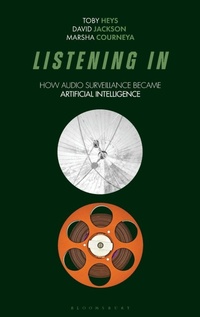
Listening In
How Audio Surveillance Became Artificial Intelligence
Published on 22. January 2026
Book
Hardback
296 pages
978-1-350-34038-1 (ISBN)
Description
In 1945, W. Averell Harriman, US Ambassador to the Soviet Union, was presented with a carved wooden plaque of the Great Seal of the United States as a 'gesture of friendship' by a delegation from the Soviet's Young Pioneer Organization.
Unbeknownst to him, one of the first covert listening devices, invented by Leon Theremin was hidden within it and was subsequently used to listen in on the ambassador's conversations for six years before being discovered. This book uses remarkable tales like this to tell the story of how modern audio surveillance developed and its important role in the evolution of today's artificial intelligence.
Beginning with post-WW2 monitoring devices, Listening In traces an arc through the Cold War era into the present day in which state and commercial spyware can record our calls, copy messages and secretly film us. It subsequently moves into the near future where AI-assisted technologies can listen to things we have not yet said as well as digitally simulate and record our voices after we have died. Exploring how mass audio surveillance is carried out through devices such as smart phones, speakers and baby monitors and used to inform and train AI algorithms, the book provides fresh insights into how we are allowing our personal privacies to be traded for enhanced social connectivity and technological convenience. Ultimately Listening In reveals how the urge to listen and record everything that has ever been uttered is scored deeply into the technological operating systems of cultures from around the world.
Listening In is also available in audiobook format from audiobook retailers.
Unbeknownst to him, one of the first covert listening devices, invented by Leon Theremin was hidden within it and was subsequently used to listen in on the ambassador's conversations for six years before being discovered. This book uses remarkable tales like this to tell the story of how modern audio surveillance developed and its important role in the evolution of today's artificial intelligence.
Beginning with post-WW2 monitoring devices, Listening In traces an arc through the Cold War era into the present day in which state and commercial spyware can record our calls, copy messages and secretly film us. It subsequently moves into the near future where AI-assisted technologies can listen to things we have not yet said as well as digitally simulate and record our voices after we have died. Exploring how mass audio surveillance is carried out through devices such as smart phones, speakers and baby monitors and used to inform and train AI algorithms, the book provides fresh insights into how we are allowing our personal privacies to be traded for enhanced social connectivity and technological convenience. Ultimately Listening In reveals how the urge to listen and record everything that has ever been uttered is scored deeply into the technological operating systems of cultures from around the world.
Listening In is also available in audiobook format from audiobook retailers.
Reviews / Votes
While this book presents a totalising account of how we came to be surveilled subjects, it retains a political imagination for the ways we can use these technologies to open our ears and listen back. -- Lawrence Abu Hamdan, Director of Earshot.ngo Listening In isn't just a historical account - it's a provocation. A kind of sonic archaeology that traces how the act of listening has evolved from a tool of espionage to a quiet force shaping the architectures of artificial intelligence. What begins with Cold War bugs ends in our bedrooms, in baby monitors, smart assistants, and even the micro-movements of our necks and jaws as we think. Along the way, the book asks something deeper: what happens when the most intimate parts of our lives - our voices, our silences, our grief - become training data? Structured like a mixtape, it doesn't just explain the mechanics of surveillance; it immerses you in them. It's haunting, and strangely personal. By the end, you may find yourself asking not what AI is becoming but what we've already become by letting it listen. * Lance Weiler, Associate Professor of Professional Practice, Founding Member & Director, Columbia University School of the Arts' Digital Storytelling Lab *More details
Series
Language
English
Place of publication
London
United Kingdom
Publishing group
Bloomsbury Publishing PLC
Target group
College/higher education
Illustrations
16 bw illus
Dimensions
Height: 240 mm
Width: 161 mm
Thickness: 23 mm
Weight
818 gr
ISBN-13
978-1-350-34038-1 (9781350340381)
Copyright in bibliographic data and cover images is held by Nielsen Book Services Limited or by the publishers or by their respective licensors: all rights reserved.
Schweitzer Classification
Persons
Toby Heys is a professor of digital arts at the School of Digital Arts (SODA) at Manchester Metropolitan University, UK, and co-founder of the AUDINT sonic research unit.
David Jackson is a Senior Lecturer in Digital Visualisation at the School of Digital Arts at Manchester Metropolitan University, UK.
Marsha Courneya is an Associate Lecturer in Digital Dramaturgy at the International Film School of Cologne and doctoral researcher in Digital Culture and Communication at Birkbeck University, London, UK.
David Jackson is a Senior Lecturer in Digital Visualisation at the School of Digital Arts at Manchester Metropolitan University, UK.
Marsha Courneya is an Associate Lecturer in Digital Dramaturgy at the International Film School of Cologne and doctoral researcher in Digital Culture and Communication at Birkbeck University, London, UK.
Content
Dedications
Introduction
Section 1: Embedded Bugs and Tunnels
1. The Thing
2. Operation Gold
3. Shoehorn
4. Acoustic Kitty
Section 2: Massive Distributed Monitoring Systems
5. STASI
6. ECHELON
7. SORM
8. PRISM
Section 3: Domotic Self-Surveillance Cultures
9. Smartphones
10. Smart Speakers
11. Smart Toys
12. Smart Baby Monitors
Section 4: Ambient Interfaces, Arcane Intelligence
13. AlterEgo
14. Jukebox
15. Gatebox
16. Thanabot
Coda
Bibliography
Introduction
Section 1: Embedded Bugs and Tunnels
1. The Thing
2. Operation Gold
3. Shoehorn
4. Acoustic Kitty
Section 2: Massive Distributed Monitoring Systems
5. STASI
6. ECHELON
7. SORM
8. PRISM
Section 3: Domotic Self-Surveillance Cultures
9. Smartphones
10. Smart Speakers
11. Smart Toys
12. Smart Baby Monitors
Section 4: Ambient Interfaces, Arcane Intelligence
13. AlterEgo
14. Jukebox
15. Gatebox
16. Thanabot
Coda
Bibliography