

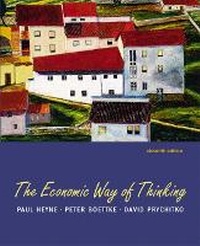
The Economic Way of Thinking
11th Edition
Published on 21. April 2005
Book
Paperback/Softback
576 pages
978-0-13-154369-0 (ISBN)
Description
Primarily for a one-semester survey course in general economics.
The Economic Way of Thinking develops the basic principles of micro- and macroeconomic analysis, and employs them as tools rather than ends unto themselves. This text introduces students to a method of reasoning; to think like an economist through example and application. It even teaches by showing students how not to think, by exposing them to the errors implicit in much popular reasoning about economic events.
The Economic Way of Thinking develops the basic principles of micro- and macroeconomic analysis, and employs them as tools rather than ends unto themselves. This text introduces students to a method of reasoning; to think like an economist through example and application. It even teaches by showing students how not to think, by exposing them to the errors implicit in much popular reasoning about economic events.
More details
Edition
11th edition
Language
English
Place of publication
United States
Publishing group
Pearson Education (US)
Target group
Professional and scholarly
Dimensions
Width: 233 mm
Thickness: 21 mm
Weight
848 gr
ISBN-13
978-0-13-154369-0 (9780131543690)
Copyright in bibliographic data and cover images is held by Nielsen Book Services Limited or by the publishers or by their respective licensors: all rights reserved.
Schweitzer Classification
Other editions
New editions
Paul Heyne | Peter J. Boettke | David L. Prychitko
The Economic Way of Thinking
International Edition
Book
02/2009
12th Edition
Pearson
€85.41
Article exhausted; check for reprint
Previous edition
Paul Heyne | Peter J. Boettke | David L. Prychitko
The Economic Way of Thinking
Book
06/2002
10th Edition
Pearson
€51.98
Article exhausted; check for reprint
Content
1. The Economic Way of Thinking
2. Efficiency, Exchange, and Comparative Advantage
3. Substitutes Everywhere: The Concept of Demand
4. Opportunity Cost and the Supply of Goods
5. Supply and Demand: A Process of Cooperation
6. Supply and Demand: Issues and Applications
7. Profit and Loss
8. Competition and Monopoly
9. Price Searching
10. Competition and Government Policy
11. The Distribution of Income
12. Externalities and Conflicting Rights
13. Markets and Government
14. The Overall Performance of Economic Systems
15. Employment and Unemployment
16. The Supply of Money
17. Monetary and Fiscal Policies
18. Economic Performance and Political Economy
19. National Policies and International Exchange
20. Promoting Economic Growth
21. The Limitations of Economics
2. Efficiency, Exchange, and Comparative Advantage
3. Substitutes Everywhere: The Concept of Demand
4. Opportunity Cost and the Supply of Goods
5. Supply and Demand: A Process of Cooperation
6. Supply and Demand: Issues and Applications
7. Profit and Loss
8. Competition and Monopoly
9. Price Searching
10. Competition and Government Policy
11. The Distribution of Income
12. Externalities and Conflicting Rights
13. Markets and Government
14. The Overall Performance of Economic Systems
15. Employment and Unemployment
16. The Supply of Money
17. Monetary and Fiscal Policies
18. Economic Performance and Political Economy
19. National Policies and International Exchange
20. Promoting Economic Growth
21. The Limitations of Economics