

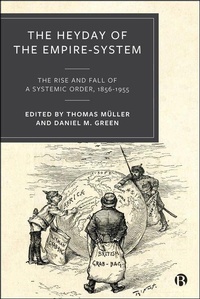
The Heyday of the Empire-System
The Rise and Fall of a Systemic Order, 1856-1955
Bristol University Press
1st Edition
Will be published approx. on 21. January 2027
Book
Hardback
400 pages
978-1-5292-5696-3 (ISBN)
Description
This volume charts the rise and fall of a distinct empire-system in the period between the end of the Crimean War in 1856 and the Bandung Conference in the 1955.
The Heyday of the Empire System argues that the late 19th and early 20th centuries were defined by the coexistence, competition and hybridization of imperial and state logics. Rather than a simple story of empire's decline and the nation state's rise, it reveals a multi phase transition in which empires not only persisted but intensified.
Bringing together leading scholars of International Relations, the volume maps how these two systemic logics interacted to produce a hybrid global order whose legacies continue to shape world politics today. By reframing this crucial century as the era of a distinct empire system, it offers a fresh and compelling account of how modern international society came to be.
The Heyday of the Empire System argues that the late 19th and early 20th centuries were defined by the coexistence, competition and hybridization of imperial and state logics. Rather than a simple story of empire's decline and the nation state's rise, it reveals a multi phase transition in which empires not only persisted but intensified.
Bringing together leading scholars of International Relations, the volume maps how these two systemic logics interacted to produce a hybrid global order whose legacies continue to shape world politics today. By reframing this crucial century as the era of a distinct empire system, it offers a fresh and compelling account of how modern international society came to be.
More details
Edition
First Edition
Language
English
Place of publication
Bristol
United Kingdom
Target group
Professional and scholarly
Product notice
Unsewn / adhesive bound
Cloth over boards
Illustrations
1 s/w Tabelle, 2 s/w Abbildungen
1 Tables, black and white; 2 Illustrations, black and white
Dimensions
Height: 234 mm
Width: 156 mm
ISBN-13
978-1-5292-5696-3 (9781529256963)
Copyright in bibliographic data and cover images is held by Nielsen Book Services Limited or by the publishers or by their respective licensors: all rights reserved.
Schweitzer Classification
Persons
Thomas Mueller is a senior lecturer at the Faculty of Sociology at Bielefeld University, Germany.
Daniel Green is Associate Professor of International Relations at the University of Delaware, USA.
Daniel Green is Associate Professor of International Relations at the University of Delaware, USA.
Content
1. Introduction - Thomas Mueller and Daniel M. Green
Part I: The Beginnings of a New System
2. The British Mid-Century Imperial Crisis and the Formative Years of the Empire-System - Daniel M. Green
3. Imperial Internationality: The Making of the Suez Canal, 1856-81 - Jan Eijking
4. Inter-Imperial Organizations: The Origins of Global Governance during the Global Empire-System of c. 1856-1914 - Ellen Ravndal
5. Treaty-Making in the Empire-System - Edward Keene
Part II: The Apogee of the System
6. Informal Imperialism Restated: The US Open Door Policy and the Imperial Contest over China - Tamas Peragovics and Viktor Friedmann
7. The Universal Human and Colonial Difference in Jevons' and Marshall's Defence of Free Trade - David L. Blaney
8. Small Wars, Military Manuals, and the Empire System - Joseph MacKay
9. A Seductive Dynamic: Navalism as Catalyst for the Empire-System - Kerrin Langer
10. Becoming an Imperial Power: Japan's Acquisition of Taiwan - Nikolaos Mavropoulos
11. To Make the World Safe for Empire: US State-Building and Colonial Administration in Western Hemisphere (1898-1912) - Tobias Lemke
Part III: The Gradual Decline of the System
12. Imperial Internationalisms: The Mandates System and the Internationalization of Empire - Sindre Gade Viksand
13. The Global Empire-System of the Interwar World - Lucian Ashworth
14. Resisting the Idea of Empire: Rabindranath Tagore and the International Public Sphere - Ritambhara Malaviya
15. Systemic Change: The UN and the 'End of Colonialism', 1945-1974 - Thomas Mueller
16. Conclusion - Thomas Mueller and Daniel M. Green
Part I: The Beginnings of a New System
2. The British Mid-Century Imperial Crisis and the Formative Years of the Empire-System - Daniel M. Green
3. Imperial Internationality: The Making of the Suez Canal, 1856-81 - Jan Eijking
4. Inter-Imperial Organizations: The Origins of Global Governance during the Global Empire-System of c. 1856-1914 - Ellen Ravndal
5. Treaty-Making in the Empire-System - Edward Keene
Part II: The Apogee of the System
6. Informal Imperialism Restated: The US Open Door Policy and the Imperial Contest over China - Tamas Peragovics and Viktor Friedmann
7. The Universal Human and Colonial Difference in Jevons' and Marshall's Defence of Free Trade - David L. Blaney
8. Small Wars, Military Manuals, and the Empire System - Joseph MacKay
9. A Seductive Dynamic: Navalism as Catalyst for the Empire-System - Kerrin Langer
10. Becoming an Imperial Power: Japan's Acquisition of Taiwan - Nikolaos Mavropoulos
11. To Make the World Safe for Empire: US State-Building and Colonial Administration in Western Hemisphere (1898-1912) - Tobias Lemke
Part III: The Gradual Decline of the System
12. Imperial Internationalisms: The Mandates System and the Internationalization of Empire - Sindre Gade Viksand
13. The Global Empire-System of the Interwar World - Lucian Ashworth
14. Resisting the Idea of Empire: Rabindranath Tagore and the International Public Sphere - Ritambhara Malaviya
15. Systemic Change: The UN and the 'End of Colonialism', 1945-1974 - Thomas Mueller
16. Conclusion - Thomas Mueller and Daniel M. Green