

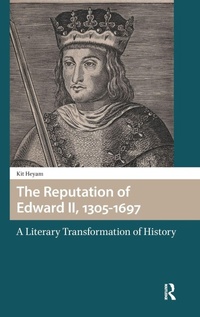
The Reputation of Edward II, 1305-1697
A Literary Transformation of History
Published on 19. October 2020
Book
Hardback
348 pages
978-94-6372-933-8 (ISBN)
Description
During his lifetime and the four centuries following his death, King Edward II (1307-1327) acquired a reputation for having engaged in sexual and romantic relationships with his male favourites, and having been murdered by penetration with a red-hot spit. This book provides the first account of how this reputation developed, providing new insights into the processes and priorities that shaped narratives of sexual transgression in medieval and early modern England. In doing so, it analyses the changing vocabulary of sexual transgression in English, Latin and French; the conditions that created space for sympathetic depictions of same-sex love; and the use of medieval history in early modern political polemic. It also focuses, in particular, on the cultural impact of Christopher Marlowe's Edward II (c.1591-92). Through such close readings of poetry and drama, alongside chronicle accounts and political pamphlets, it demonstrates that Edward's medieval and early modern afterlife was significantly shaped by the influence of literary texts and techniques. A 'literary transformation' of historiographical methodology is, it argues, an apposite response to the factors that shaped medieval and early modern narratives of the past.
Reviews / Votes
"[..] Heyam's careful analysis of sources (also summarized in a detailed, critically annotated appendix) reveals a continuous interplay between literary and historical discourse, united by their manipulation of genre and their manifest appeal to a reading public. The Reputation of Edward II masterfully delineates how so many pre modern writers sought to answer the question-who was Edward II?-and to decipher what he means for us now."- Graham N. Drake, Speculum Vol. 97, No. 3 (July 2022)
"[...] a thorough and ambitious study that makes a significant contribution to our understanding of the development of Edward II's reputation over the centuries, the evolution of vocabulary used to discuss sexual transgression, and the writing of medieval history in early modern England."
- Kathryn Warner, Journal of British Studies, Vol. 61, Iss. 3
More details
Series
Language
English
Place of publication
Oxford
Netherlands
Target group
Professional and scholarly
Academic
Dimensions
Height: 240 mm
Width: 161 mm
Thickness: 23 mm
Weight
687 gr
ISBN-13
978-94-6372-933-8 (9789463729338)
Copyright in bibliographic data and cover images is held by Nielsen Book Services Limited or by the publishers or by their respective licensors: all rights reserved.
Schweitzer Classification
Other editions
Additional editions
Book
approx. 12/2025
1st Edition
Routledge
€68.40
Not yet published
E-Book
10/2025
Routledge
€60.49
Available for download
E-Book
10/2025
Routledge
€60.49
Available for download
Person
Kit Heyam is a Lecturer in English in the Department of Humanities, Northumbria University and a queer history activist. Their recent publications include 'Paratexts and Pornographic Potential in SeventeenthCentury Anatomy Books' (The Seventeenth Century, 2018) and 'Gender Nonconformity and Military Internment: Curating the Knockaloe Slides' (Critical Military Studies, 2019).
Content
Acknowledgements
Introduction
Life of an 'unfortunate king'
Writing Edward II's narrative
Reading Edward II's narrative
Structure
Chapter 1 - Riot, Sodomy, and Minions: The Ambiguous Discourse of Sexual Transgression
Introduction
Riot
Sodomy
Minions
Conclusion
Chapter 2 - From Goats to Ganymedes: The Development of Edward II's Sexual Reputation
Introduction
Lechery and goats
Sexualized stock phrases
Ganymede
The role of Marlowe
Conclusion
Chapter 3 - Edward II and Piers Gaveston: Brothers, Friends, Lovers
Introduction
Brotherhood and friendship
Romanticizing Edward and Gaveston
Conclusion
Chapter 4 - 'Is it not strange that he is thus bewitch'd?': Edward II's Agency and Culpability
Introduction
Unsuitable companions
Agency in attraction
Political agency
Evil counsel - or evil nature?
Conclusion
Chapter 5 - Edward II as Political Exemplum
Introduction
Polemical invocations
Other political allusions
Conclusion
Chapter 6 - 'No escape now from a life full of suffering': Edward II's Sensational Fall
Introduction
Deposition
Imprisonment
Edward's story as de casibus narrative
Conclusion
Chapter 7 - Beyond Sexual Mimesis: The Penetrative Murder of Edward II
Introduction
Development of a consensus
Precedents for penetration
Sexual mimesis
Pain and torture
Marlowe's murder scene
Conclusion
Conclusion: The Literary Transformation of History
Introduction
Illuminating Marlowe
Literary transformations
Appendix: Accounts of and allusions to Edward II's reign, composed 1305-1697
Introduction
Index
Introduction
Life of an 'unfortunate king'
Writing Edward II's narrative
Reading Edward II's narrative
Structure
Chapter 1 - Riot, Sodomy, and Minions: The Ambiguous Discourse of Sexual Transgression
Introduction
Riot
Sodomy
Minions
Conclusion
Chapter 2 - From Goats to Ganymedes: The Development of Edward II's Sexual Reputation
Introduction
Lechery and goats
Sexualized stock phrases
Ganymede
The role of Marlowe
Conclusion
Chapter 3 - Edward II and Piers Gaveston: Brothers, Friends, Lovers
Introduction
Brotherhood and friendship
Romanticizing Edward and Gaveston
Conclusion
Chapter 4 - 'Is it not strange that he is thus bewitch'd?': Edward II's Agency and Culpability
Introduction
Unsuitable companions
Agency in attraction
Political agency
Evil counsel - or evil nature?
Conclusion
Chapter 5 - Edward II as Political Exemplum
Introduction
Polemical invocations
Other political allusions
Conclusion
Chapter 6 - 'No escape now from a life full of suffering': Edward II's Sensational Fall
Introduction
Deposition
Imprisonment
Edward's story as de casibus narrative
Conclusion
Chapter 7 - Beyond Sexual Mimesis: The Penetrative Murder of Edward II
Introduction
Development of a consensus
Precedents for penetration
Sexual mimesis
Pain and torture
Marlowe's murder scene
Conclusion
Conclusion: The Literary Transformation of History
Introduction
Illuminating Marlowe
Literary transformations
Appendix: Accounts of and allusions to Edward II's reign, composed 1305-1697
Introduction
Index