

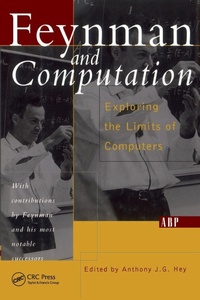
Feynman And Computation
Exploring the Limits of Computers
1st Edition
Published on 27. June 2002
Book
Paperback/Softback
462 pages
978-0-8133-4039-5 (ISBN)
Description
Computational properties of use to biological organisms or to the construction of computers can emerge as collective properties of systems having a large number of simple equivalent components (or neurons). The physical meaning of content-addressable memory is described by an appropriate phase space flow of the state of a system. A model of such a system is given, based on aspects of neurobiology but readily adapted to integrated circuits. The collective properties of this model produce a content-addressable memory which correctly yields an entire memory from any subpart of sufficient size. The algorithm for the time evolution of the state of the system is based on asynchronous parallel processing. Additional emergent collective properties include some capacity for generalization, familiarity recognition, categorization, error correction, and time sequence retention. The collective properties are only weakly sensitive to details of the modeling or the failure of individual devices.
More details
Series
Language
English
Place of publication
Oxford
United States
Publishing group
Taylor & Francis Inc
Target group
College/higher education
Professional and scholarly
Dimensions
Height: 229 mm
Width: 152 mm
Thickness: 25 mm
Weight
667 gr
ISBN-13
978-0-8133-4039-5 (9780813340395)
Copyright in bibliographic data and cover images is held by Nielsen Book Services Limited or by the publishers or by their respective licensors: all rights reserved.
Schweitzer Classification
Other editions
Additional editions
Book
08/2019
1st Edition
CRC Press
€209.20
Shipment within 15-20 days

Person
David Pines is research professor of physics at the University of Illinois at Urbana-Champaign. He has made pioneering contributions to an understanding of many-body problems in condensed matter and nuclear physics, and to theoretical astrophysics. Editor of Perseus' Frontiers in Physics series and former editor of American Physical Society's Reviews of Modern Physics, Dr. Pines is a member of the National Academy of Sciences, the American Philosophical Society, a foreign member of the USSR Academy of Sciences, a fellow of the American Academy of Arts and Sciences, and of the American Association for the Advancement of Science. Dr. Pines has received a number of awards, including the Eugene Feenberg Memorial Medal for Contributions to Many-Body Theory the P.A.M. Dirac Silver Medal for the Advancement of Theoretical Physics and the Friemann Prize in Condensed Matter Physics.
Content
Feynman and Computation -- Feynman's Course on Computation -- Feynman and Computation -- Neural Networks and Physical Systems with Emergent Collective Computational Abilities -- Feynman as a Colleague -- Collective Electrodynamics I -- A Memory -- Numerical Evidence that the Motion of Pluto is Chaotic -- Reducing the Size -- There's Plenty of Room at the Bottom -- Information is Inevitably Physical -- Scaling of MOS Technology to Submicrometer Feature Sizes -- Richard Feynman and Cellular Vacuum -- Quantum Limits -- Simulating Physics with Computers -- Quantum Robots -- Quantum Information Theory -- Quantum Computation -- Parallel Computation -- Computing Machines in the Future -- Internetics: Technologies, Applications and Academic Fields -- Richard Feynman and the Connection Machine -- Crystalline Computation -- Fundamentals -- Information, Physics, Quantum: The Search for Links -- Feynman, Barton and the Reversible Schroedinger Difference Equation -- Action, or the Fungibility of Computation -- Algorithmic Randomness, Physical Entropy, Measurements, and the Demon of Choice