

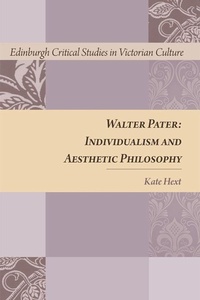
Walter Pater
Individualism and Aesthetic Philosophy
Published on 14. June 2013
Book
Hardback
232 pages
978-0-7486-4625-8 (ISBN)
Description
Explores how Walter Pater and his contemporary aesthetes were influenced by modern philosophies
Repositioning Walter Pater at the philosophical nexus of Aestheticism, this study presents the first discussion of how Pater redefines Romantic Individualism through his engagements with modern philosophical discourses and in the context of emerging modernity in Britain. It also considers the dynamics between form and thought at the fin de siecle, contextualizing its comments in terms of Matthew Arnold, Oscar Wilde and Vernon Lee and others, to offer a fully integrated account of the intellectual cultures and currents in this period.
Key Features:
Boldly reassesses Pater's intellectual significance, arguing that he self-consciously poised on the cusp between late-Victorian Romanticism and ModernismImaginatively combines close readings with cultural and intellectual history and biography to reconsider individualism and philosophical thought in the Aesthetic 'Movement'Provides the most substantial scholarly engagement with Pater's unpublished manuscripts (held at the Houghton Library, Harvard University)
Repositioning Walter Pater at the philosophical nexus of Aestheticism, this study presents the first discussion of how Pater redefines Romantic Individualism through his engagements with modern philosophical discourses and in the context of emerging modernity in Britain. It also considers the dynamics between form and thought at the fin de siecle, contextualizing its comments in terms of Matthew Arnold, Oscar Wilde and Vernon Lee and others, to offer a fully integrated account of the intellectual cultures and currents in this period.
Key Features:
Boldly reassesses Pater's intellectual significance, arguing that he self-consciously poised on the cusp between late-Victorian Romanticism and ModernismImaginatively combines close readings with cultural and intellectual history and biography to reconsider individualism and philosophical thought in the Aesthetic 'Movement'Provides the most substantial scholarly engagement with Pater's unpublished manuscripts (held at the Houghton Library, Harvard University)
Reviews / Votes
In this original study of Walter Pater's many contexts - Oxford's classicists and colleges, late Victorian ideologies, German Idealism, theories of evolution and time - Kate Hext's Pater is revealed as intensely modern, obsessed with the most modern of problems: the status of the individual in nature and society. If the Blessed will not care what angle they are regarded from, the individual Pater and Pater's Individual are blessed in Hext's graceful, philosophical touch. * Professor Regenia Gagnier, University of Exeter * [An] elegant and erudite new study... -- Matthew Kaiser * Victorian Studies, Volume 57, Number 4 *More details
Series
Language
English
Place of publication
Edinburgh
United Kingdom
Target group
Professional and scholarly
Product notice
sewn/stitched
Cloth over boards
Illustrations
1 black and white illustration
Dimensions
Height: 239 mm
Width: 165 mm
Thickness: 18 mm
Weight
476 gr
ISBN-13
978-0-7486-4625-8 (9780748646258)
Copyright in bibliographic data and cover images is held by Nielsen Book Services Limited or by the publishers or by their respective licensors: all rights reserved.
Schweitzer Classification
Other editions
Additional editions
E-Book
06/2013
Edinburgh University Press
€92.49
Available for download
E-Book
06/2013
Edinburgh University Press
€0.00
Available for download
Person
Kate Hext is a lecturer in English at the University of Exeter. She has written widely on aestheticism and the relationship between literature and philosophy in the nineteenth century.
Content
Acknowledgements; Note on Editions and Abbreviations; 1. Introduction: Individualism and the 'aesthetic philosopher'; 2. Empiricism and the Imperilled Self; 3. Subjectivity and Imagination: from Hume to Kant via Berkeley; 4. Metaphysics: Pater's Failed Attempt at Atheism; 5. Sense and Sensuality: Caught between Venus and Dionysus; 6. Pater's Copernican Revolution: the Desiring, Dying Body; 7. Evolution and the "species": The Individual in Deep Time; 8. The Moment and the Aesthetic Imagination; 9. Ethics, Society and the Aesthetic Individual; 10. Conclusion: 'the elusive inscrutable mistakable self'; Bibliography.