

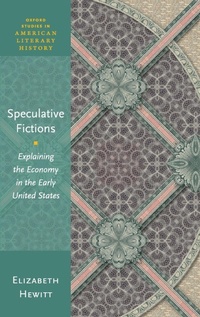
Speculative Fictions
Explaining the Economy in the Early United States
Published on 2. July 2020
Book
Hardback
346 pages
978-0-19-885913-0 (ISBN)
Description
Speculative Fictions places Alexander Hamilton at the center of American literary history to consider the important intersections between economics and literature. By studying Hamilton as an economic and imaginative writer, it argues that we can recast the conflict with the Jeffersonians as a literary debate about the best way to explain and describe modern capitalism, and explores how various other literary forms allow us to comprehend the complexities of a modern global economy in entirely new ways.
Speculative Fictions identifies two overlooked literary genres of the late eighteenth-century as exemplary of this narrative mode. It asks that we read periodical essays and Black Atlantic captivity narratives with an eye not towards bourgeois subject formation, but as descriptive analyses of economic systems. In doing so, we discover how these two literary genres offer very different portraits of a global economy than that rendered by the novel, the imaginative genre we are most likely to associate with modern capitalism. Developing an aesthetic appreciation for the speculative, digressive, and unsystematic plotlines of these earlier narratives has the capacity to generate new imaginative projects with which to make sense of our increasingly difficult economic world.
Speculative Fictions identifies two overlooked literary genres of the late eighteenth-century as exemplary of this narrative mode. It asks that we read periodical essays and Black Atlantic captivity narratives with an eye not towards bourgeois subject formation, but as descriptive analyses of economic systems. In doing so, we discover how these two literary genres offer very different portraits of a global economy than that rendered by the novel, the imaginative genre we are most likely to associate with modern capitalism. Developing an aesthetic appreciation for the speculative, digressive, and unsystematic plotlines of these earlier narratives has the capacity to generate new imaginative projects with which to make sense of our increasingly difficult economic world.
Reviews / Votes
Speculative Fictions will alter the way we must read the period of the framers, economic writing, and literary writing of many forms. Hewitt's volume should inspire us to read through her lens the more traditionally labeled literature we tend to teach, and to broaden the forms of literature we include in syllabi. * Howard Horwitz, The University of Utah * This is a timely and important work-deeply and creatively researched, expansive, interdisciplinary (without cliche), and original in conception and execution. * Philip Gould, Brown University * Hewitt makes a compelling, lucid, and insightful case for reading what are now considered the separate domains of early economic theory and literature as interdependent and mutually illuminating...Recommended. Upper-division undergraduates through faculty. * A. T. Hale, University of Puget Sound, CHOICE * Speculative Fictions provides an innovative and dynamic contribution to the field of economic criticism. * David Anthony, Early American Literature *More details
Series
Language
English
Place of publication
Oxford
United Kingdom
Target group
Professional and scholarly
Dimensions
Height: 240 mm
Width: 161 mm
Thickness: 23 mm
Weight
684 gr
ISBN-13
978-0-19-885913-0 (9780198859130)
Copyright in bibliographic data and cover images is held by Nielsen Book Services Limited or by the publishers or by their respective licensors: all rights reserved.
Schweitzer Classification
Other editions
Additional editions
E-Book
06/2020
1st Edition
OUP eBook
€22.99
Available for download
E-Book
06/2020
1st Edition
OUP eBook
€24.99
Available for download
Person
Elizabeth Hewitt is a professor in the Department of English at The Ohio State University, Columbus. She is the author of Correspondence and American Literature, 1770-1865 (Cambridge University Press, 2004) and editor of The Letters and Early Epistolary Writings of Charles Brockden Brown and Edgar Allan Poe: A Case Study in Critical Controversy.
Content
Introduction: Hamilton's Country
1: Hamilton and the Encyclopedic Stories of Public Credit
2: Jefferson and the Simple Story of Pastoral Economies
3: Stories without Plots
4: The Slave as System
Conclusion
1: Hamilton and the Encyclopedic Stories of Public Credit
2: Jefferson and the Simple Story of Pastoral Economies
3: Stories without Plots
4: The Slave as System
Conclusion