

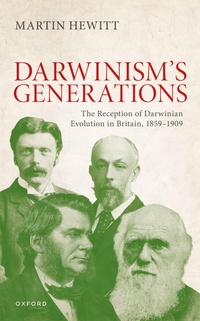
The Reception of Darwinian Evolution in Britain, 1859-1909
Darwinism's Generations
Published on 14. November 2024
Book
Hardback
512 pages
978-0-19-289099-3 (ISBN)
Description
The Reception of Darwinian Evolution in Britain, 1859-1909: Darwinism's Generations uses the impact of Charles Darwin's On the Origin of Species (1859) in the 50 years after its publication to demonstrate the effectiveness of a generational framework for understanding the cultural and intellectual history of Britain in the nineteenth century. It challenges conventional notions of the 'Darwinian Revolution' by examining how people from across all sections of society actually responded to Darwin's writings. Drawing on the opinions and interventions of over 2,000 Victorians, drawn from an exceptionally wide range of archival and printed sources, it argues that the spread of Darwinian belief was slower, more complicated, more stratified by age, and ultimately shaped far more powerfully by divergent generational responses, than has previously been recognised. In doing so, it makes a number of important contributions. It offers by far the richest and most comprehensive account to date of how contemporaries came to terms with the intellectual and emotional shocks of evolutionary theory. It makes a compelling case for taking proper account of age as a fundamental historical dynamic, and for the powerful generational patternings of the effects that age produced. It demonstrates the extent to which the most common sub-periodisation of the Victorian period are best understood not merely as constituted by the exigencies of events, but are also formed by the shifting balance generational influence.
Taken together these insights present a significant challenge to the ways historians currently approach the task of describing the nature and experience of historical change, and have fundamental implications for our current conceptions of the shape and pace of historical time.
Taken together these insights present a significant challenge to the ways historians currently approach the task of describing the nature and experience of historical change, and have fundamental implications for our current conceptions of the shape and pace of historical time.
Reviews / Votes
It demonstrates the extent to which the most common sub-periodisation of the Victorian period are best understood not merely as constituted by the exigencies of events, but are also formed by the shifting balance generational influence. * British Association for Victorian Studies * This well-researched intellectual history examines how leading figures in Victorian Great Britain responded to the evolutionary work of Charles Darwin.The book will be of particular interest to scholars in the history of ideas. * J. S. Schwartz, Choice * Fresh and fascinating ...astonishingly detailed ...I have not read any other such study that ranges so widely in Britain, is so authoritative, and so clearly expressed ...an exciting new way to think about the century. * Janet Browne, Metascience *More details
Language
English
Place of publication
Oxford
United Kingdom
Target group
College/higher education
Product notice
sewn/stitched
Cloth over boards
Illustrations
8 b&w illustrations
Dimensions
Height: 219 mm
Width: 143 mm
Thickness: 33 mm
Weight
814 gr
ISBN-13
978-0-19-289099-3 (9780192890993)
Copyright in bibliographic data and cover images is held by Nielsen Book Services Limited or by the publishers or by their respective licensors: all rights reserved.
Schweitzer Classification
Other editions
Additional editions
E-Book
10/2024
OUP eBook
€143.99
Available for download
E-Book
10/2024
OUP eBook
€143.99
Available for download
Person
After postgraduate work at the University of New Brunswick, and Nuffield College, Oxford, Martin Hewitt has held academic positions at the University of Hull, Trinity and All Saints (Leeds), Manchester Metropolitan University, the University of Huddersfield, and Anglia Ruskin University. He has held visiting positions at Universite de Cergy-Pontoise, Universite Paris VII, La Trobe University, and the Australian National University. He has published widely in nineteenth century British history, Victorian culture, and the history of Victorian Studies and was the founding editor of the Journal of Victorian Culture, and first Honorary Secretary of the British Association for Victorian Studies.
Content
Introduction: Victorian Britain and the Problem of Generations
1: The Publication of On the Origin of Species
2: In the Wake of the Origin
3: The Descent of Man (1871) and the High Victorians
4: The Death of Darwin and After: The 1880s and the Late Victorians
5: Darwinian Debates at the Fin de Siecle: The Edwardians
Conclusion: Continuity, Conversion, and Counter-Example
1: The Publication of On the Origin of Species
2: In the Wake of the Origin
3: The Descent of Man (1871) and the High Victorians
4: The Death of Darwin and After: The 1880s and the Late Victorians
5: Darwinian Debates at the Fin de Siecle: The Edwardians
Conclusion: Continuity, Conversion, and Counter-Example