

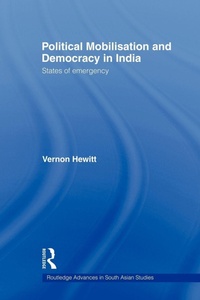
Political Mobilisation and Democracy in India
States of Emergency
1st Edition
Published on 21. April 2009
Book
Paperback/Softback
240 pages
978-0-415-54479-5 (ISBN)
Description
This book addresses the paradox of political mobilization and the failings of governance in India, with reference to the conflict between secularism and Hindu nationalism, authoritarianism and democracy.
It demonstrates how the Internal Emergency of 1975 led to increased support of groups such as the BJS and the RSS, accounting for the rise of political movements advocating Hindu nationalism - Hindutva - as a response to rapid political mobilization triggered by the Emergency, and an attempt by political elites to control this to their advantage. Vernon Hewitt argues that the political disjuncture between democracy and mobilization in India is partly a function of the Indian state, the nature of a caste-class based society, but also - and significantly - the contingencies of individual leaders and the styles of rule. He shows how, in the wake of the Emergency, the BJP and the RSS gained popularity and power amid the on-going decline and fragmentation of the Congress, whilst, at the same time, Hindu nationalism appeared to be of such importance that Congress began aligning themselves with the Hindu right for electoral gains. The volume suggests that, in the light of these developments, the rise of the BJP should not be considered as remarkable - or as transformative - as was at first imagined.
It demonstrates how the Internal Emergency of 1975 led to increased support of groups such as the BJS and the RSS, accounting for the rise of political movements advocating Hindu nationalism - Hindutva - as a response to rapid political mobilization triggered by the Emergency, and an attempt by political elites to control this to their advantage. Vernon Hewitt argues that the political disjuncture between democracy and mobilization in India is partly a function of the Indian state, the nature of a caste-class based society, but also - and significantly - the contingencies of individual leaders and the styles of rule. He shows how, in the wake of the Emergency, the BJP and the RSS gained popularity and power amid the on-going decline and fragmentation of the Congress, whilst, at the same time, Hindu nationalism appeared to be of such importance that Congress began aligning themselves with the Hindu right for electoral gains. The volume suggests that, in the light of these developments, the rise of the BJP should not be considered as remarkable - or as transformative - as was at first imagined.
More details
Series
Language
English
Place of publication
London
United Kingdom
Publishing group
Taylor & Francis Ltd
Target group
College/higher education
Illustrations
1 s/w Abbildung, 1 s/w Zeichnung
1 Line drawings, black and white; 1 Illustrations, black and white
Dimensions
Height: 234 mm
Width: 156 mm
Thickness: 13 mm
Weight
377 gr
ISBN-13
978-0-415-54479-5 (9780415544795)
Copyright in bibliographic data and cover images is held by Nielsen Book Services Limited or by the publishers or by their respective licensors: all rights reserved.
Schweitzer Classification
Other editions
Additional editions
E-Book
11/2007
Routledge
€20.99
Available for download
E-Book
11/2007
Routledge
€20.99
Available for download
Book
10/2007
1st Edition
Routledge
€62.50
Article not available at the moment
Person
Vernon Hewitt is Senior Lecturer in the Department of Politics at the University of Bristol, UK. He is the author of The International Politics of South Asia (1992), Reclaiming the Past: Jammu and Kashmir (1996) and numerous articles and chapters on ethnicity and the post-colonial state, development, and colonial history.
Content
Introduction 1. Emergencies, States and Societies: The Study of Indian Politics 2. State-Society Relations 1947-1950: A Democratic Polity? 3. Political Mobilisations: 1963-1971 4. The State and Political Crisis 1971-75 5. The State As Political Impasse: 1975-1980 6. Political Mobilisations: 1980-1996 7. Hindutva as Crisis: 1996-2004. Conclusions