

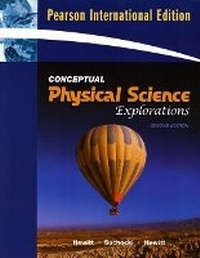
Conceptual Physical Science Explorations
International Edition
2nd Edition
Published on 2. April 2009
Book
Paperback/Softback
864 pages
978-0-321-56107-7 (ISBN)
Description
Focused on the idea that the rules of the physical world can be taught using a conceptual approach that emphasizes qualitative analysis, the Hewitt team has created a text that is highly readable, flexible, and hands-on. Thirty-four concisely written chapters allow you to better select topics to match your course and the needs of your students in a one- or two- semester course. Conceptual Physical Science Explorations, Second Edition presents a clear and engaging introduction to physics, chemistry, astronomy, and earth sciences. The authors use analogies and everyday examples to clarify key concepts and help students better understand the world around them. The textbook's consistent, high-quality coverage stimulates active learning with critical thinking exercises, hands-on experiments, review questions, and quantitative problems. Conceptual Physical Science Explorations is less rigorous in coverage and written more simply than Conceptual Physical Science, Fourth Edition, and directed primarily to college courses where students are less well prepared, and in some cases, remedial.
The Second Edition features updated content, new Chapter Opening statements, and more.
The Second Edition features updated content, new Chapter Opening statements, and more.
More details
Edition
2nd edition
Language
English
Place of publication
United States
Publishing group
Pearson Education (US)
Target group
College/higher education
Dimensions
Height: 274 mm
Width: 218 mm
Thickness: 28 mm
Weight
1640 gr
ISBN-13
978-0-321-56107-7 (9780321561077)
Copyright in bibliographic data and cover images is held by Nielsen Book Services Limited or by the publishers or by their respective licensors: all rights reserved.
Schweitzer Classification
Other editions
Previous edition
Book
05/2002
Pearson
€74.27
Article exhausted; check for reprint
Persons
Paul G. Hewitt
Former silver-medal boxing champion, sign painter, uranium prospector, and soldier, Paul began college at the age of 27, with the help of the GI Bill. He pioneered the conceptual approach to teaching physics at the City College of San Francisco. He has taught as a guest teacher at various middle schools and high schools, the University of California at both the Berkeley and Santa Cruz campuses, and the University of Hawaii at both the Manoa and Hilo campuses. He also taught for 20 years at the Exploratorium in San Francisco, which honored him with its Outstanding Educator Award in 2000. He is the author of Conceptual Physics and a co-author of Conceptual Physical Science and Conceptual Physical Science Explorations (with John and Leslie).
John A. Suchocki
John is the author of Conceptual Chemistry as well as a co-author (with Paul and Leslie Hewitt) of Conceptual Physical Science and Conceptual Physical Science Explorations. John obtained his Ph.D. in organic chemistry from Virginia Commonwealth University. He taught chemistry at the University of Hawaii at Manoa and then at the Leeward Community College. In addition to authoring textbooks, John is currently an adjunct faculty member at Saint Michael's College in Colchester, Vermont. He also produces science education multimedia through his company, Conceptual Productions (www.CPro.cc) and writes and illustrates science-oriented children's books.
Leslie A. Hewitt
Leslie is also coauthor of Conceptual Physical Science and Conceptual Physical Science Explorations (with Paul and John). After obtaining her geology degree at San Francisco State University, Leslie's interest in teaching broadened to include educating elementary and middle school students. She completed additional graduate work in geography and education, receiving her California State Teaching Certification, also from San Francisco State University. In addition to writing, she devotes considerable time and energy to bringing science education to young people in engaging ways. She is particularly active in her local school district where she works on curriculum development and hands-on science, organizes interactive science fairs, guest teaches, and works with students on connections between scientific concepts and life in the every day world.
Former silver-medal boxing champion, sign painter, uranium prospector, and soldier, Paul began college at the age of 27, with the help of the GI Bill. He pioneered the conceptual approach to teaching physics at the City College of San Francisco. He has taught as a guest teacher at various middle schools and high schools, the University of California at both the Berkeley and Santa Cruz campuses, and the University of Hawaii at both the Manoa and Hilo campuses. He also taught for 20 years at the Exploratorium in San Francisco, which honored him with its Outstanding Educator Award in 2000. He is the author of Conceptual Physics and a co-author of Conceptual Physical Science and Conceptual Physical Science Explorations (with John and Leslie).
John A. Suchocki
John is the author of Conceptual Chemistry as well as a co-author (with Paul and Leslie Hewitt) of Conceptual Physical Science and Conceptual Physical Science Explorations. John obtained his Ph.D. in organic chemistry from Virginia Commonwealth University. He taught chemistry at the University of Hawaii at Manoa and then at the Leeward Community College. In addition to authoring textbooks, John is currently an adjunct faculty member at Saint Michael's College in Colchester, Vermont. He also produces science education multimedia through his company, Conceptual Productions (www.CPro.cc) and writes and illustrates science-oriented children's books.
Leslie A. Hewitt
Leslie is also coauthor of Conceptual Physical Science and Conceptual Physical Science Explorations (with Paul and John). After obtaining her geology degree at San Francisco State University, Leslie's interest in teaching broadened to include educating elementary and middle school students. She completed additional graduate work in geography and education, receiving her California State Teaching Certification, also from San Francisco State University. In addition to writing, she devotes considerable time and energy to bringing science education to young people in engaging ways. She is particularly active in her local school district where she works on curriculum development and hands-on science, organizes interactive science fairs, guest teaches, and works with students on connections between scientific concepts and life in the every day world.
Content
1. About Science
I. MECHANICS
2. Newton's First Law of Motion - Inertia
3. Newton's Second Law of Motion - Force and Acceleration
4. Newton's Third Law of Motion - Action and Reaction
5. Momentum
6. Energy
7. Gravity
8. Fluid Mechanics
II. FORMS OF ENERGY 9. Heat
10. Electricity
11. Magnetism
12. Waves and Sound
13. Light and Color
14. Properties of Light
15. The Atom
16. Nuclear Energy
III. CHEMISTRY 17. Elements of Chemistry
18. How Atoms Bond and Molecules Attract
19. How Chemicals Mix
20. How Chemicals React
21. Two Types of Chemical Reactions
22. Organic Compounds
23. The Chemistry of Drugs
24. Nutrition
IV. EARTH SCIENCE
25. Rocks and Minerals
26. Earth's Interior
27. Plate Tectonics
28. Earth's Surface Features
29. Earth History Over Time
30. Oceans and Atmosphere
31. Driving Forces of Weather
V. ASTRONOMY
32. The Solar System
33. Stars and Galaxies
34. The Structure of Space and Time
Appendix A. Systems of Measurement
Appendix B. Linear Motion
Appendix C. Vectors
Appendix D. Physics of Fluids
Appendix E. Exponential Growth and Doubling Time
Appendix F. Safety
I. MECHANICS
2. Newton's First Law of Motion - Inertia
3. Newton's Second Law of Motion - Force and Acceleration
4. Newton's Third Law of Motion - Action and Reaction
5. Momentum
6. Energy
7. Gravity
8. Fluid Mechanics
II. FORMS OF ENERGY 9. Heat
10. Electricity
11. Magnetism
12. Waves and Sound
13. Light and Color
14. Properties of Light
15. The Atom
16. Nuclear Energy
III. CHEMISTRY 17. Elements of Chemistry
18. How Atoms Bond and Molecules Attract
19. How Chemicals Mix
20. How Chemicals React
21. Two Types of Chemical Reactions
22. Organic Compounds
23. The Chemistry of Drugs
24. Nutrition
IV. EARTH SCIENCE
25. Rocks and Minerals
26. Earth's Interior
27. Plate Tectonics
28. Earth's Surface Features
29. Earth History Over Time
30. Oceans and Atmosphere
31. Driving Forces of Weather
V. ASTRONOMY
32. The Solar System
33. Stars and Galaxies
34. The Structure of Space and Time
Appendix A. Systems of Measurement
Appendix B. Linear Motion
Appendix C. Vectors
Appendix D. Physics of Fluids
Appendix E. Exponential Growth and Doubling Time
Appendix F. Safety