

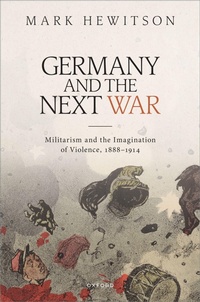
Germany and the Next War
Militarism and the Imagination of Violence, 1888-1914
Will be published approx. on 9. July 2026
Book
Hardback
560 pages
978-0-19-879106-5 (ISBN)
Description
In 1914, the actions of German political and military decision-makers depended, not merely on the machinery of the government, army, and navy, but also on the public's attitudes to the military, military service, and military conflict. No German leader could ignore the complicated responses and coalitions of political parties and their electorates required to wage war. The likelihood of revolution, the willingness of citizens to put up with economic dislocation and to bear the burden of human suffering--or the catastrophic effects of war--rested on the attitudes and behaviour of this wider public, which in turn derived from their experiences and memories of the wars of unification, their political support for and opposition to the army and navy, and their contact with the military as conscripts and volunteers, or as relatives of soldiers and veterans. The lessons of foreign wars, the evaluation of enemies, and the imagination of 'wars of the future' also played a part. How and why did German leaders help to bring about a European war in 1914 which so many observers had predicted might turn into a disaster?
This is the third volume of Mark Hewitson's study of the violence of war in the German lands during the nineteenth and twentieth centuries. It examines the contradictory legacy of the 'wars of unification' on popular conceptions of military conflict in the changing public sphere of the Wilhelmine era. The decisions, and unexpected consequences of decisions, which led to war in 1914 can only be understood in this context.
This is the third volume of Mark Hewitson's study of the violence of war in the German lands during the nineteenth and twentieth centuries. It examines the contradictory legacy of the 'wars of unification' on popular conceptions of military conflict in the changing public sphere of the Wilhelmine era. The decisions, and unexpected consequences of decisions, which led to war in 1914 can only be understood in this context.
More details
Language
English
Place of publication
Oxford
United Kingdom
Target group
College/higher education
Product notice
sewn/stitched
Cloth over boards
Illustrations
40 Illustrations
Dimensions
Height: 234 mm
Width: 156 mm
ISBN-13
978-0-19-879106-5 (9780198791065)
Copyright in bibliographic data and cover images is held by Nielsen Book Services Limited or by the publishers or by their respective licensors: all rights reserved.
Schweitzer Classification
Person
Mark Hewitson is a Professor of German History and Politics at UCL, where he was appointed in 1998. His interests lie principally in the intellectual, cultural, and political history of nineteenth- and twentieth-century Germany and Europe. He is currently working on projects about nationalism and national identity, experiences and representations of modern warfare, and conceptions of Europe and the West during the nineteenth and twentieth centuries. He is also interested in various aspects of historical theory, including the relationship between history and other social sciences.
Content
Introduction 1: Past Wars 2: The Arms Race 3: Militarism and Its Limits 4: Conscripts and Veterans 5: War Scares 6: Virtual Wars 7: Friends and Foes 8: War Plans 9: War or Peace Conclusion