

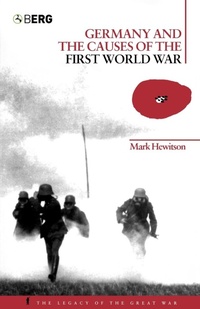
Germany and the Causes of the First World War
Published on 1. October 2004
Book
Paperback/Softback
280 pages
978-1-85973-870-2 (ISBN)
Description
How can we understand what caused World War I? What role did Germany play? This book encourages us to re-think the events that led to global conflict in 1914.Historians in recent years have argued that German leaders acted defensively or pre-emptively in 1914, conscious of the Reich's deteriorating military and diplomatic position. Germany and the Causes of the First World War challenges such interpretations, placing new emphasis on the idea that the Reich Chancellor, the German Foreign Office and the Great General Staff were confident that they could win a continental war. This belief in Germany's superiority derived primarily from an assumption of French decline and Russian weakness throughout the period between the turn of the century and the eve of the First World War. Accordingly, Wilhelmine policy-makers pursued offensive policies - at the risk of war at important junctures during the 1900s and 1910s.The author analyses the stereotyping of enemy states, representations of war in peacetime, and conceptualizations of international relations.
He uncovers the complex role of ruling elites, political parties, big business and the press, and contends that the decade before the First World War witnessed some critical changes in German foreign policy. By the time of the July crisis of 1914, for example, the perception of enemies had altered, with Russia - the traditional bugbear of the German centre and left - becoming the principal opponent of the Reich. Under these changed conditions, German leaders could now pursue their strategy of brinkmanship, using war as an instrument of policy, to its logical conclusion.
He uncovers the complex role of ruling elites, political parties, big business and the press, and contends that the decade before the First World War witnessed some critical changes in German foreign policy. By the time of the July crisis of 1914, for example, the perception of enemies had altered, with Russia - the traditional bugbear of the German centre and left - becoming the principal opponent of the Reich. Under these changed conditions, German leaders could now pursue their strategy of brinkmanship, using war as an instrument of policy, to its logical conclusion.
Reviews / Votes
We should be extremely grateful to Mark Hewitson for providing such an expertly judicious, admirably lucid guide to the variety of explanatory contexts intersecting in the final crisis that produced Germany's entry into the First World War. Geoff Eley, University of Michigan, in EHR (April 2006) His work is a valuable contribution to the field, for it always treats issues exhaustively covered elsewhere from a slightly different angle that makes them appear different than they had before. Nathan N. Orgill, H-GermanMore details
Series
Language
English
Place of publication
London
United Kingdom
Publishing group
Bloomsbury Publishing PLC
Illustrations
bibliography, index
Dimensions
Height: 216 mm
Width: 140 mm
Thickness: 17 mm
Weight
399 gr
ISBN-13
978-1-85973-870-2 (9781859738702)
Copyright in bibliographic data and cover images is held by Nielsen Book Services Limited or by the publishers or by their respective licensors: all rights reserved.
Schweitzer Classification
Other editions
Additional editions
Mark Hewitson
Germany and the Causes of the First World War
E-Book
03/2014
1st Edition
Bloomsbury Academic
€38.49
Available for download
Mark Hewitson
Germany and the Causes of the First World War
E-Book
03/2014
1st Edition
Berg Publishers
€38.49
Available for download
Person
Content
1. Introduction: Historiography from Fischer to Foerster
2. The Economics of War: Industrialists, Financiers and Landowners
3. Nationalism and Images of the Enemy
4. The Politics of War: Parties, the Press and Public Opinion
5. Militarism and Representations of Conflict
6. Strategies of War: The Army and the Navy
7. Imperialism and Conceptions of Diplomatic Relations
8. Diplomacy and War: Chancellor, Kaiser and Foreign Office
9. The July Crisis: Brinkmanship and War
10. Conclusion: Germany and the Question of Guilt
Select Bibliography
Index
2. The Economics of War: Industrialists, Financiers and Landowners
3. Nationalism and Images of the Enemy
4. The Politics of War: Parties, the Press and Public Opinion
5. Militarism and Representations of Conflict
6. Strategies of War: The Army and the Navy
7. Imperialism and Conceptions of Diplomatic Relations
8. Diplomacy and War: Chancellor, Kaiser and Foreign Office
9. The July Crisis: Brinkmanship and War
10. Conclusion: Germany and the Question of Guilt
Select Bibliography
Index