

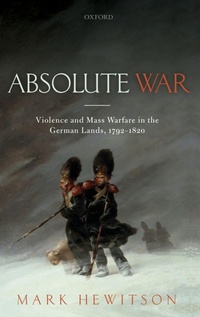
Absolute War
Violence and Mass Warfare in the German Lands, 1792-1820
Published on 9. February 2017
Book
Hardback
318 pages
978-0-19-878745-7 (ISBN)
Description
Wars have played a fundamental part in modern German history. Although infrequent, conflicts involving German states have usually been extensive and often catastrophic, constituting turning-points for Europe as a whole. Absolute War is the first in a series of studies from Mark Hewitson that explore how such conflicts were experienced by soldiers and civilians during wartime, and how they were subsequently imagined and understood during peacetime, from Clausewitz and Kleist to Juenger and Adorno. Without such an understanding, it is difficult to make sense of the dramatic shifts characterising the politics of Germany and Europe over the past two centuries. The studies argue that the ease - or reluctance - with which Germans went to war, and the far-reaching consequences of such wars on domestic politics, were related to soldiers' and civilians' attitudes to violence and death, as well as to long-term transformations in contemporaries' conceptualisation of conflict.
Absolute War reassesses the meaning of military conflict for the millions of German subjects who were directly implicated in the Revolutionary and Napoleonic Wars. Based on a re-reading of contemporary diaries, letters, memoirs, official correspondence, press reports, pamphlets, treatises, plays, and cartoons, this volume refocuses attention on combat and conscription as the central components of new forms of mass warfare. It concentrates, in particular, on the impact of violence, killing, and death on many soldiers' and some civilians' experiences and subsequent memories of conflict. War has often been conceived of as 'an act of violence pushed to its utmost bounds', as Clausewitz put it, but the relationship between military conflicts and violent acts remains a problematic one.
Absolute War reassesses the meaning of military conflict for the millions of German subjects who were directly implicated in the Revolutionary and Napoleonic Wars. Based on a re-reading of contemporary diaries, letters, memoirs, official correspondence, press reports, pamphlets, treatises, plays, and cartoons, this volume refocuses attention on combat and conscription as the central components of new forms of mass warfare. It concentrates, in particular, on the impact of violence, killing, and death on many soldiers' and some civilians' experiences and subsequent memories of conflict. War has often been conceived of as 'an act of violence pushed to its utmost bounds', as Clausewitz put it, but the relationship between military conflicts and violent acts remains a problematic one.
Reviews / Votes
An important acquisition for research libraries. Summing Up: Highly recommended. * CHOICE * Mark Hewitson's achievements are formidable... these two books are a treasure trove of insights and information from which scholars will benefit for years to come. * James Sheehan Journal of Modern History * These two volumes are clearly structured, fluently written, and open up a broad panorama of contemporary German views on violence and warfare. ... We can look forward to the third volume in the trilogy. * German Historical Institute London Bulletin *More details
Language
English
Place of publication
Oxford
United Kingdom
Target group
College/higher education
Professional and scholarly
Dimensions
Height: 240 mm
Width: 161 mm
Thickness: 22 mm
Weight
640 gr
ISBN-13
978-0-19-878745-7 (9780198787457)
Copyright in bibliographic data and cover images is held by Nielsen Book Services Limited or by the publishers or by their respective licensors: all rights reserved.
Schweitzer Classification
Other editions
Additional editions
E-Book
02/2017
1st Edition
OUP eBook
€50.49
Available for download
E-Book
01/2017
1st Edition
OUP eBook
€56.99
Available for download
Person
Mark Hewitson is a Professor of German History and Politics, and Director of European Social and Political Studies at University College London. His publications include monographs on National Identity and Political Thought in Germany (2000), Germany and the Causes of the First World War (2004), Nationalism in Germany, 1848-1866 (2010), and History and Causality (2014). He is the co-editor of What is a Nation? Europe, 1789-1914 (2006, with Timothy Baycroft), and of Europe in Crisis: Intellectuals and the European Idea, 1917-1957 (2012, with Matthew D'Auria).
Content
Introduction: Theories of War and Violence
1: From Cabinet Warfare to Mass Armies
2: Heroism and the Defence of the Volk
3: The Violence of Civilian Life
4: The Lives of Soldiers
5: War Memories
Conclusion: A History of Remembering and Forgetting
1: From Cabinet Warfare to Mass Armies
2: Heroism and the Defence of the Volk
3: The Violence of Civilian Life
4: The Lives of Soldiers
5: War Memories
Conclusion: A History of Remembering and Forgetting