

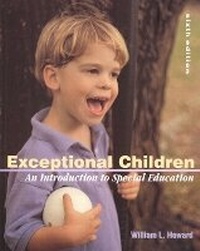
Exceptional Children
An Introduction to Special Education
6th Edition
Published on 6. September 1999
Book
Mixed media product
735 pages
978-0-13-012938-3 (ISBN)
Description
For courses in Introduction to Special Education, Exceptionalities or Mainstreaming.
For two decades, professors at more than 350 colleges and universities have relied on this comprehensive, engaging text for professional research, current practice, and trends in special education. Grounded in scholarship, yet written with the human experience in mind, this best-selling book effectively conveys the stories of teachers and children in special education. With a reorganized format, this latest edition captures the spirit of previous editions but with the necessary updates future teachers will need in the dynamic field of special education.
For two decades, professors at more than 350 colleges and universities have relied on this comprehensive, engaging text for professional research, current practice, and trends in special education. Grounded in scholarship, yet written with the human experience in mind, this best-selling book effectively conveys the stories of teachers and children in special education. With a reorganized format, this latest edition captures the spirit of previous editions but with the necessary updates future teachers will need in the dynamic field of special education.
More details
Edition
6th edition
Language
English
Place of publication
United States
Publishing group
Pearson Education (US)
Target group
Professional and scholarly
Dimensions
Width: 262 mm
Thickness: 27 mm
Weight
1600 gr
ISBN-13
978-0-13-012938-3 (9780130129383)
Copyright in bibliographic data and cover images is held by Nielsen Book Services Limited or by the publishers or by their respective licensors: all rights reserved.
Schweitzer Classification
Other editions
New editions
Book
10/2002
7th Edition
Pearson
€61.99
Article exhausted; check for reprint
Previous edition

Book
08/1995
5th Edition
Pearson Education (US)
€55.79
Article exhausted; check different version
Person
WILLIAM LEE HEWARD grew up in Three Oaks, Michigan, watching his hero Ernie Banks and the Chicago Cubs. He majored in psychology and sociology as an undergraduate at Western Michigan University, earned his doctorate in special education at the University of Massachusetts, and has been a member of the special education faculty at The Ohio State University since 1975. In 1985, Bill received Ohio State's highest honor for teaching excellence, the Alumni Association's Distinguished Teaching Award. He has had several opportunities to teach and lecture abroad, most recently in 1993 when he served as a Visiting Professor of Psychology at Keio University in Tokyo, Japan.
Bill's current research interests focus on "low tech" methods classroom teachers can use to increase the frequency with which each student actively responds and participates during group instruction and on methods for promoting the generalization and maintenance of newly learned skills. His research has appeared in many of the field's leading journals, including Behavioral Disorders, Education and Training in Mental Retardation and Developmental Disability Quarterly, Research in Developmental Disabilities, Teacher Education and Special Education, and Teaching Exceptional Children.
Bill has co-authored five other textbooks, including Applied Behavior Analysis (Merrill/Prentice Hall, 1987). He has also written for the popular market. His book Some Are Called Clowns (Crowell, 1974) chronicled his five summers as a pitcher for the Indianapolis Clowns, the last of the barnstorming baseball teams.
Bill's current research interests focus on "low tech" methods classroom teachers can use to increase the frequency with which each student actively responds and participates during group instruction and on methods for promoting the generalization and maintenance of newly learned skills. His research has appeared in many of the field's leading journals, including Behavioral Disorders, Education and Training in Mental Retardation and Developmental Disability Quarterly, Research in Developmental Disabilities, Teacher Education and Special Education, and Teaching Exceptional Children.
Bill has co-authored five other textbooks, including Applied Behavior Analysis (Merrill/Prentice Hall, 1987). He has also written for the popular market. His book Some Are Called Clowns (Crowell, 1974) chronicled his five summers as a pitcher for the Indianapolis Clowns, the last of the barnstorming baseball teams.
Content
Prologue: A Personal View of Special Education.
I. FOUNDATIONS FOR UNDERSTANDING SPECIAL EDUCATION.
1. Defining Special Education
2. Planning and Providing Special Education Services.
3. Special Education in a Culturally Diverse Society.
4. Parents and Families of Children with Special Needs.
II. EDUCATIONAL NEEDS OF EXCEPTIONAL STUDENTS.
5. Early Childhood Special Education.
6. Mental Retardation.
7. Learning Disabilities.
8. Emotional and Behavioral Disorders.
9. Communication Disorders.
10. Hearing Loss.
11. Blindness and Low Vision.
12. Physical Impairments and Special Health Care Needs.
13. Severe Disabilities.
14. Giftedness and Talent Development.
15. Transition to Adulthood.
Postscript: Developing Your Own Personal View of Special Education.
Glossary.
References.
Name Index.
Subject Index.
I. FOUNDATIONS FOR UNDERSTANDING SPECIAL EDUCATION.
1. Defining Special Education
2. Planning and Providing Special Education Services.
3. Special Education in a Culturally Diverse Society.
4. Parents and Families of Children with Special Needs.
II. EDUCATIONAL NEEDS OF EXCEPTIONAL STUDENTS.
5. Early Childhood Special Education.
6. Mental Retardation.
7. Learning Disabilities.
8. Emotional and Behavioral Disorders.
9. Communication Disorders.
10. Hearing Loss.
11. Blindness and Low Vision.
12. Physical Impairments and Special Health Care Needs.
13. Severe Disabilities.
14. Giftedness and Talent Development.
15. Transition to Adulthood.
Postscript: Developing Your Own Personal View of Special Education.
Glossary.
References.
Name Index.
Subject Index.