

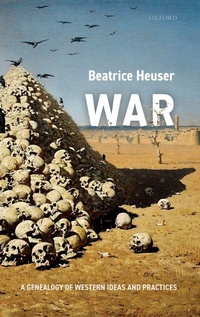
War
A Genealogy of Western Ideas and Practices
Published on 17. March 2022
Book
Hardback
446 pages
978-0-19-879689-3 (ISBN)
Description
War has been conceptualised from a military perspective, but also from ethical, legal, and philosophical viewpoints. These different analytical perspectives are all necessary to understand the many dimensions war, the continua on which war is situated - from small-scale to large-scale, from limited in time or long, from less to extremely destructive, with varying aims, and degrees of involvement of populations.
Western civilisations have conceptualised war in binary ways denying the variety of manifestations of war along these continua. While binary definitions are necessary to capture different conditions legally, they hamper analysis. The binaries include inter-State and intestine war, just war and unjust war (the latter including insurgencies), citizen-soldiers and professionals, civilians and combatants. Yet realities have mostly straddled such demarcations. Even citizen-armies have usually included professionals, civilians have been treated as enemies and sometimes even formally defined as enemies, and rules have not conformed with binary distinctions, if they were respected at all. While customary rules governing the conduct of war have been turned into International Law, this is the only aspect of war that has developed in a fairly linear way, while the rise, disappearance, and renaissance of the just war tradition has been anything but linear. This non-linearity also applies to the brutality with which war has been fought, especially towards civilians, who for long stretches of European history must have been the main victims of war, notwithstanding increasing protection they were afforded in theory by customary law. To understand war, we must shed some of these binaries.
Western civilisations have conceptualised war in binary ways denying the variety of manifestations of war along these continua. While binary definitions are necessary to capture different conditions legally, they hamper analysis. The binaries include inter-State and intestine war, just war and unjust war (the latter including insurgencies), citizen-soldiers and professionals, civilians and combatants. Yet realities have mostly straddled such demarcations. Even citizen-armies have usually included professionals, civilians have been treated as enemies and sometimes even formally defined as enemies, and rules have not conformed with binary distinctions, if they were respected at all. While customary rules governing the conduct of war have been turned into International Law, this is the only aspect of war that has developed in a fairly linear way, while the rise, disappearance, and renaissance of the just war tradition has been anything but linear. This non-linearity also applies to the brutality with which war has been fought, especially towards civilians, who for long stretches of European history must have been the main victims of war, notwithstanding increasing protection they were afforded in theory by customary law. To understand war, we must shed some of these binaries.
Reviews / Votes
a highly impressive work - rigorous and deeply scholarly, yet bold and challenging in its argument. It is also, especially given the complexity of its topic, highly readable...an excellent book, and highly recommended. * C Dale Walton, Journal of Policy & Strategy * Beatrice Heuser has written a tour-de-force intellectual history of war in the Western world...this book serves as both a comprehensive investigation into how cultural narratives surrounding war arose and changed over time in light of practices of war, and an in-depth study of war related conceptual and normative topics. It will be extraordinarily helpful for readers looking to comprehend how people and groups in the West have thought, and continue to think, about war and how they arrived at those understandings. * Jennifer Kling, Ethics & International Affairs * Recommended. Advanced undergraduates through faculty. * Choice * At a time of growing threats to the international law inherited from 1945, reading this rich and rigorous work has never been more necessary. * Bruno Cabanes, Francia-Recensio *More details
Language
English
Place of publication
Oxford
United Kingdom
Target group
College/higher education
Dimensions
Height: 240 mm
Width: 161 mm
Thickness: 28 mm
Weight
831 gr
ISBN-13
978-0-19-879689-3 (9780198796893)
Copyright in bibliographic data and cover images is held by Nielsen Book Services Limited or by the publishers or by their respective licensors: all rights reserved.
Schweitzer Classification
Other editions
Person
Beatrice Heuser holds the Chair in International Relations at Glasgow University. Her degrees are from the Universities of London (BA, MA) and Oxford (DPhil), and the Philipps-University of Marburg (Habilitation). From 1991-2003 she taught at the Department of War Studies, King's College London, ultimately as Chair of International and Strategic Studies. She has also taught at Sciences Po' and the Universities Paris I, IV (Sorbonne), and VIII (St Denis), and at two German universities. From 1997-1998, she worked in the International Staff at NATO headquarters in Brussels. Between 2003-2007 she was Director for Research at the Military History Research Office of the Bundeswehr in Potsdam.
Content
1: Introduction
2: War in Europe: A Short Typological Survey
3: Ethical, Political And Legal Concepts Of War
4: Root Causes and Drivers of War
5: Just War Traditions
6: Professed Reasons for Going to War and War Aims
7: Who Fights?
8: Who is the Enemy?
9: Traditional and Legal Constraints on Warfare
10: The Rules and Practice of Warfare
11: Conclusions
2: War in Europe: A Short Typological Survey
3: Ethical, Political And Legal Concepts Of War
4: Root Causes and Drivers of War
5: Just War Traditions
6: Professed Reasons for Going to War and War Aims
7: Who Fights?
8: Who is the Enemy?
9: Traditional and Legal Constraints on Warfare
10: The Rules and Practice of Warfare
11: Conclusions