

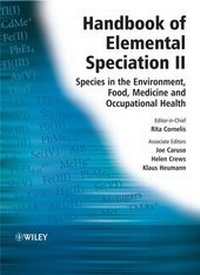
Handbook of Elemental Speciation
II. Species in the Environment, Food, Medicine and Occupational Health
1st Edition
Will be published approx. on 25. April 2005
Book
Hardback
788 pages
978-0-470-85598-0 (ISBN)
Description
Written by an internationally recognized group of editors and contributors, Handbook of Elemental Speciation, Volume 2 provides a comprehensive, cross-disciplinary presentation of the analytical techniques involved in speciation.
* Comprehensive coverage of key elements and compounds in situ
* Addresses the analysis and impact of these elements and compounds, e.g. arsenic, lead, copper, iron, halogens, etc., in food, the environment, clinical and occupational health
* Detailed methodology and data are reported, as well as regulatory limits
* Includes general introduction on the impact in these key areas
Reviews / Votes
"...should definitely be available in the reference library of every university or organization where speciation studies are carried out." (Applied Organometallic Chemistry, November 2007)More details
Other editions
Additional editions
Rita Cornelis | Joseph A. Caruso | Helen Crews
Handbook of Elemental Speciation II
Species in the Environment, Food, Medicine and Occupational Health
E-Book
09/2005
2nd Edition
Wiley
€408.99
Available for download
Previous edition
Rita Cornelis | Joseph A. Caruso | Helen Crews
Handbook of Elemental Speciation
Techniques and Methodology
Book
06/2003
1st Edition
Wiley
€480.00
Shipment within 10-20 days
Persons
Rita Cornelis, Department of Analytical Chemistry, Ghent University, The Netherlands.
Content
List of contributors.
Preface.
Acknowledgements.
1. Introduction.
2. Elements by element review.
2.1. Introduction.
2.2. Speciation of aluminium.
2.3 Speciation of antimony.
2.4 Speciation of arsenic.
2.5. Speciation of cadmium.
2.6. Speciation of chromium.
2.7. Speciation of cobalt.
2.8. Speciation of copper.
2.9. Speciation of iron.
2.10. Speciation of lead.
2.11. Speciation of manganese.
2.12. Speciation of mercury.
2.13. Speciation of molybdenum.
2.14. Speciation of nickel.
2.15. Speciation of platinum, gold and rhodium.
2.16. Speciation of selenium.
2.17. Speciation of silicon.
2.18. Speciation of sulfur.
2.19. Speciation of thallium.
2.20. Speciation of tin.
2.21. Speciation of vanadium.
2.22. Speciation of zinc.
2.23. Speciation of actinides.
2.24. Speciation of Halogens.
2.25. Volatile metal compounds of biogenic origin.
2.26. Metal complexes of humic substances.
2.27. Metal complexes of proteins.
3. Modeling of elemental species.
3.1. Modeling of trace elements partitioning in the environment.
3.2 Modeling in nutrition.
3.3. Modeling of trace elements in health and disease.
4. Elemental speciation and present day legislation.